Range / Head to head
ESS Crossbow vs Suppressor: same lens, different temple, one real decision
Most people searching this expect two eyeshields. There is one eyeshield and two frames — and the frame you pick depends entirely on whether you shoot with over-ear muffs or a headset on your head.
By Mike M.Updated Researched from maker specs & standards
#adLens & Lead earns from qualifying Amazon purchases. Prices are set by the retailer and change. A commission never decides a ranking. How we rate · Disclosure
The contenders
Side by side
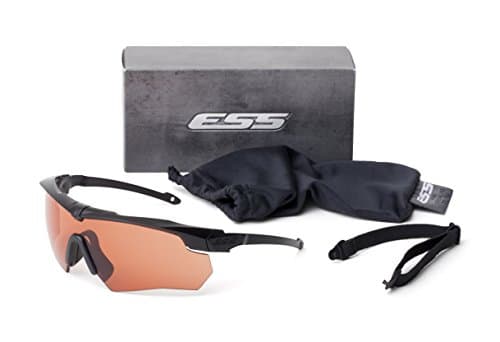
Buy this if you shoot in muffs
ESS Crossbow Suppressor ONE Kit
MIL-PRF-310138.4 /10Ultra-thin Z-Bend Geometry temples ESS describes as slim and pliable so they minimize the effect on the padded seal of ear cups, on the same ballistic lens as a regular Crossbow. The ONE kit ships the hi-def copper lens, so plan on buying a clear lens separately for indoor work.
$48.29Amazon#ad · Price as of November 2, 2026 · Disclosure for the link to ESS Crossbow Suppressor ONE Kit
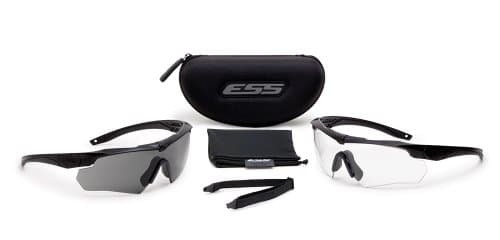
Buy this if you shoot bare-eared or in plugs
ESS Crossbow 2LS Kit
APEL8.6 /10The documented one: MIL-PRF-32432A and APEL on the APEL kit page, ClearZone FlowCoat named, the DedBolt tool-free lens lock, three published Rx inserts, and clear plus smoke lenses in the box. Standard temples, which is exactly what the muff seal objects to.
$107.77Amazon#ad · Price as of November 2, 2026 · Disclosure for the link to ESS Crossbow 2LS Kit
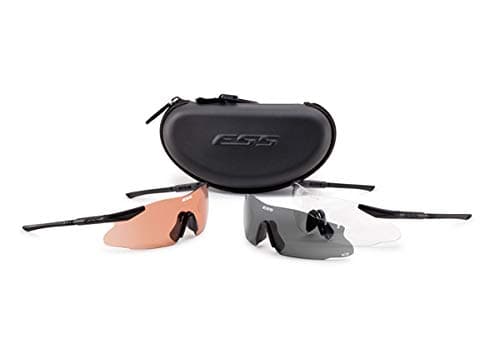
The third option, if the temple still hurts
ESS ICE-3LS Kit
MIL-PRF-32432A8.2 /10Telescoping temples with bend-to-fit inner-wire ear tabs, a snap-on leash and three lenses in the kit. A different answer to the same problem: adjust the temple to the muff rather than thin it.
$90.92Amazon#ad · Price as of November 2, 2026 · Disclosure for the link to ESS ICE-3LS Kit
The short verdict
If you wear over-ear hearing protection — a pair of passive muffs at an indoor range, electronic muffs in a dove field, a comms headset — buy the Suppressor. That is the entire reason it exists, and ESS is explicit about it: the frame kit "is for use with ear cup hearing protection and communications devices", and its temples "minimize the effect on the padded seal of ear cups to keep out noise" while eliminating "the hot spots and pressure points that commonly occur when normal eyewear is worn under ear cups".
If you shoot in foam plugs or in-ear electronic protection, buy the standard Crossbow instead. You give up nothing you will use, and you gain the things the Suppressor pages do not give you: an APEL-listed configuration, the newer MIL-PRF-32432A wording, a named anti-fog and anti-scratch coating, three documented prescription inserts, and a clear lens plus a smoke lens in the box rather than a single copper one.
And if you already own a Crossbow or a Crosshair, the answer is neither: buy the Suppressor frame on its own. ESS sells it as a kit that "converts any Crossbow or Crosshair eyeshield into an ear-cup-optimized ballistic eyeshield", and it is the cheapest item in this comparison by a wide margin.
What the Suppressor actually is
Search results treat "ESS Suppressor" like a model name, which is how most people arrive at this page expecting a second eyeshield with its own lens, its own rating and its own test report. It is not that. The Suppressor is a frame — the two temple arms and the bridge that the Crossbow lens snaps into — and ESS says plainly that the new frame "is cross-compatible with any other product in the ESS Crossbow series" and that "Suppressor frames are compatible with all Crossbow and Crosshair lenses".
That has a useful consequence and an awkward one. The useful one: whatever you have already learned about Crossbow lenses — the tints, the optics, the fact that a lens swap takes seconds — carries straight across. The awkward one: because the Suppressor is a frame rather than a separately certified eyeshield, the standards you can quote for it are the standards ESS states for the Crossbow eyeshield, and those statements live on different pages written years apart. We go into that in detail below, because it is the one place the Suppressor is genuinely weaker than the kit it is built from.
ESS sold the Suppressor in complete kits as well as a bare frame. The Suppressor ONE, SKU 740-0472, is the configuration described as including "a Crossbow Suppressor with a high-definition copper lens ideal for targeting" — one eyeshield, one copper lens, aimed at "the tactical and shooting communities". The Suppressor 2X ships two eyeshields instead: a Suppressor frame preassembled with a clear lens, plus a standard Crossbow frame with a smoke gray lens. The ONE kit is the one reliably stocked new, so it is the configuration this page prices and links.
The one job it does: the muff seal
If you have never thought about this, here is the mechanism. An over-ear muff works by pressing a foam or gel cushion flat against the side of your head in a continuous ring. Run a temple arm through that ring and two things happen at once. The cushion tents over the temple and leaves a channel for sound to leak through, which costs you real attenuation — the number on the box assumes nothing is under the seal. And the cushion presses the temple into your skull at a single point, which is the hot spot that turns into a headache an hour into a match.
There are three ways out of that, and the ESS line happens to contain all three. You can thin the temple, which is the Suppressor: ESS calls the frames "ultra-thin" and gives them "Z-Bend Geometry", a profile that drops away from the ear rather than running straight through the seal. You can make the temple adjustable so it can be routed around the obstruction, which is the ICE, with telescoping temples and bend-to-fit inner-wire ear tabs. Or you can get rid of the temples entirely and run a strap, which is what the goggles do.
We have ranked those three approaches against each other on best shooting glasses for ear muffs, and the broader question of pairing eye and ear protection as a system is on shooting glasses and ear protection combos. What matters for this comparison is narrower: the Suppressor is the only frame in this registry whose maker states that it was designed for the job, rather than a thin temple that happens to help.
What ESS publishes for each
Every cell is quoted from the ESS page linked for that product. A dash means ESS does not publish the figure on the page we cite. The Suppressor's empty APEL, Rx and coating cells are the substance of this comparison — they are not gaps in our reading.
The documentation gap
This site ranks eyewear by what the maker puts in writing, so the Suppressor's thin paper trail has to be stated plainly rather than smoothed over.
The standards sentence we can quote for the Suppressor comes from the announcement ESS published when it introduced the frame: "The ESS Crossbow eyeshield is compliant with U.S. Federal OSHA, ANSI Z87.1+, U.S. MIL SPEC MIL-PRF-31013, and CE EN 166." Note what that sentence is about — the Crossbow eyeshield, not the Suppressor frame specifically — and note the number. MIL-PRF-31013 is the older of the two military ballistic specifications for spectacles. The current Crossbow APEL kit page states the newer MIL-PRF-32432A, and the difference between those two documents is unpicked on MIL-PRF-32432 vs MIL-PRF-31013. The same sentence also names CE EN 166, which is the European standard — what its letters mean next to a Z87 stamp is on ANSI Z87.1 vs EN 166.
The current Suppressor frame page does not restate a MIL-PRF number at all. It carries badges reading "US Made", "ANSI Z87+" and "Battle Rated". "Battle Rated" is marketing language, not a specification, and we do not score it. "ANSI Z87+" is real and it is the floor this site requires — what the plus means is on Z87 vs Z87+.
There is also no APEL statement anywhere in the Suppressor material we read. That is worth being precise about, because it is easy to over-read in both directions. The APEL — the U.S. Army's Authorized Protective Eyewear List — applies to a specific configuration, not to a model family, so a different frame on the same lens is not automatically covered. At the same time, the absence of a listing is not evidence that anything fails: the lens is the Crossbow lens either way. It simply means the external verification exists for one configuration and not the other, and if that listing is what you are buying, you want the standard Crossbow APEL kit. The pairs that carry one are collected on the APEL approved eyewear list.
Lenses, and what is in each box
Lens cross-compatibility is the Suppressor's quiet advantage and the reason the comparison is close. Because "Suppressor frames are compatible with all Crossbow and Crosshair lenses", you are not choosing a lens library when you choose the frame — you are choosing a temple. Clear for an indoor range, smoke for a bright afternoon, a high-contrast tint for clays: whatever the Crossbow range offers, the Suppressor frame accepts. ESS also states that "all Crossbow lenses provide 100% UVA/UVB protection", which applies to both.
What differs is what arrives in the box, and it matters more than it sounds. The standard Crossbow 2LS kit ships an assembled frame with a smoke gray lens plus a clear lens, which covers both ends of the light range on day one. The Suppressor ONE kit ships a single hi-def copper lens. Copper is a contrast tint — it is useful in flat, overcast light and against green, and it is a poor choice for a dim indoor range where you want maximum light transmission. If the Suppressor ONE is your pick and your shooting is mostly indoors, budget for a clear Crossbow lens on top of the kit price.
Which tint belongs on which firing line is the job of the shooting glasses lens color guide, and the indoor case specifically is on best lens color for an indoor range.
Buy the frame, not a second kit
The option almost nobody searching "Crossbow vs Suppressor" has considered: if you already own a Crossbow or a Crosshair, you do not need either kit. ESS sells the Suppressor Frame Kit as a standalone item, model 740-0450, and describes it as converting "any Crossbow or Crosshair eyeshield into an ear-cup-optimized ballistic eyeshield". The kit "includes an ultra-thin, black Suppressor frame and an elastic retention strap", and on the ESS site it is listed in the same price bracket as a replacement lens — a fraction of what a complete eyeshield kit costs.
So the sequence most existing owners should follow is: keep the lenses you have, add the Suppressor frame, and move the lens between frames depending on whether muffs are going on your head that day. You end up with the APEL kit's documentation in your drawer and the ear-cup-optimized temple on your face, which is the best of both and the cheapest route to it.
One caution on the strap. The elastic retention strap in the frame kit holds the eyeshield on; it does not turn it into a goggle and it does not seal to your face. If what you actually need is a seal — wind, dust, a prairie-dog field — that is a different product class, ranked on best shooting goggles.
Prescription: where the Suppressor loses
If you shoot in a prescription, this section decides it. ESS publishes a documented insert route for the standard Crossbow: the product page lists compatibility with the ESS U-Rx Insert, the ESS Vice Insert and the UPLC. We found no equivalent statement for the Suppressor frame — not a denial, simply nothing published — so the Rx row in the table above is empty, and we will not fill it with an assumption just because the two frames share a lens. An insert has to clip to the frame, and the frame is the part that changed.
If an insert is non-negotiable, the honest recommendation is the standard Crossbow, or one of the ballistic platforms whose makers document the prescription path explicitly. Those are ranked on best shooting glasses with Rx inserts, and the trade-offs between a carrier insert and a prescription lens are on Rx inserts vs prescription lenses. If you wear contacts at the range instead, that route is covered on shooting glasses with contact lenses.
Which one you should buy
Take the Suppressor if over-ear hearing protection or a headset is part of how you shoot. It is the only frame here designed for that, the lens in front of your eye is the Crossbow lens, and the comfort difference over a three-hour session is not subtle. Accept that the paper trail is thinner, that there is no APEL claim, that the ONE kit's copper lens may need a clear companion, and that ESS has not published an insert route for it.
Take the standard Crossbow if you shoot in plugs, want the most-documented ESS kit, need an Rx insert, or want clear and smoke lenses in the box. It is the better-evidenced product and it remains our pick in the line — the full read is on the ESS Crossbow review, and the sibling frame question is settled on Crossbow vs Crosshair.
Take the ICE if a thinner temple is not enough and you want one that adjusts around the muff rather than under it. And take the bare Suppressor frame if you already own any Crossbow or Crosshair — it is the cheapest fix in this entire comparison. If you are still deciding between brands rather than between ESS frames, the cross-brand reads are Wiley X vs ESS and best ballistic glasses.
In detail
The contenders, in full
Buy this if you shoot in muffs
ESS Crossbow Suppressor ONE Kit
Ultra-thin Z-Bend Geometry temples ESS describes as slim and pliable so they minimize the effect on the padded seal of ear cups, on the same ballistic lens as a regular Crossbow. The ONE kit ships the hi-def copper lens, so plan on buying a clear lens separately for indoor work.
EvidenceResearched · maker specs & standards
How the 8.4 score breaks down
- Protection rating (30%)
- 8
- Optical clarity & tint options (20%)
- 8
- Fit & ear-pro compatibility (20%)
- 10
- Fog & scratch resistance (15%)
- 7
- Value (15%)
- 9
What the spec page supports
- The only frame in this registry a maker designed specifically for wear under ear cup hearing protection and comms
- Z-Bend Geometry temples that ESS says remove the hot spots and pressure points normal temples cause under muffs
- Takes every Crossbow and Crosshair lens, so the lens library and the tints carry across
- The Suppressor frame is also sold on its own, so an existing Crossbow owner can convert rather than re-buy
Where it falls short
- ESS's Suppressor documentation is thin: the ballistic number comes from a 2010 announcement citing MIL-PRF-31013, not the newer MIL-PRF-32432A the Crossbow APEL kit states
- No APEL claim on any Suppressor page we read, and the ONE kit ships the hi-def copper lens rather than clear plus smoke
- ESS does not publish an Rx-insert route for the Suppressor frame the way it does for the standard Crossbow
- Lens thickness, weight and warranty are not published
Skip this if…
…you need the strongest paper trail or an Rx insert — the standard Crossbow APEL kit states MIL-PRF-32432A, carries the APEL listing and documents three inserts.
#ad · Price as of November 2, 2026 · Disclosure for the link to ESS Crossbow Suppressor ONE Kit
Buy this if you shoot bare-eared or in plugs
ESS Crossbow 2LS Kit
The documented one: MIL-PRF-32432A and APEL on the APEL kit page, ClearZone FlowCoat named, the DedBolt tool-free lens lock, three published Rx inserts, and clear plus smoke lenses in the box. Standard temples, which is exactly what the muff seal objects to.
EvidenceResearched · maker specs & standards
How the 8.6 score breaks down
- Protection rating (30%)
- 10
- Optical clarity & tint options (20%)
- 8
- Fit & ear-pro compatibility (20%)
- 8
- Fog & scratch resistance (15%)
- 8
- Value (15%)
- 8
What the spec page supports
- APEL listing and MIL-PRF-32432A stated by the maker on the APEL kit page
- Clear and smoke lenses in the box; tool-free DedBolt swap
- Three documented Rx-insert options (U-Rx, Vice, UPLC)
- Named anti-fog / anti-scratch coating (ClearZone FlowCoat)
Where it falls short
- Lens material, thickness, weight and warranty are not stated on the product pages
- The plain 2LS kit page lists ANSI Z87+ and OSHA but not the MIL-PRF wording — buy the APEL SKU if the Army listing matters to you
- Universal fit only; no small or large size
Skip this if…
…you have a narrow face — the Crossbow comes in one universal size, and the Sawfly's Small or a youth frame will seal better.
#ad · Price as of November 2, 2026 · Disclosure for the link to ESS Crossbow 2LS Kit
The third option, if the temple still hurts
ESS ICE-3LS Kit
Telescoping temples with bend-to-fit inner-wire ear tabs, a snap-on leash and three lenses in the kit. A different answer to the same problem: adjust the temple to the muff rather than thin it.
EvidenceResearched · maker specs & standards
| Rating tier | MIL-PRF-32432A. The maker states a MIL-PRF-32432 (or MIL-PRF-31013 / military V0) ballistic pass: a fragment simulator at several times the energy of the ANSI high-velocity test. Not on the Army list. |
|---|---|
| Impact rating | ANSI Z87.1 |
| Ballistic standard | MIL-PRF-32432A |
| Lens material | Polycarbonate |
| Lenses included | Three interchangeable lenses; ESS lists Clear, Smoke Gray and Hi-Def Yellow for the ICE-3LS kit, and the ICE Tactical Kit sold new on Amazon ships Clear, Gray and Hi-Def Copper. Elastic strap, anti-fog cloth and case included |
| Rx insert | U-Rx Insert and Vice Rx Insert ("compatible with all eyeshields") |
| Temples | "Adjustable earbends with telescoping temples featuring bend-to-fit inner-wire ear tabs and snap-on leash system for improved fit with headborne equipment" |
| UV | 100% UVA/UVB |
How the 8.2 score breaks down
- Protection rating (30%)
- 9
- Optical clarity & tint options (20%)
- 8
- Fit & ear-pro compatibility (20%)
- 9
- Fog & scratch resistance (15%)
- 6
- Value (15%)
- 8
What the spec page supports
- Three-lens kit covers indoor, bright and flat light out of the box
- Check the lens set on the listing: the kit stocked on Amazon is Clear / Gray / Hi-Def Copper, not the Hi-Def Yellow set ESS lists on its own page
- Thin telescoping temples the maker designs for headborne equipment — the reason it sits under muffs
- MIL-PRF-32432A and Rx-insert compatibility both stated
- Strap included for a goggle-style hold
Where it falls short
- Frameless lens edge is exposed; lens scratches show more than on a framed pair
- No named anti-fog coating on the page — a cloth is supplied instead
- Weight not published
Skip this if…
…you want a named anti-fog coating for a humid indoor range — the Crossbow's ClearZone FlowCoat is documented, the ICE's is not.
#ad · Price as of November 2, 2026 · Disclosure for the link to ESS ICE-3LS Kit
How Lens & Lead rates eyewear
How these picks were chosen
Every pair here is picked from the certification its maker publishes and repeats in its own wording ("meets", "certified", "tested to", "APEL"), the lens system and the tints in the box, whether the temples are described for ear muffs, and whether an Rx route exists — then scored on a public rubric that weights protection first. Every figure links to the page it came from, so you can confirm the protection before you buy. The standards themselves are explained on ANSI Z87.1 vs MIL-PRF-32432.
Scores are editorial judgments from that documented research, and the rating, the lens system and the fit are what move a pick. The rubric and its weights are published.
Questions
Frequently asked
What is the difference between the ESS Crossbow and the Suppressor?
The frame, not the lens. ESS created the Suppressor by exchanging the standard eyeshield frame for an ultra-thin Suppressor frame with Z-Bend Geometry while keeping the same ballistic Crossbow lens. The Suppressor frame is built for wear under ear cup hearing protection and comms; the standard Crossbow frame is not.
Do Suppressor frames take normal Crossbow lenses?
Yes. ESS states that Suppressor frames are compatible with all Crossbow and Crosshair lenses, and that the frame is cross-compatible with any other product in the Crossbow series. That is why buying the frame on its own works so well if you already own a Crossbow.
Is the ESS Suppressor APEL approved?
We found no APEL statement on any Suppressor page, so we do not claim one. The APEL listing we quote belongs to a specific standard Crossbow configuration, SKU 740-0386. APEL approval applies to a configuration rather than a model family, so a different frame is not automatically covered.
Can you buy the Suppressor frame separately?
Yes — ESS lists it as the Suppressor Frame Kit, model 740-0450, with an ultra-thin black frame and an elastic retention strap in the box, and describes it as converting any Crossbow or Crosshair eyeshield into an ear-cup-optimized ballistic eyeshield. For an existing owner that is the cheapest route to the thin temple.
Which lens comes with the Suppressor ONE kit?
A high-definition copper lens, which ESS describes as ideal for targeting. Copper is a contrast tint, so it is strong in flat or overcast light and weak on a dim indoor range. The Suppressor 2X configuration instead pairs a Suppressor frame with a clear lens and a standard Crossbow frame with a smoke gray lens.
Is the Suppressor less protective than the Crossbow?
The lens is the same ballistic Crossbow lens, so we have no basis to say it protects less. What is different is the evidence: the Crossbow APEL kit page states MIL-PRF-32432A and APEL, while the standards sentence available for the Suppressor comes from an older ESS announcement citing ANSI Z87.1+, OSHA, MIL-PRF-31013 and CE EN 166. We score documentation, so the Crossbow scores higher.
Keep reading
Related on Lens & Lead
Receipts
Sources
- ESS EyePro — Crossbow Suppressor Frame Black page, model 740-0450 ("This Suppressor Frame Kit in Black is for use with ear cup hearing protection and communications devices."; "The Suppressor Frame Kit converts any Crossbow or Crosshair eyeshield into an ear-cup-optimized ballistic eyeshield."; "The ultra-thin, Suppressor frames feature Z-Bend Geometry."; "These slim, pliable temple arms minimize the effect on the padded seal of ear cups to keep out noise," and "eliminate the hot spots and pressure points that commonly occur when normal eyewear is worn under ear cups."; "Suppressor frames are compatible with all Crossbow and Crosshair lenses."; "Kit includes an ultra-thin, black Suppressor frame and an elastic retention strap."; badges read "US Made", "ANSI Z87+" and "Battle Rated"; UPC 811533016600; listed $26.00, In stock) (checked 2026-10-29)
- ESS EyePro — news release, ESS Introduces Crossbow Suppressor Eyeshield, dated October 25 2010 ("The first eyewear designed specifically for use under ear cup hearing protection and communications gear"; "exchanging the standard eyeshield frame for an ultra-thin Crossbow Suppressor frame"; "incorporating the same ballistic lens as a regular Crossbow"; "maintains the effectiveness of such devices and eliminates soreness around the ear caused by pinching and pressure."; "This new frame is cross-compatible with any other product in the ESS Crossbow series."; the Suppressor ONE "includes a Crossbow Suppressor with a high-definition copper lens ideal for targeting."; the Suppressor 2X ships "one with the Crossbow Suppressor frame preassembled with a clear lens" and "one with a standard Crossbow frame and a smoke gray lens"; "The Suppressor frame may also be purchased separately"; "The ESS Crossbow eyeshield is compliant with U.S. Federal OSHA, ANSI Z87.1+, U.S. MIL SPEC MIL-PRF-31013, and CE EN 166."; "All Crossbow lenses provide 100% UVA/UVB protection.") (checked 2026-10-29)
- ESS EyePro — Crossbow 2LS Kit page (ANSI Z87+ 2020, ClearZone FlowCoat, U-Rx / Vice inserts, Tri-Tech Fit) (checked 2026-09-21)
- ESS EyePro — Crossbow Black 2x w/Clear & Smoke Gray APEL page (ANSI Z87.1+ 2015, MIL-PRF-32432A, APEL) (checked 2026-09-21)
- ESS EyePro — ICE-3LS Kit page (ANSI Z87.1, MIL-PRF-32432A, kit contents, Rx inserts, temples) (checked 2026-09-21)
- U.S. Army — Effective Eye Protection Preserves Sight to Fight (APEL managed by PEO Soldier / MCEP; the APEL logo marks authorized eyewear) (checked 2026-09-21)
- ISEA — ISEA publishes ANSI/ISEA Z87.1-2020 eye and face protection standard update (anti-fog criteria, relaxed optics, marking) (checked 2026-09-21)
Ratings, lens systems, fit notes and coatings come from the maker's own product pages and manuals (linked on every product), with the published safety standards behind them, and a labeled retailer or press page where the maker's own page was unavailable. Every buy button opens today's live Amazon price. Read the full method.