Ratings / Guide
MIL-PRF-32432 vs MIL-PRF-31013: the old spec, the current one, and what the 'A' means
Three pieces of wording turn up on ballistic eyewear and buyers treat them as interchangeable. They are not. One is superseded, one is current, and one is a revision letter that tells you how recently the page was written.
By Mike M.Updated Researched from maker specs & standards
#adLens & Lead earns from qualifying Amazon purchases. Prices are set by the retailer and change. A commission never decides a ranking. How we rate · Disclosure
The short version
If you are choosing between two pairs of glasses and one says 31013 while the other says 32432, buy the 32432. It is the current specification, it is the one the U.S. Army's Authorized Protective Eyewear List is built around, and the fragment velocity it requires for spectacles is higher. If one says 32432 and the other says 32432A, they are the same specification and the A is a revision letter — choose on the rest of the spec sheet instead.
Everything below is the detail behind those two sentences, including what the velocity numbers are actually measuring and why a "V50" figure is worth more than any of the standard names.
The two specs side by side
| ANSI Z87.1+ (for scale) | MIL-PRF-31013 | MIL-PRF-32432 | |
|---|---|---|---|
| Status | Current civilian standard | Older military spec, superseded | Current military spec |
| Projectile, spectacles | 1/4 in steel ball | 0.15 cal T37 fragment simulator | 22-calibre projectile |
| Velocity, spectacles | About 150 ft/s | About 640–660 ft/s | More than 660 ft/s |
| Projectile, goggles | Same ball, same test | 0.22 cal at about 550–560 ft/s | Goggle class tested separately |
| What it is testing | Impact resistance of the device | Ballistic fragmentation resistance | Ballistic fragmentation resistance |
| Who requires it | OSHA, through 29 CFR 1910.133 | U.S. military, historically | U.S. military; basis for APEL listing |
The 31013 figures are from the ballistic eyewear overview cited below; the 32432 velocity is Edge Eyewear's own description of the test its tactical line is built to; the ANSI figures are from the Z87.1 explainer. Where a source gives a range we print the range rather than picking a number inside it.
Two readings matter in that table. First, the gap between the civilian and military tiers is enormous — a quarter-inch ball at about 150 ft/s against a fragment simulator at four times that velocity. Gatorz, whose comparison we cite, makes the same point in terms of test energy. Second, both military specs are testing fragmentation, which is shrapnel, not a bullet. Nothing on this site stops a bullet, and no maker claims it does. The full version of that argument is on ANSI Z87.1 vs MIL-PRF-32432.
MIL-PRF-31013: the older spec
MIL-PRF-31013 is the specification most of the ballistic eyewear of the 1990s and 2000s was built to, and it is the reason so many much-loved frames still carry its number. It set out two classes with different projectiles: for spectacles, a 0.15 calibre T37 fragment simulating projectile at roughly 640 to 660 feet per second; for goggles, a 0.22 calibre projectile at about 550 to 560 feet per second.
You may notice something counter-intuitive there — the goggle test uses a bigger projectile at a lower velocity. That is deliberate rather than a loophole: a goggle covers more area and sits further from the eye, so the threat profile it is being tested against is different.
If a pair of glasses in front of you states 31013 and nothing else, it is not bad eyewear. It is eyewear whose certification paperwork is a generation old, which in a category where the standard has moved on is a reason to prefer something current — and the practical reason is procurement rather than physics: the Army's list is built on the newer specification.
MIL-PRF-32432 and the MCEPS family
MIL-PRF-32432 is the current specification, and it comes with a piece of vocabulary that confuses almost everybody: MCEPS, the Military Combat Eye Protection System. Edge Eyewear describes MIL-PRF-32432 as a classification of MCEPS, and states that eyewear tested for compliance with it must withstand the impact of a 22-calibre projectile travelling at more than 660 feet per second.
You will also see the string MCEPS GL-PD 10-12 on product pages — Walker's prints it for the IKON Tanker, and the retailer listing for the Edge Hamel pairs it with ANSI Z87.1+2010 and EN 166. Treat it as the same family of military ballistic wording rather than as a separate, higher claim.
The thing MIL-PRF-32432 enables, and 31013 no longer does, is the APEL. The Authorized Protective Eyewear List is managed through the Army's programme offices, and the APEL logo on a pair is how the Army marks eyewear authorised for issue; a listing implies the configuration passed MIL-PRF-32432 fragmentation testing and was approved. That makes the APEL the strongest third-party signal available in this category — with the caveat that it applies to a configuration, not to a model name. The whole list, and what it does and does not prove, is on the APEL approved eyewear list.
What MIL-PRF-32432A actually means
A great many people search for "MIL-PRF-32432A" specifically, so let us be exact about it. In the U.S. defence specification system a trailing letter is the revision of the document. MIL-PRF-32432A is revision A of MIL-PRF-32432. It is not a higher grade, a stricter class or a premium tier, and a pair stating 32432A is not more protective than one stating 32432 by virtue of the letter.
What the letter does tell you is how recently somebody wrote the product page. Wiley X states "MIL-PRF-32432A Ballistic safety standards" on the Saber Advanced, the Vapor and the Gravity. ESS states "U.S. MIL-PRF-32432A" on the Crossbow APEL kit page and plain "MIL SPEC MIL-PRF-32432" on the Profile NVG and Crosshair pages. Edge writes "MIL-PRF 32432-A" with the hyphen in a different place. Revision goes furthest and cites the clause: "MIL-PRF-32432A clause 3.8.4.1 Ballistic fragmentation characteristics Class 1 spectacles".
Military V0, V50 and the numbers makers quote
Three more pieces of wording, in rough order of usefulness.
V50 is the velocity at which half the shots would be expected to penetrate — a measured threshold, not a marketing figure. Revision publishes a STANAG V50 of 807 ft/s for the StingerHawk. It is the only published velocity number on this site, and it is worth more than any standard name because it is a result rather than a claim of compliance.
Military V0 is older wording for a zero-penetration result at a stated velocity, and it still appears on long-serving products. Honeywell uses it for the Genesis Sharp-Shooter: clear and amber lenses "meet Military V0 ballistic impact test requirements (7X higher than ANSI)". Note what that sentence does and does not cover — it names two lens colours, and the vermillion lens is not in the statement. That is exactly the kind of detail that disappears when a retailer summarises a spec.
"Tested to" is the weakest of the three and it is deliberately different from "compliant with" or "certified to". The Magpul Defiant is reported as tested to MIL-PRF-32432 ballistic standards rather than certified, and our card says so in plain words. It is not an accusation — it may simply be how the brand chooses to phrase an uncertified internal test — but you should know which you are buying. The checks are on how to tell if glasses are ballistic rated.
Picks by wording
Our picks for this
Three pairs, three levels of documentation
Best-documented ballistic rating
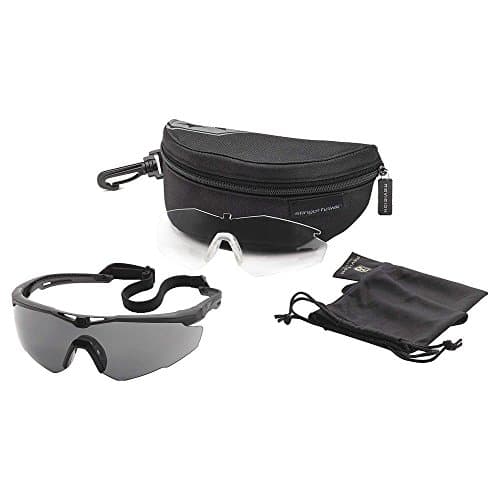
Revision StingerHawk
APEL8.3/10The tightest wording available: MIL-PRF-32432A clause 3.8.4.1 Class 1 spectacles, ANSI Z87.1-2020 clause 7.1, a published STANAG V50 of 807 ft/s, EN 166 FT and the APEL listing.
$119.05Amazon#ad · Price as of October 10, 2026 · Disclosure for the link to Revision StingerHawk
Best APEL-listed kit
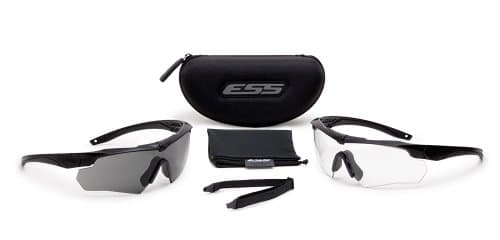
ESS Crossbow 2LS Kit
APEL8.6/10The issued kit: 'U.S. MIL-PRF-32432A' and the APEL listing on ESS's own APEL kit page, with clear and smoke lenses and three documented Rx inserts.
$101.55Amazon#ad · Price as of October 10, 2026 · Disclosure for the link to ESS Crossbow 2LS Kit
Best value ballistic-rated pair
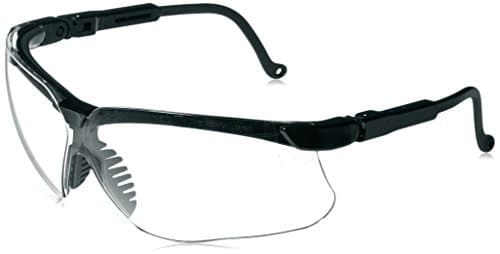
Howard Leight Genesis Sharp-Shooter
Military V08.1/10The older wording, honestly priced: Honeywell states a military V0 pass on the clear and amber lenses only, alongside ANSI Z87.1-2010 high impact. The cheapest pair on this site that states a ballistic test at all.
$15.97Amazon#ad · Price as of October 10, 2026 · Disclosure for the link to Howard Leight Genesis Sharp-Shooter
The whole MIL-PRF tier ranked by rating rather than by wording is on best ballistic glasses, and the fragment test itself is pulled apart on MIL-PRF-32432 explained.
What to do with this at the checkout
Four rules, in order.
Prefer 32432 to 31013. Current specification, higher spectacle velocity, and the basis of the APEL.
Ignore the revision letter. 32432 and 32432A are the same specification. Decide on fit, coatings, lens kit and warranty instead — the brand-level comparison is on best safety glasses brands.
Check which part of the product the claim covers. Honeywell's V0 statement covers two lens colours. The APEL covers a configuration. A ballistic claim that does not say what it applies to is worth less than one that does.
Remember that most people do not need this tier at all. For a range day, a clays course or a workshop, ANSI Z87.1 with the high-impact plus is the right answer and the money is better spent on fit and tint. The honest version of that argument is on Z87 vs Z87+.
How Lens & Lead rates eyewear
How these picks were chosen
Every pair here is picked from the certification its maker publishes and repeats in its own wording ("meets", "certified", "tested to", "APEL"), the lens system and the tints in the box, whether the temples are described for ear muffs, and whether an Rx route exists — then scored on a public rubric that weights protection first. Every figure links to the page it came from, so you can confirm the protection before you buy. The standards themselves are explained on ANSI Z87.1 vs MIL-PRF-32432.
Scores are editorial judgments from that documented research, and the rating, the lens system and the fit are what move a pick. The rubric and its weights are published.
Questions
Frequently asked
Is MIL-PRF-32432A better than MIL-PRF-32432?
No. The trailing A is the revision letter of the specification document, not a higher class. A pair stating 32432A is not more protective than one stating 32432 on the strength of the letter; the useful detail is the clause and class, as Revision prints for the StingerHawk.
What replaced MIL-PRF-31013?
MIL-PRF-32432, which sits within the Military Combat Eye Protection System family and is the specification the U.S. Army's Authorized Protective Eyewear List is built around. Eyewear tested to it must withstand a 22-calibre projectile at more than 660 feet per second.
What velocity does MIL-PRF-31013 test at?
For spectacles, a 0.15 calibre T37 fragment simulating projectile at roughly 640 to 660 feet per second. For goggles, a 0.22 calibre projectile at about 550 to 560 feet per second — a larger projectile at a lower velocity, because a goggle presents a different threat profile.
Do I need MIL-PRF rated glasses for the range?
No. ANSI Z87.1 with the high-impact plus covers a casing, a chip of clay or a ricocheting fragment at the end of its flight. The MIL-PRF tier is a fragmentation standard; buy it if you want the margin, not because a range day requires it.
Keep reading
Related on Lens & Lead
Receipts
Sources
- Wikipedia — Ballistic eyewear (MIL-PRF-31013 0.15 cal T37 at 640–660 ft/s for spectacles; 0.22 cal at 550–560 ft/s for goggles; Z87 vs Z87+ marking) (checked 2026-09-21)
- Edge Eyewear — tactical eyewear collection page ("Eyewear tested for compliance with the MIL-PRF-32432 standard must withstand the impact of a 22-caliber projectile traveling at more than 660 feet per second"; MIL-PRF-32432 described as a classification of MCEPS) (checked 2026-09-26)
- Safety Glasses USA — Edge Hamel listing ("ANSI Z87.1+2010, Military Ballistic MCEPS GL-PD 10-12, and EN166 F CE standards"; "3x Anti-Scratch lens coating"; Vapor Shield anti-fog) (checked 2026-09-26)
- Revision Military — StingerHawk Eyewear APEL U.S. Military Kit page (MIL-PRF-32432A clause 3.8.4.1, ANSI Z87.1-2020 clause 7.1, V50, EN 166, sizes, OcuMax) (checked 2026-09-21)
- ESS EyePro — Crossbow Black 2x w/Clear & Smoke Gray APEL page (ANSI Z87.1+ 2015, MIL-PRF-32432A, APEL) (checked 2026-09-21)
- ESS EyePro — Profile NVG Black w/Clear & Smoke Gray page, SKU 740-0499 (ANSI Z87.1-2015, MIL-PRF-32432, EN 166, 2.8 mm polycarbonate, kit contents, Rx inserts, Outrigger strap, ClearZone FlowCoat) (checked 2026-09-21)
- Wiley X — Saber Advanced product page (ratings, frame measurements, warranty) (checked 2026-09-21)
- Walker's — IKON Tanker Glasses page (ANSI Z87.1-2010 high impact, MCEPS GL-PD 10-12, TPR temples) (checked 2026-09-21)
- Howard Leight Shooting Sports — Genesis Sharp-Shooter Combo Kit page (ANSI Z87.1-2010 high impact, CSA Z94.3, "Military V0" on clear/amber, Uvextreme, 3 lenses) (checked 2026-09-21)
- Gatorz — Impact ratings: ANSI Z87.1+ vs MIL-PRF-32432A (test-energy comparison, Delta frame note) (checked 2026-09-21)
- U.S. Army — Effective Eye Protection Preserves Sight to Fight (APEL managed by PEO Soldier / MCEP; the APEL logo marks authorized eyewear) (checked 2026-09-21)
- Wikipedia — Authorized Protective Eyewear List (overview; PM SPIE; MIL-PRF-32432 fragmentation testing) (checked 2026-09-21)
- MSC Industrial Supply — Understanding ANSI Z87.1 (high-mass 500 g from 4 ft; high-velocity steel ball at 102 mph; Z87+ and U/L/W/H/D/X markings) (checked 2026-09-21)
Ratings, lens systems, fit notes and coatings come from the maker's own product pages and manuals (linked on every product), with the published safety standards behind them, and a labeled retailer or press page where the maker's own page was unavailable. Every buy button opens today's live Amazon price. Read the full method.