Ratings / Guide
ANSI Z87.1 vs EN 166: reading the other stamp on your safety glasses
Plenty of eyewear sold in the US carries EN 166 markings, a CE mark, or both alongside Z87. Here is what each letter means, how the impact tests actually compare, and the one situation where an EN 166 mark is not good enough.
By Mike M.Updated Researched from maker specs & standards
#adLens & Lead earns from qualifying Amazon purchases. Prices are set by the retailer and change. A commission never decides a ranking. How we rate · Disclosure
Two standards, two marking systems
If you have bought safety or shooting glasses in the last few years, you have probably seen a frame stamped with something like Z87+ on one temple and EN 166 FT or CE 1 F on the other, and wondered which one counts. Both count, for different purposes. ANSI/ISEA Z87.1 is the American national standard for eye and face protection. EN 166 is the European standard, and it is the one behind the CE mark on eyewear sold in the EU and the UKCA mark in Britain.
Makers who sell into both markets test to both and stamp both, which is why dual marks are so common on the better frames. That is good news — it means more independent testing, not less — but the two systems encode their results completely differently, and a letter that means one thing in one system can mean something else entirely in the other. The clearest example: in EN 166, S is an impact class. Under Z87.1, S on a lens means a special-purpose filter. Same letter, unrelated meanings.
This page is the translation key. It assumes you have already read what Z87 means — if not, start there, because the American marks are the ones that govern anything you buy and wear in the United States.
What ANSI Z87.1 tests
Two impact tests decide whether a pair earns the plus, and both are physical tests on a complete lens-and-frame assembly rather than on a lens alone.
The high-mass test drops a 500 g pointed weight from 50 inches onto the lens. The high-velocity test fires a quarter-inch steel ball at 150 feet per second — about 102 miles per hour, or roughly 46 m/s. Pass both and the maker may mark the product Z87+. Pass only the basic drop-ball requirement and the mark is a plain Z87.
That is the whole hierarchy. Z87.1 adds plenty of other letters for other hazards — U for UV filtering, L for visible light, W for welding, D3 for splash, D4 for dust — but on impact there are two levels, and the plus is the one that matters on a firing line or at a grinder. The marks are laid out in full on Z87 vs Z87+, and the current edition's changes to anti-fog criteria and marking are covered in what Z87 means.
What EN 166 tests, letter by letter
EN 166 does not use a plus. It uses a letter for mechanical strength, and the letter tells you the speed of the projectile the eyewear survived. A 6 mm steel ball is fired at the lens, and the class depends on how fast.
S — increased robustness. The lowest mechanical-strength class, and the one with the least consistent published description across the sources we read. Treat it as a basic strength requirement rather than an impact rating.
F — low-energy impact, particles at up to about 45 m/s. The everyday class: general manufacturing, maintenance, most safety spectacles.
B — medium-energy impact, up to about 120 m/s. Grinding and engineering work. You will usually see B on goggles rather than spectacles, because the frame has to hold the lens through a much harder hit.
A — high-energy impact, up to about 190 m/s. Face shields and the heaviest industrial work.
There is one more letter worth knowing, because it turns up on the best-documented eyewear on this site: T. Appended to the impact letter — FT, BT, AT — it means the impact test was also passed at temperature extremes. An FT mark is therefore better than a plain F: same speed, harder conditions. Revision publishes exactly that for the StingerHawk, citing "EN 166 clause 7.3.4 Protection against high speed particles (FT)", which is the most precise EN citation we have found on any product page — see the Revision StingerHawk review.
Optical class 1, 2 and 3
This is the part of EN 166 that has no direct equivalent in the American mark, and it is genuinely useful information that Z87.1 does not give you on the frame. Optical class describes the visual quality of the lens, and it is stated as a digit: 1, 2 or 3.
Class 1 is for continuous wear — all day, every day, through a full shift. Class 2 is for intermittent use. Class 3 should not be worn for long periods at all, and is typical of face shields and heavy visors where the priority is coverage rather than clarity.
For anything you intend to shoot in, you want class 1 and nothing less. A class 2 or 3 lens is not dangerous, but it has more permitted distortion, and distortion in a lens you are aiming through is a problem you will feel long before you can name it. If a listing shows an EN 166 mark on a pair you plan to wear for hours, the digit beside the letters is the number to look for — and it is a better clarity signal than anything on the American side of the frame, where optical requirements are met but not graded on the stamp.
The field-of-use digits
EN 166 also carries digits for the hazard the eyewear is built for, and they appear before the mechanical strength letter. The ones you will actually meet:
3 for liquids — droplets and splashes. 4 for large dust particles. 5 for gas and fine dust. 8 for electrical work, meaning a short-circuit electric arc. 9 for molten metal and hot solids.
If those sound familiar, it is because Z87.1 encodes the same hazards with its own letters: D3 for splash, D4 for dust and D5 for fine dust. The hazards are universal; only the notation changes. The splash-and-dust end of the American system is covered on safety goggles vs glasses, which is the practical version of the same decision.
Which one is stricter
Here is the honest answer, and it needs the numbers rather than a verdict.
The ANSI Z87.1 high-velocity test uses a quarter-inch (6.35 mm) steel ball at 150 ft/s. EN 166 uses a 6 mm steel ball, and the F class corresponds to about 45 m/s. Convert and those two are remarkably close: 150 ft/s is about 46 m/s, and the projectiles are within a third of a millimeter of each other. So EN 166 F and ANSI Z87+ high-velocity are testing at approximately the same energy. Neither is meaningfully tougher than the other at that level.
Above that, EN 166 keeps going where Z87.1 stops. B is about 120 m/s — roughly 394 ft/s — and A is about 190 m/s, or about 623 ft/s. There is no ANSI impact class above the plus, so a lens marked B or A has survived a demonstrably harder hit than Z87+ requires. That is the one respect in which the European system is more demanding: it has more headroom at the top.
Below that, Z87.1 has something EN 166 does not: the high-mass drop test, a 500 g pointed weight from 50 inches. That is a different failure mode — a heavy slow object rather than a light fast one — and the European impact classes do not cover it the same way. So the two standards are not nested; they test overlapping but different things.
The one place an EN mark is not enough
This is the practical point that justifies the whole page, and it has a clear answer rather than a judgment call.
OSHA's eye and face protection rule, 29 CFR 1910.133, requires that protective devices "comply with any of the following consensus standards" and then names ANSI/ISEA Z87.1-2010, ANSI Z87.1-2003 and ANSI Z87.1-1989 (R-1998) — or be demonstrated to be "at least as effective". EN 166 is not on that list. So a pair of glasses marked only EN 166 1 F, with no Z87 marking anywhere, does not satisfy the rule on its face in a US workplace. An employer can in principle demonstrate equivalence, but that burden falls on the employer, and no safety manager wants to argue it during an inspection.
For your own garage or your own range trip, nobody is inspecting anything and an EN 166 F lens is a real tested lens. But if the glasses are going into a workplace, on a contractor's site, or anywhere a safety officer looks at frames, buy a pair that carries the Z87 mark. The regulation and what it actually requires of you is on OSHA approved safety glasses.
The reverse case is worth a line too. A Z87+-only pair taken to a European worksite has the same problem in mirror image: the EU expects CE and EN 166. If you work across both, the dual-marked frames below are the ones that travel.
Pairs that carry both
Dual marking is the simplest way out of this entire question: if a maker states both standards, you do not have to decide which system to trust. These four do, and they are spread across the price range and the product types deliberately — a ballistic spectacle, a sealed glasses-goggle hybrid, a military goggle and a budget shop pair.
Our picks for this
Four pairs whose makers state both ANSI and EN 166
Dual-marked eyewear has been tested under both systems, so the stamp travels. Each of these states EN 166 alongside the American standard on the maker's own page.
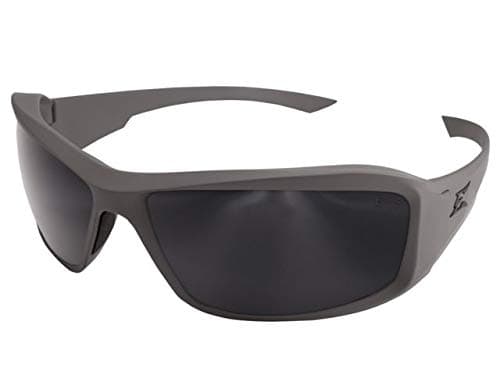
Best ballistic frame with polarized and photochromic lenses
Edge Hamel
MIL-PRF-32432A8.7/10The most-marked spectacle here: Edge states MIL-PRF 32432-A, ANSI Z87.1+, EN166, UKCA and CSA Z94.3 on one product page, with thin temples it says integrate with helmets, hats or hearing protection. Four jurisdictions on one frame.
$49.99Amazon#ad · Price as of November 2, 2026 · Disclosure for the link to Edge Hamel
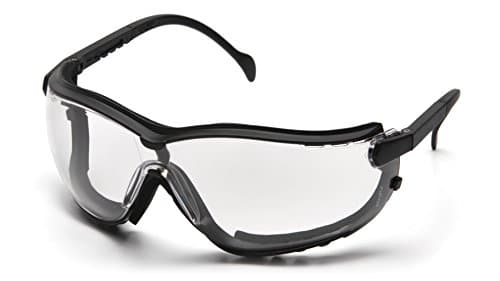
Best glasses-to-goggle hybrid
Pyramex V2G
MIL-PRF-324328.1/10ANSI/ISEA Z87.1-2020 + High Impact, MIL-PRF-32432, CAN/CSA Z94.3 and CE/UKCA EN 166, on a frame that converts between glasses and a sealed goggle with interchangeable temples and a headband. The broadest certification set under $50 on this site.
$6.53Amazon#ad · Price as of November 2, 2026 · Disclosure for the link to Pyramex V2G
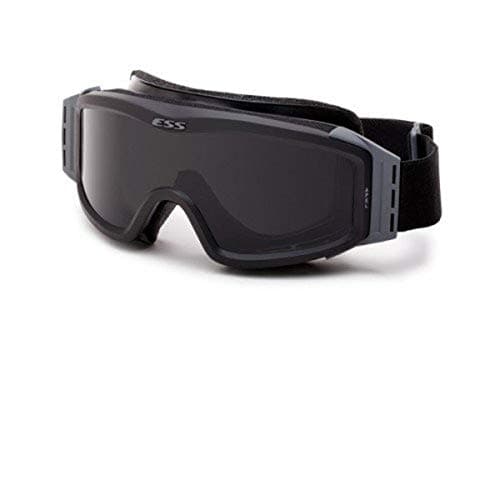
Best ballistic goggle
ESS Profile NVG Goggle
MIL-PRF-324328.0/10ESS states ANSI Z87.1-2015, MIL-PRF-32432 and EN 166 for the Profile NVG, plus the only published lens thickness on this site at 2.8 mm polycarbonate. A goggle, so expect EN's goggle-grade strength rather than a spectacle's.
$89.95Amazon#ad · Price as of November 2, 2026 · Disclosure for the link to ESS Profile NVG Goggle
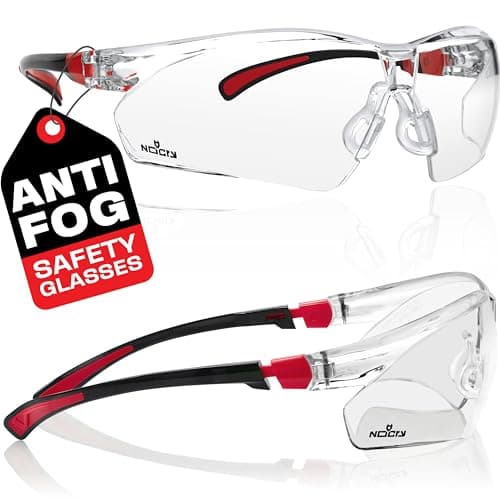
Best adjustable shop glasses
NoCry EyeArmor+
Z87.16.5/10The cheap end done properly: ANSI/ISEA Z87.1-2020 and EN 166 both stated, with adjustable temples, an adjustable nose pad, a named anti-fog and anti-scratch pairing and a lifetime warranty. Clear lens only.
$13.99Amazon#ad · Price as of November 2, 2026 · Disclosure for the link to NoCry EyeArmor+
How to read your own glasses
Take the pair you already own and look at the inside of the left temple, then the lens itself near the nose. You are looking for three groups of characters.
On the frame: the maker's mark, then the standard, then the markings. European marking order runs maker, EN 166, field of use, then mechanical strength — so EN 166 3 4 FT is a frame tested for liquid splash and large dust particles at low-energy impact with temperature extremes. On the American side you are looking for Z87 or Z87+ on the frame, and the edition is usually not printed, which is why the maker's page matters.
On the lens: the maker's mark plus the plus sign if it is high impact, and on a European-marked lens the optical class digit first. A lens stamped 1 F is class 1 optics at low-energy impact.
What should worry you: no marks at all. Unmarked eyewear has no claim behind it in either system, which is a different and much worse situation than a lens marked to a standard you were not expecting. The step-by-step version of this inspection is on how to tell if glasses are ballistic rated, and if your marks have worn off the frame entirely, that is one of the retirement triggers on when to replace shooting glasses.
One closing caution on the sources behind this page. EN 166 is a paid standard and we have not bought a copy; the figures above come from manufacturer and safety-supplier technical notes, which agree with each other on optical class and on the F, B and A speeds but describe the S class inconsistently. We have said so above rather than picking the version we liked. Where a number is approximate we have written "about", and the exact conversions between feet per second and meters per second are ours. Our broader method is on how we rate.
How Lens & Lead rates eyewear
How these picks were chosen
Every pair here is picked from the certification its maker publishes and repeats in its own wording ("meets", "certified", "tested to", "APEL"), the lens system and the tints in the box, whether the temples are described for ear muffs, and whether an Rx route exists — then scored on a public rubric that weights protection first. Every figure links to the page it came from, so you can confirm the protection before you buy. The standards themselves are explained on ANSI Z87.1 vs MIL-PRF-32432.
Scores are editorial judgments from that documented research, and the rating, the lens system and the fit are what move a pick. The rubric and its weights are published.
Questions
Frequently asked
Is EN 166 the same as ANSI Z87.1?
No. They are separate standards with separate marking systems, run by different bodies for different markets. They test overlapping hazards and their everyday impact levels land close together, but neither one certifies the other, and a product has to be tested to each standard to carry its mark.
Is EN 166 F the same as Z87+?
Close, on impact energy. The ANSI high-velocity test fires a quarter-inch steel ball at 150 ft/s, about 46 m/s; EN 166 F corresponds to roughly 45 m/s with a 6 mm ball. The difference is that Z87+ also requires a high-mass drop test, which EN 166 handles differently, so the two are approximately equivalent rather than identical.
What does EN 166 1 F mean?
Optical class 1 — suitable for continuous wear — and mechanical strength F, meaning low-energy impact at up to about 45 m/s. It is the most common combination on European-marked safety spectacles and it is the one to look for if you will be wearing the glasses for hours at a time.
Are EN 166 glasses OSHA compliant?
Not on their own. OSHA's 29 CFR 1910.133 names ANSI/ISEA Z87.1-2010, ANSI Z87.1-2003 and ANSI Z87.1-1989 (R-1998), or eyewear demonstrated to be at least as effective. EN 166 is not on that list, so for a US workplace buy a pair that carries the Z87 marking — ideally one marked to both standards.
What does the T mean after the EN 166 impact letter?
That the impact test was also passed at temperature extremes. FT is better than F at the same projectile speed, because the lens held up hot and cold as well as at room temperature. Revision cites EN 166 clause 7.3.4 (FT) for the StingerHawk, which is the most precise EN citation on this site.
Which is stricter, EN 166 or ANSI Z87.1?
Neither, overall. EN 166 has more headroom at the top — its B class is about 120 m/s and A about 190 m/s, well beyond anything ANSI requires — while ANSI Z87.1 adds a high-mass drop test the European impact classes do not replicate. Above both sits MIL-PRF-32432, which is the ballistic tier.
Keep reading
Related on Lens & Lead
Receipts
Sources
- JSP Safety — technical note, What do the numbers and letters shown on spectacles, goggles and visors mean? (markings show whether a lens is "suitable for continuous use (1) or short-term use (2 or 3)"; "F is for low-energy impact (up to 45 m/s), B for medium-energy (up to 120 m/s)", with A for high-energy impact up to 190 m/s; "the markings must be presented in a specific order and position on the product") (checked 2026-10-29)
- Safetyware — EN166 Eye Protection Standard Explained ("Optical class indicates the visual quality of the lens."; Class 1 for continuous wear through the workday, Class 2 for intermittent use, Class 3 for short-term use; impact letters S "increased robustness", F low-energy particles at about 45 m/s, B medium-energy at about 120 m/s, A high-energy at about 190 m/s; field-of-use examples 3 for chemical splashes, 4 or 5 for dust, 8 for electrical work, 9 for molten metal or hot particles) (checked 2026-10-29)
- ISEA — ISEA publishes ANSI/ISEA Z87.1-2020 eye and face protection standard update (anti-fog criteria, relaxed optics, marking) (checked 2026-09-21)
- MSC Industrial Supply — Understanding ANSI Z87.1 (high-mass 500 g from 4 ft; high-velocity steel ball at 102 mph; Z87+ and U/L/W/H/D/X markings) (checked 2026-09-21)
- Cornell Legal Information Institute — 29 CFR 1910.133, Eye and face protection, full text ("The employer shall ensure that each affected employee uses appropriate eye or face protection when exposed to eye or face hazards from flying particles, molten metal, liquid chemicals, acids or caustic liquids, chemical gases or vapors, or potentially injurious light radiation"; "eye protection that provides side protection when there is a hazard from flying objects"; employees who wear prescription lenses must wear "eye protection that incorporates the prescription in its design, or... eye protection that can be worn over the prescription lenses without disturbing the proper position of the prescription lenses or the protective lenses"; devices "must comply with any of the following consensus standards" — ANSI/ISEA Z87.1-2010, ANSI Z87.1-2003 or ANSI Z87.1-1989 (R-1998) — or be demonstrated "at least as effective") (checked 2026-10-17)
- OSHA — 29 CFR 1910.133 Eye and face protection (checked 2026-09-21)
- Edge Eyewear — Hamel tactical eyewear page ("MIL-PRF 32432-A"; "ANSI Z87.1+"; EN166; UKCA; CSA Z94.3; Polarized Smoke, Photochromic, G-15, Clear and Tigers Eye Vapor Shield lens options; "block 99.9% of UVA, UVB and UVC rays"; thin temples that integrate with "helmets, hats or hearing protection"; 66 mm lens width, 140 mm temple; $71.88) (checked 2026-09-26)
- Pyramex — V2G Sealed Eyewear page (ANSI/ISEA Z87.1-2020+, MIL-PRF-32432, CSA, EN 166, H2X/H2MAX, temples + strap) (checked 2026-09-21)
- ESS EyePro — Profile NVG Black w/Clear & Smoke Gray page, SKU 740-0499 (ANSI Z87.1-2015, MIL-PRF-32432, EN 166, 2.8 mm polycarbonate, kit contents, Rx inserts, Outrigger strap, ClearZone FlowCoat) (checked 2026-09-21)
- NoCry — EyeArmor+ Adjustable Anti-Fog page (ANSI/ISEA Z87.1-2020, EN 166, adjustable temples, anti-fog/anti-scratch, UV380) (checked 2026-09-21)
- Revision Military — StingerHawk Eyewear APEL U.S. Military Kit page (MIL-PRF-32432A clause 3.8.4.1, ANSI Z87.1-2020 clause 7.1, V50, EN 166, sizes, OcuMax) (checked 2026-09-21)
Ratings, lens systems, fit notes and coatings come from the maker's own product pages and manuals (linked on every product), with the published safety standards behind them, and a labeled retailer or press page where the maker's own page was unavailable. Every buy button opens today's live Amazon price. Read the full method.