Prescription / Guide
Prescription shooting glasses: three routes, what each does to the rating, and which one is yours
An insert keeps the ballistic lens in front of your prescription. Direct-glaze puts your prescription in the impact path. Over-the-glasses puts a rated shield over frames that were never rated. Each is right for someone.
By Mike M.Updated Researched from maker specs & standards
#adLens & Lead earns from qualifying Amazon purchases. Prices are set by the retailer and change. A commission never decides a ranking. How we rate · Disclosure
The three routes in one table
| Route | Where your prescription sits | Rating that survives | Best for | Cost driver |
|---|---|---|---|---|
| Rx insert / carrier | Behind the ballistic lens, on a clip-in carrier | The frame's full rating (MIL-PRF / APEL where stated), because the outer lens is untouched | Anyone who wants the ballistic tier; kit owners who swap tints | Carrier plus your optician's lenses |
| Direct-glaze | Ground into the outer lens itself | ANSI Z87.1 (Z87-2 frame) if made as a safety lens; MIL-PRF only if the maker offers it and says so | Single-tint wearers who want no insert; bench and shop use | Your optician's Rx safety lenses; higher for tints and coatings |
| Over-the-glasses (OTG) | Your everyday frames, under a rated shield | The OTG shield's own rating (typically Z87.1+); your street frames add nothing | Occasional shooters; anyone unwilling to buy a second prescription | The shield only |
Route 1: the Rx insert
The maker sells a small carrier that clips to the inside of the frame; your optician glazes the carrier with your prescription; the rated ballistic lens sits in front of it. ESS states the Crossbow is "prescription compatible with the ESS U-Rx Insert, ESS Vice Insert, and UPLC" and lists the URX carrier for the Crosshair; Wiley X calls the Vapor "Rx-ready" with an RX insert; Revision offers an Rx carrier for the StingerHawk and Sawfly with a spec sheet on the page. The virtue is that the impact rating is the frame's, untouched, and you can swap tints over one prescription. The costs are a second lens surface close to the eye (fogging is worse, and a named anti-fog coating on the outer lens matters), a limit on very strong or highly curved prescriptions, and a slightly narrower corrected field than a full lens. The insert-ready ranking is on best shooting glasses with Rx inserts.
Route 2: direct-glaze
Your prescription is ground into the outer lens. Done as a safety lens in a Z87-2 frame, the pair is an ANSI Z87.1 protector and carries its mark; Pyramex sells the Emerge with a "prescription lens" option and SSP sells the Methow as "RX-able". What you usually lose is the ballistic tier: a MIL-PRF-32432 rating belongs to the maker's tested lens, and a lens your optician cut is a different lens unless the maker offers direct-glaze under its own rating and says so. The trade is a wider corrected field and one lens surface instead of two, against a prescription that lives in the impact path and a new lens every time your prescription or your tint changes. The comparison is on Rx inserts vs prescription lenses.
Route 3: over-the-glasses
A rated shield sized to fit over your street frames — Pyramex publishes the limit for the OTS, "frames up to 137 mm × 44 mm", and 151 mm × 49 mm for the OTS XL. No second prescription, no insert; the rating is the shield's and it is typically Z87.1+, not MIL-PRF. The costs are bulk under muffs, two lens surfaces plus your own, and a shield that sits farther from the face than a wrap. It is the right answer for a shooter who goes twice a year, and the wrong one for a shooter who goes twice a month. The ranking is on best over-the-glasses shooting glasses.
Which rating survives
Which route is yours
- You want the ballistic tier and you swap tints: insert. Crossbow, Vapor, StingerHawk, ICE.
- You shoot one light, mostly at a bench, and hate inserts: direct-glaze in a Z87-2 frame; Emerge or Methow.
- You need readers, not distance correction: a bifocal or top-focal safety lens — see best bifocal shooting glasses.
- You shoot rarely or your prescription changes yearly: OTG.
- Your prescription is very strong or highly cylindrical: ask the optician which route can be made before you buy a frame; inserts have limits.
What each route costs, with the maker figures we could cite, is on how much prescription shooting glasses cost.
Frames that document a route
Our picks for this
Insert-ready and Rx-able, in the maker's words
Best APEL-listed kit
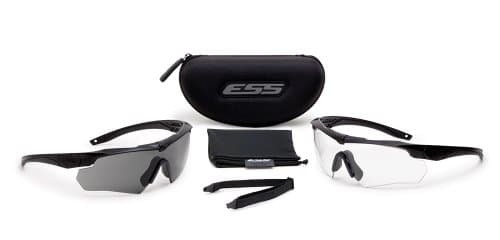
ESS Crossbow 2LS Kit
APEL9.7/10Three inserts documented (U-Rx, Vice, UPLC) behind an APEL-listed lens.
$104.98Amazon#ad · Price as of November 13, 2026 · Disclosure for the link to ESS Crossbow 2LS Kit
Best Rx-ready ballistic frame
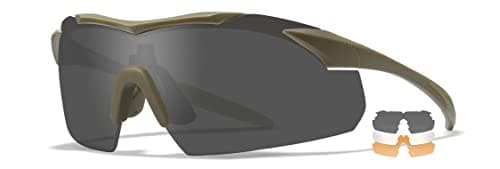
Wiley X WX Vapor
MIL-PRF-32432A9.6/10"Rx-ready" — Wiley X's insert on a MIL-PRF-32432A frame with thin temples.
$175.00Amazon#ad · Price as of November 13, 2026 · Disclosure for the link to Wiley X WX Vapor
Best-documented ballistic rating
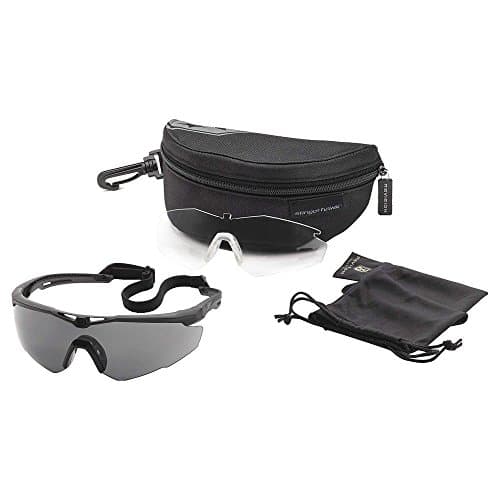
Revision StingerHawk
APEL9.6/10Rx carrier with a spec sheet, clause-cited ratings, two sizes.
$119.05Amazon#ad · Price as of November 13, 2026 · Disclosure for the link to Revision StingerHawk
Best safety readers with an Rx path
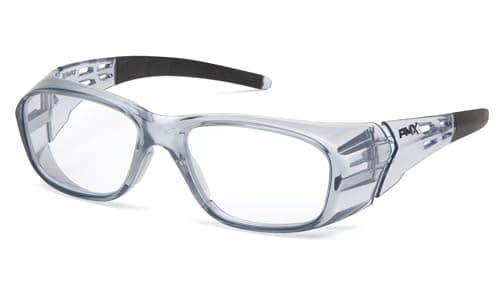
Pyramex Emerge Reader
Z87.1+8.8/10The direct-glaze route: plano, reader or Rx lens in a Z87.1-2020+ frame.
$20.56Amazon#ad · Price as of November 13, 2026 · Disclosure for the link to Pyramex Emerge Reader
Choosing a route is half the job. The other half is technique: where your eye sits in the lens, what progressives do to a front sight, and how eye dominance behaves with glasses on. That is on how to shoot with glasses.
There is a fourth route this guide does not rank, because it is not eyewear at all: contact lenses, which put the correction behind the protective lens with no insert and no stacking. What that changes about frame choice — and what it does not change about protection — is on shooting glasses with contact lenses.
How Lens & Lead rates eyewear
How these picks were chosen
Every pair here is picked from the certification its maker publishes and repeats in its own wording ("meets", "certified", "tested to", "APEL"), the lens system and the tints in the box, whether the temples are described for ear muffs, and whether an Rx route exists — then scored on a public rubric that weights protection first. Every figure links to the page it came from, so you can confirm the protection before you buy. The standards themselves are explained on ANSI Z87.1 vs MIL-PRF-32432.
Scores are editorial judgments from that documented research, and the rating, the lens system and the fit are what move a pick. The rubric and its weights are published.
Questions
Frequently asked
Can you get prescription shooting glasses?
Yes, three ways: an Rx insert behind a rated lens (ESS, Wiley X, Revision document theirs), a prescription ground into a Z87.1-2 safety lens, or a rated over-the-glasses shield worn over street frames.
Are prescription glasses safe for shooting?
Ordinary street glasses are not rated for impact and can shatter toward the eye. Wear a rated OTG shield over them, or use an insert or a Z87-2 safety lens.
Do Rx inserts keep the ballistic rating?
Yes. The insert sits behind the maker's tested lens, which is untouched, so the frame's stated rating stands.
Can my optometrist make MIL-PRF-32432 lenses?
Generally no. A MIL-PRF rating belongs to the maker's tested lens. Your optician can make Z87.1 safety lenses in a Z87-2 frame; for the ballistic tier, use an insert.
Keep reading
Related on Lens & Lead
- Best prescription safety glassesThe same four routes, for work rather than the range.
- Best for astigmatismWhy a cylinder correction changes the choice of route.
- Best safety readersWhen magnification is all you actually need.
- Best shooting glasses with Rx insertsThe insert route, ranked.
- Best over-the-glasses shooting glassesThe OTG route, ranked.
- Rx inserts vs prescription lensesInsert vs direct-glaze.
- Prescription shooting glasses costWhat each route costs.
- Best bifocal shooting glassesReaders for the bench and the front sight.
Receipts
Sources
- ESS EyePro — Crossbow 2LS Kit page (ANSI Z87+ 2020, ClearZone FlowCoat, U-Rx / Vice inserts, Tri-Tech Fit) (checked 2026-09-21)
- ESS EyePro — Crosshair 3LS Kit page (ANSI Z87.1-2015, MIL-PRF-32432, kit contents, URX insert) (checked 2026-09-21)
- Wiley X — WX Vapor product page (ratings, Rx insert, frame measurements) (checked 2026-09-21)
- Revision Military — StingerHawk Eyewear APEL U.S. Military Kit page (MIL-PRF-32432A clause 3.8.4.1, ANSI Z87.1-2020 clause 7.1, V50, EN 166, sizes, OcuMax) (checked 2026-09-21)
- Revision Military — Sawfly Eyewear 1 Lens Kit page (MIL-PRF-32432A clause 3.8.4.1, ANSI Z87.1-2020 clause 7.1, sizes, Rx carrier) (checked 2026-09-21)
- Pyramex — Emerge Reader page (ANSI/ISEA Z87.1-2020+, +1.5 / +2.0 / Rx lens) (checked 2026-09-21)
- SSP Eyewear — Methow shooting eyewear collection (3 XHD kit, NVR Fog a-EYE lenses, RX-able) (checked 2026-09-21)
- Pyramex — OTS Over the Spectacle Eyewear page (ANSI/ISEA Z87.1-2020+, fits frames up to 137 mm x 44 mm, adjustable temples) (checked 2026-09-21)
- MSC Industrial Supply — Understanding ANSI Z87.1 (high-mass 500 g from 4 ft; high-velocity steel ball at 102 mph; Z87+ and U/L/W/H/D/X markings) (checked 2026-09-21)
Ratings, lens systems, fit notes and coatings come from the maker's own product pages and manuals (linked on every product), with the published safety standards behind them, and a labeled retailer or press page where the maker's own page was unavailable. Every buy button opens today's live Amazon price. Read the full method.