Prescription / Guide
Shooting glasses with contact lenses: the easiest prescription route, with one hard rule
Contacts solve the problem that makes prescription eyewear awkward — they put the correction behind the protective lens without an insert. They solve nothing about protection, and they make the seal matter more.
By Mike M.Updated Researched from maker specs & standards
#adLens & Lead earns from qualifying Amazon purchases. Prices are set by the retailer and change. A commission never decides a ranking. How we rate · Disclosure
The one hard rule
A contact lens is a vision correction sitting on the surface of your eye. It is not impact protection, it is not a barrier against a fragment or a flying case, and it does nothing about the hazards this entire site exists for. You need rated eyewear over contacts exactly as much as someone with perfect vision does — which is to say, always.
That sounds obvious written down, and yet the assumption that something in front of the eye must help is common enough to be worth stating. If anything, contacts remove a safety margin people were unknowingly relying on: a spectacle lens is a poor protector, as covered on safety glasses vs normal glasses, but it is something. A contact lens is nothing.
Worth noting what the regulation does and does not say. OSHA's eye and face protection rule addresses employees who wear prescription lenses — spectacles — and requires protection that either incorporates the prescription or can be worn over it without disturbing either device. It says nothing about contact lenses, because from the rule's point of view a contact-lens wearer simply needs appropriate eye protection like anybody else. The full reading of the rule is on OSHA approved safety glasses.
Why contacts are the easiest route
If you compare the four ways a shooter with a correction can see the sights, contacts win on nearly every practical axis — which is why plenty of competitive shooters use them.
Nothing between you and the protective lens. A prescription insert puts a second lens behind the ballistic one: a second surface to fog, a small reduction in field of view, and a frame-within-a-frame you can sometimes see the edge of. Contacts remove all of that. The insert trade-offs in full are on Rx inserts vs prescription lenses.
Full peripheral correction. A spectacle lens corrects where the lens is; look past its edge and you are uncorrected. On a wraparound eyeshield that edge is where the frame curves away. A contact lens moves with your eye, so a target acquired with a head turn is in focus immediately.
Any frame fits. This is the big one. Choosing eyewear with a prescription normally means filtering to insert-ready platforms or over-the-glasses shields. With contacts, the whole of this site is available to you — including the frames that fit under ear muffs properly, which is the fit problem that causes the most trouble, on best shooting glasses for ear muffs.
No stacking, no sliding. Over-the-glasses frames work and we rank them, but they are bulkier, they trap air between two lenses and they sit differently under a gun mount. Contacts sidestep the geometry entirely.
Dust and wind change the frame you want
Here is the trade that nobody mentions when they recommend contacts. A contact lens sits in your tear film, and anything that disturbs that film — wind across an outdoor range, dust off a berm, a hot dry day, hours of concentration without blinking much — is felt immediately and specifically by a contact-lens wearer. Grit that gets behind a lens is worse still: it is painful, it ends your string, and getting it out at a dusty range is awkward.
That is a frame decision, not a lens decision. Three practical consequences:
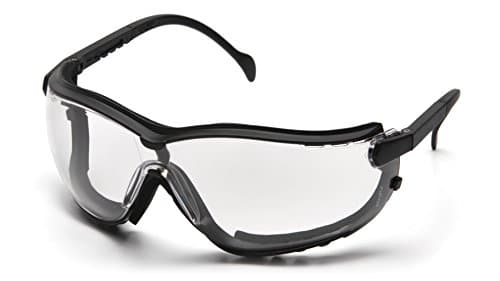
Prefer more wrap, or a seal. A high-wrap eyeshield that sits close to the face moves far less air across the eye than a flat frame with a gap at the temple. On a genuinely dusty or windy day, a sealed goggle with foam is not overkill — it is the difference between shooting the match and sitting it out. The V2G is in the picks below precisely because it converts from temples to a headband with flame-resistant foam, so one rated frame covers both conditions.
Prefer a clear or lightly tinted lens. If you need to get a lens out and back in, you want to see what you are doing, and a dark lens in a dim bay makes that harder. The tint decision itself is unchanged by contacts — choose it on light and target, per the lens color guide.
Prefer a frame you can take off and put back on one-handed. Interchangeable-lens kits with quick lens locks are a bonus here rather than a gimmick, since a lens swap is often what you want after handling a contact with dusty fingers.
Three frames for a contact-lens wearer
Our picks for this
A high-wrap kit, a convertible goggle and the backup pair
Best APEL-listed kit
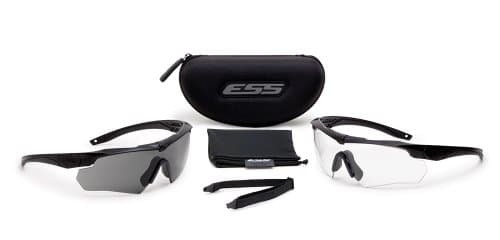
ESS Crossbow 2LS Kit
APEL8.6/10The high-wrap pick: an APEL-listed kit stating ANSI Z87+ and MIL-PRF-32432A, with the ClearZone FlowCoat anti-fog and anti-scratch coating and a clear lens in the box alongside the smoke gray. Maximum coverage, minimum air across the eye.
$107.77Amazon#ad · Price as of November 2, 2026 · Disclosure for the link to ESS Crossbow 2LS Kit
Best glasses-to-goggle hybrid
Pyramex V2G
MIL-PRF-324328.1/10The dusty-day answer: interchangeable temples and a headband both ship with the pair, so the same ANSI/ISEA Z87.1-2020 + High Impact frame that also states MIL-PRF-32432 becomes a sealed goggle with flame-resistant foam when the wind gets up.
$6.53Amazon#ad · Price as of November 2, 2026 · Disclosure for the link to Pyramex V2G
Best OTG for the range
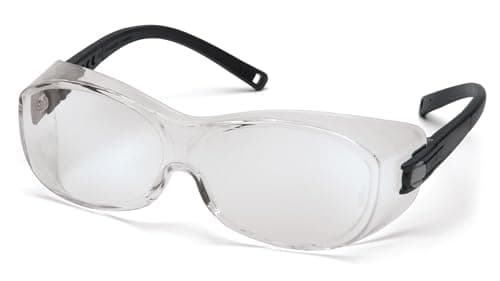
Pyramex OTS
Z87.1+7.0/10The backup, for the day a lens tears: an over-the-spectacle frame that fits over your own glasses up to 137 mm by 44 mm, stating Z87.1-2020 + High Impact. Keep one in the bag and a dropped contact does not end the session.
$6.08Amazon#ad · Price as of November 2, 2026 · Disclosure for the link to Pyramex OTS
What to carry in the range bag
The failure mode for a contact-lens wearer is not an impact, it is a lost or unusable lens two stages into a match. Four items make that a five-minute problem instead of a drive home.
A spare set of contacts in whatever your prescriber supplies them as. Daily disposables are popular with shooters for exactly this reason.
Whatever drops your eye care professional recommends for dryness, used as directed. We are not going to name a product; the person who prescribed your lenses will.
Your ordinary glasses plus an over-the-glasses frame. This is the backup plan that actually works: if a contact comes out and will not go back in, you put your own glasses on and a rated OTG shield over them. The field is ranked on best over-the-glasses shooting glasses, and the goggle versions on best safety goggles over glasses.
Clean water and a clean towel — the same kit that lets you rinse a dusty lens properly rather than wiping it, per how to clean safety glasses.
Contacts vs inserts vs over-the-glasses
None of these is universally right, and plenty of shooters use two of them depending on the day.
Contacts give the best sight picture and the widest frame choice, at the cost of dust and dryness sensitivity and a dependency on a consumable. Best for: clays, competition, anyone whose frame choice is being limited by their prescription.
An Rx insert behind a ballistic lens is the most robust option — nothing to lose, nothing to dry out — at the cost of a second surface to fog and a narrower choice of platforms. Best for: duty use, long days, strong prescriptions. Ranked on best shooting glasses with Rx inserts.
Over-the-glasses is the cheapest and the most forgiving, at the cost of bulk, fogging between two lenses and a frame that interacts awkwardly with a gun mount and with muffs. Best for: occasional shooters, and as everyone's backup.
If you are weighing the cost of each route before deciding, the dated figures we can source are on prescription shooting glasses cost, and the overall decision tree is on the prescription shooting glasses guide. If your correction includes astigmatism, there is a specific discussion of what that does to a sight picture on best shooting glasses for astigmatism.
How Lens & Lead rates eyewear
How these picks were chosen
Every pair here is picked from the certification its maker publishes and repeats in its own wording ("meets", "certified", "tested to", "APEL"), the lens system and the tints in the box, whether the temples are described for ear muffs, and whether an Rx route exists — then scored on a public rubric that weights protection first. Every figure links to the page it came from, so you can confirm the protection before you buy. The standards themselves are explained on ANSI Z87.1 vs MIL-PRF-32432.
Scores are editorial judgments from that documented research, and the rating, the lens system and the fit are what move a pick. The rubric and its weights are published.
Questions
Frequently asked
Can you wear safety glasses over contact lenses?
Yes, and you must. Contacts correct vision and provide no protection at all, so rated eyewear over them is required exactly as it would be for someone with no correction. The advantage is that any frame fits — there is no insert or stacking to work around.
Are contacts better than prescription shooting glasses?
For sight picture and frame choice, usually yes: the correction moves with your eye and the protective lens stays unobstructed. For dusty or windy conditions and for very long days, an Rx insert behind a ballistic lens is more robust.
What eye protection is best if I wear contacts at a dusty range?
A high-wrap eyeshield that sits close to the face, or a sealed goggle when it is genuinely dusty. The Pyramex V2G is useful here because it ships with both temples and a headband, so one rated frame covers both conditions.
What should I pack in case a contact lens comes out?
A spare set of lenses, whatever drops your eye care professional recommends, clean water, and your ordinary glasses with a rated over-the-glasses frame to wear over them. That last pair is what keeps a lost lens from ending the day.
Keep reading
Related on Lens & Lead
Receipts
Sources
- Cornell Legal Information Institute — 29 CFR 1910.133, Eye and face protection, full text ("The employer shall ensure that each affected employee uses appropriate eye or face protection when exposed to eye or face hazards from flying particles, molten metal, liquid chemicals, acids or caustic liquids, chemical gases or vapors, or potentially injurious light radiation"; "eye protection that provides side protection when there is a hazard from flying objects"; employees who wear prescription lenses must wear "eye protection that incorporates the prescription in its design, or... eye protection that can be worn over the prescription lenses without disturbing the proper position of the prescription lenses or the protective lenses"; devices "must comply with any of the following consensus standards" — ANSI/ISEA Z87.1-2010, ANSI Z87.1-2003 or ANSI Z87.1-1989 (R-1998) — or be demonstrated "at least as effective") (checked 2026-10-17)
- American Academy of Ophthalmology — Sports Eye Safety ("Regular eyeglasses do not offer proper eye protection and, in some cases, can make an injury worse if they shatter"; polycarbonate protective sports glasses) (checked 2026-09-24)
- ESS EyePro — Crossbow 2LS Kit page (ANSI Z87+ 2020, ClearZone FlowCoat, U-Rx / Vice inserts, Tri-Tech Fit) (checked 2026-09-21)
- ESS EyePro — Crossbow Black 2x w/Clear & Smoke Gray APEL page (ANSI Z87.1+ 2015, MIL-PRF-32432A, APEL) (checked 2026-09-21)
- Pyramex — V2G Sealed Eyewear page (ANSI/ISEA Z87.1-2020+, MIL-PRF-32432, CSA, EN 166, H2X/H2MAX, temples + strap) (checked 2026-09-21)
- Pyramex — OTS Over the Spectacle Eyewear page (ANSI/ISEA Z87.1-2020+, fits frames up to 137 mm x 44 mm, adjustable temples) (checked 2026-09-21)
- ISEA — ISEA publishes ANSI/ISEA Z87.1-2020 eye and face protection standard update (anti-fog criteria, relaxed optics, marking) (checked 2026-09-21)
Ratings, lens systems, fit notes and coatings come from the maker's own product pages and manuals (linked on every product), with the published safety standards behind them, and a labeled retailer or press page where the maker's own page was unavailable. Every buy button opens today's live Amazon price. Read the full method.