Ratings / Guide
Safety glasses vs normal glasses: three differences, and why the frame is one of them
Your everyday glasses are tested at the lens. Safety glasses are tested as an assembly — frame, lens and all — because in a real impact the question is not only whether the lens breaks but whether it stays in front of your eye.
By Mike M.Updated Researched from maker specs & standards
#adLens & Lead earns from qualifying Amazon purchases. Prices are set by the retailer and change. A commission never decides a ranking. How we rate · Disclosure
The three differences
People usually assume the difference is lens thickness or lens material, and it is neither. Plenty of ordinary prescription lenses are polycarbonate, the same material used in safety lenses. The three real differences are what gets tested, what the test is, and whether the sides of your eyes are covered at all.
That distinction is the whole of this page, and it is also the reason "my glasses are polycarbonate, so they are basically safety glasses" is the most common wrong belief in this category.
Difference one: the lens test
Every pair of eyeglasses and sunglasses sold in the United States has to pass an impact-resistance rule, and it is worth knowing exactly how small that rule is. The FDA regulation, 21 CFR 801.410, describes the test this way: "a 5/8-inch steel ball weighing approximately 0.56 ounce is dropped from a height of 50 inches upon the horizontal upper surface of the lens".
That is a real test and it is why ordinary lenses rarely shatter when dropped. But note what it is: a static object, falling under gravity, onto a lens lying on a support. A lens maker's explainer of the related ANSI Z80.3 sunglass standard makes the comparison plainly — the drop-ball test is run on the lens alone on a tube, while ANSI Z87.1 tests the assembled frame and lens on a head form.
ANSI Z87.1's impact tests are a different order of event. The high-mass test drops a 500 g pointed weight from 50 inches; the high-velocity test fires a quarter-inch steel ball at roughly 150 ft/s. A device that passes both and is marked with the "+" is tested against something travelling at speed, not something falling off a shelf. The detail is on Z87 vs Z87+.
Difference two: the frame is part of the device
This is the difference almost nobody is told, and it is the most important one. Under Z87.1 the thing being tested is the device — frame and lens together, mounted on a head form — and part of what it must do is retain the lens. The failure a safety frame is designed to prevent is not only a broken lens, it is a lens popping out of its mount, or a frame fracturing and driving material inward.
An ordinary spectacle frame is engineered for weight, comfort and looks. Its hinges, its rims and the way the lens is held in are all tuned for a product that lives on a face, not one that gets hit. You can fit the toughest polycarbonate lens available into a fashion frame and still have a device that fails the way the standard cares about — which is why there is no way to upgrade your everyday glasses into safety glasses by changing the lenses.
Difference three: side protection
Normal glasses are open at the temples by design — that is what makes them look like glasses. OSHA's eye and face protection rule is explicit that where there is a hazard from flying objects, eye protection must provide side protection, and it allows detachable clip-on or slide-on side shields as a way to get there.
That is not a bureaucratic detail. A particle that reaches your eye from the side has gone around the lens entirely, and the lens rating is irrelevant to it. Anyone standing near a grinder, a lathe or a firing line is in a situation where the sides matter at least as much as the front. The ways to cover them — wraparound geometry, integrated shields, clip-ons for people who want to keep their own frames — are ranked on best shooting glasses with side shields.
When normal glasses make an injury worse
The American Academy of Ophthalmology puts this bluntly in its sports eye safety guidance: regular eyeglasses do not offer proper eye protection and, in some cases, can make an injury worse if they shatter. That is the scenario worth holding in your head — not "my glasses might not help" but "my glasses might be the thing that injures me".
It is also why we treat this as a safety question rather than a preference. On a range, in a shop, mowing a lawn with a string trimmer, the cost of being wrong is not symmetric. The related argument about sunglasses — which are tested as lenses under the same sort of rule — is on are sunglasses safe for shooting, and the difference between shooting glasses and general safety glasses is on shooting glasses vs safety glasses.
Two routes that keep your prescription
If you wear glasses, you have exactly two compliant options, and OSHA's rule names them both: eye protection that incorporates the prescription in its design, or eye protection worn over your prescription lenses without disturbing the proper position of either. The picks below are one of each, plus the reader route for people whose only correction is for close work.
Our picks for this
One of each route, all stating the rating
Best Rx-ready ballistic frame
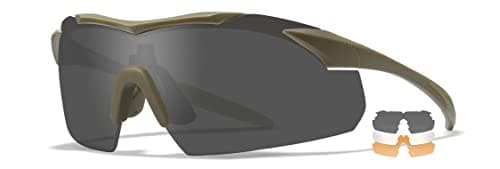
Wiley X WX Vapor
MIL-PRF-32432A8.4/10The prescription-in-the-device route: Wiley X states the Vapor is Rx-ready with an insert available, on a frame stating ANSI Z87.1+ and MIL-PRF-32432A. Your correction sits behind a rated ballistic lens.
$175.00Amazon#ad · Price as of November 2, 2026 · Disclosure for the link to Wiley X WX Vapor
Best OTG for the range
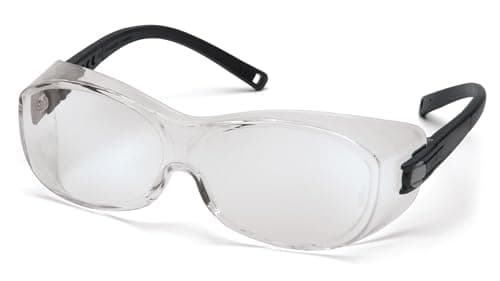
Pyramex OTS
Z87.1+7.0/10The over-the-glasses route, with the number that makes it work: Pyramex publishes a fit limit of frames up to 137 mm wide by 44 mm tall, and states ANSI/ISEA Z87.1-2020 + High Impact. Measure your own frames before you order.
$6.08Amazon#ad · Price as of November 2, 2026 · Disclosure for the link to Pyramex OTS
Best safety readers with an Rx path
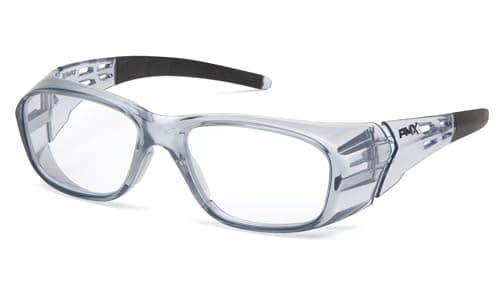
Pyramex Emerge Reader
Z87.1+6.8/10For presbyopia only: a rated frame with built-in reader lenses at +1.5 and +2.0 and a prescription lens option, stating ANSI/ISEA Z87.1-2020 + High Impact. Cheaper than a prescription safety frame if distance vision is fine.
$16.42Amazon#ad · Price as of November 2, 2026 · Disclosure for the link to Pyramex Emerge Reader
What is not on that list, deliberately: a pair of loose safety glasses worn perched over your own. It disturbs the position of both devices, which is the specific thing the regulation rules out, and in practice it fogs and slides. Costs and trade-offs for each route are on prescription shooting glasses cost.
How to tell which you are holding
Look at the frame, not the box. A device built to the standard carries a marking: the manufacturer's mark plus Z87 on basic-impact eyewear, Z87+ where it passes the high-impact tests, and Z87-2 on a prescription safety frame. Lenses carry their own marks. If there is nothing on the frame at all, you are holding ordinary glasses no matter what the listing claimed.
That thirty-second check is the whole skill, and the full decoder — including the U, L, W, D and X codes — lives on what does Z87+ mean. If the claim you are checking is a ballistic one rather than an ANSI one, the method is on how to tell if glasses are ballistic rated, and the question of whether an employer's rules are satisfied is on OSHA approved safety glasses.
How Lens & Lead rates eyewear
How these picks were chosen
Every pair here is picked from the certification its maker publishes and repeats in its own wording ("meets", "certified", "tested to", "APEL"), the lens system and the tints in the box, whether the temples are described for ear muffs, and whether an Rx route exists — then scored on a public rubric that weights protection first. Every figure links to the page it came from, so you can confirm the protection before you buy. The standards themselves are explained on ANSI Z87.1 vs MIL-PRF-32432.
Scores are editorial judgments from that documented research, and the rating, the lens system and the fit are what move a pick. The rubric and its weights are published.
Questions
Frequently asked
Can I wear my normal glasses instead of safety glasses?
No. Everyday glasses are impact tested as a lens, not as a complete device, and they have no side protection. The American Academy of Ophthalmology notes that regular eyeglasses can make an injury worse if they shatter. Use a rated frame, or a rated frame over your own.
Are polycarbonate prescription lenses the same as safety lenses?
The material can be the same; the device is not. Z87.1 tests the assembled frame and lens on a head form and includes lens retention, so a polycarbonate lens in a fashion frame is still not safety eyewear.
What does Z87-2 mean on my prescription glasses?
It is the marking used on prescription safety frames — the signal that the frame itself was built and tested to the standard, rather than simply holding tough lenses.
Do clip-on side shields make my glasses safety glasses?
They address the side-protection requirement, and OSHA accepts detachable side protectors that meet the pertinent requirements. They do not change the frame or lens rating, so the underlying frame still has to be a rated one.
Keep reading
Related on Lens & Lead
Receipts
Sources
- Cornell Legal Information Institute — 21 CFR 801.410, Use of impact-resistant lenses in eyeglasses and sunglasses ("a 5/8-inch steel ball weighing approximately 0.56 ounce is dropped from a height of 50 inches upon the horizontal upper surface of the lens") (checked 2026-09-24)
- Revant Optics (lens maker explainer) — Sunglasses impact resistance: the ANSI Z80.3 drop-ball test is run on the lens alone on a tube, while ANSI Z87.1 tests the assembled frame and lens on a head form (checked 2026-09-24)
- American Academy of Ophthalmology — Sports Eye Safety ("Regular eyeglasses do not offer proper eye protection and, in some cases, can make an injury worse if they shatter"; polycarbonate protective sports glasses) (checked 2026-09-24)
- Cornell Legal Information Institute — 29 CFR 1910.133, Eye and face protection, full text ("The employer shall ensure that each affected employee uses appropriate eye or face protection when exposed to eye or face hazards from flying particles, molten metal, liquid chemicals, acids or caustic liquids, chemical gases or vapors, or potentially injurious light radiation"; "eye protection that provides side protection when there is a hazard from flying objects"; employees who wear prescription lenses must wear "eye protection that incorporates the prescription in its design, or... eye protection that can be worn over the prescription lenses without disturbing the proper position of the prescription lenses or the protective lenses"; devices "must comply with any of the following consensus standards" — ANSI/ISEA Z87.1-2010, ANSI Z87.1-2003 or ANSI Z87.1-1989 (R-1998) — or be demonstrated "at least as effective") (checked 2026-10-17)
- MSC Industrial Supply — Understanding ANSI Z87.1 (high-mass 500 g from 4 ft; high-velocity steel ball at 102 mph; Z87+ and U/L/W/H/D/X markings) (checked 2026-09-21)
- ISEA — ISEA publishes ANSI/ISEA Z87.1-2020 eye and face protection standard update (anti-fog criteria, relaxed optics, marking) (checked 2026-09-21)
- Wiley X — WX Vapor product page (ratings, Rx insert, frame measurements) (checked 2026-09-21)
- Pyramex — OTS Over the Spectacle Eyewear page (ANSI/ISEA Z87.1-2020+, fits frames up to 137 mm x 44 mm, adjustable temples) (checked 2026-09-21)
- Pyramex — Emerge Reader page (ANSI/ISEA Z87.1-2020+, +1.5 / +2.0 / Rx lens) (checked 2026-09-21)
Ratings, lens systems, fit notes and coatings come from the maker's own product pages and manuals (linked on every product), with the published safety standards behind them, and a labeled retailer or press page where the maker's own page was unavailable. Every buy button opens today's live Amazon price. Read the full method.