Prescription / Guide
How to shoot with glasses: the three problems, in the order they cost you
Wearing prescription glasses at the range is normal and entirely workable. It just breaks in three specific ways, and two of them are about where your eye sits in the lens rather than about the prescription.
By Mike M.Updated Researched from maker specs & standards
#adLens & Lead earns from qualifying Amazon purchases. Prices are set by the retailer and change. A commission never decides a ranking. How we rate · Disclosure
Problem one: street glasses are not eye protection
This is the one people resist and it is the one that matters. Your everyday glasses almost certainly comply with the FDA rule at 21 CFR 801.410, which requires eyeglass and sunglass lenses to survive a 5/8-inch steel ball weighing about 0.56 ounce dropped from 50 inches. That test is run on the lens alone, resting on a tube. It says nothing about the frame, the mounting, or what happens to the lens edge under a lateral impact.
ANSI Z87.1 tests the assembled frame and lens together on a head form, and the Z87+ high-impact version adds a quarter-inch steel ball fired at roughly 150 feet per second. The American Academy of Ophthalmology puts the practical consequence plainly in its sports eye safety guidance: regular eyeglasses do not offer proper eye protection and, in some cases, can make an injury worse if they shatter. A dress frame also puts a hard rim and a sharp lens edge directly in front of your eye.
So the first move is not optical, it is protective: get a rated device between you and the firing line. The full argument, including why a tough sunglass is not a substitute, is on are sunglasses safe for shooting and shooting glasses vs safety glasses.
Problem two: you are looking through the wrong part of the lens
Every prescription lens has an optical centre, ground to sit in front of your pupil when you are looking straight ahead with your head upright. Shooting does not involve looking straight ahead with your head upright. With a rifle or shotgun your head is canted down and forward onto a stock; with a pistol at full extension your eyes are rolled slightly up; and in either case you may be looking through the upper inner corner of the lens rather than the middle.
Away from the optical centre a lens introduces prism and aberration, and the stronger your prescription the worse it gets. The symptom is not dramatic blur — it is a sight picture that will not quite settle, a front sight that looks slightly soft, or a target edge that shifts when you move your head a few millimetres. People blame the gun, the light or their eyes. It is the lens geometry.
There are three fixes and they cost nothing to try. Move your head, not your eyes: bring the optical centre to the target by tilting and turning your head so you are looking through the middle of the lens, which with a shotgun means building the mount around the glasses rather than around your neck. Raise the frame: a frame sitting too low on the nose puts your sightline above the optical centre; a frame that sits high and close keeps you in it, which is one practical reason wraparound shooting frames work better than dress frames. Shorten the distance: the closer the lens is to your eye, the larger the usable field through it, which is why adjustable nose pieces and temple pitch are worth paying for.
Problem three: progressives and the front sight
Progressive lenses are the single biggest complaint from shooters over about forty-five, and the reason is structural rather than a matter of getting used to them. A progressive puts distance correction at the top, intermediate in the middle and near at the bottom, with a narrow usable corridor down the centre and distortion either side of it.
On a pistol that is precisely wrong. The front sight is roughly an arm's length away — intermediate distance — and it sits in the upper part of your field of view because your arms are extended in front of you. A progressive puts intermediate correction in the middle-to-lower lens and distance at the top, so your front sight lands in the distance zone and your target lands there too. You can get one or the other sharp by tipping your head back, which is uncomfortable and inconsistent.
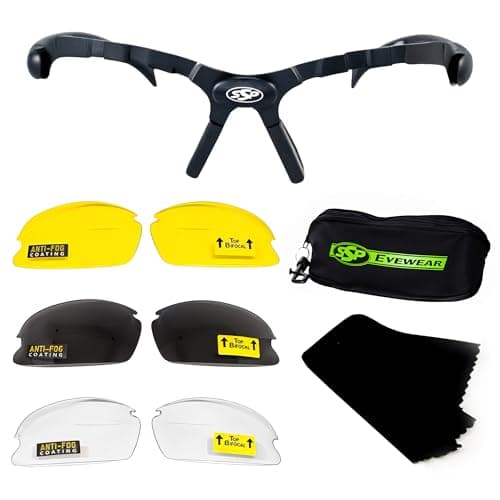
Three answers, in increasing cost. Use a single-vision distance lens dedicated to shooting and accept that you cannot read a loading manual in them. Use a top-focal lens — a reading segment at the top of the lens rather than the bottom — which puts magnification exactly where the front sight is; SSP sells that as the Top Focal AST kit with segments from +1.00 to +3.00 in three tints. Or get a prescription shooting lens made for the distance you actually need, which an optician can do once you tell them it is for a front sight at arm's length rather than for reading. The costs are laid out on how much prescription shooting glasses cost, and the bifocal options are ranked on best bifocal shooting glasses.
With a rifle and a scope none of this applies, because the scope does the focusing. With iron sights on a rifle it applies as much as with a pistol. With a shotgun it mostly does not — you are looking at the bird, not the bead — which is why clay shooters usually do fine with a plain distance lens.
Eye dominance with glasses on
Glasses change nothing about which eye is dominant, but they change two things about how you manage it.
First, if your prescription differs significantly between eyes, the stronger-corrected eye may feel like the one in charge even when it is not, because its image is crisper. That can make a shotgun shooter who has always shot both eyes open suddenly start switching between barrels. The test is the same as always — frame a distant object in a triangle made with both hands, then close one eye — but do it wearing the glasses you will shoot in, not without them.
Second, the usual fix for cross-dominance is to occlude part of the non-dominant eye's view rather than shut the eye, and a lens gives you somewhere to put that: a small patch of translucent tape on the non-dominant side of a shooting lens, positioned where that eye sees the rib, blurs the competing picture without blinding you. It is a cheap experiment and it is one of the few genuine advantages of shooting in glasses. Do it on a dedicated shooting lens, not on your street pair.
The three routes out
Our picks for this
Over the glasses, insert, or a shooting lens
Best OTG for the range
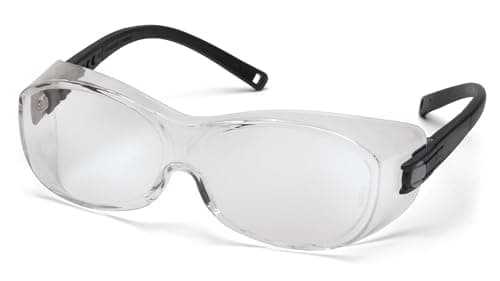
Pyramex OTS
Z87.1+7.0/10Route one, cheapest: an over-the-spectacle shield worn over your own glasses, rated ANSI/ISEA Z87.1-2020 with the high-impact plus and with a published fit limit of 137 mm by 44 mm, so measure your frames first.
$6.08Amazon#ad · Price as of October 10, 2026 · Disclosure for the link to Pyramex OTS
Best APEL-listed kit
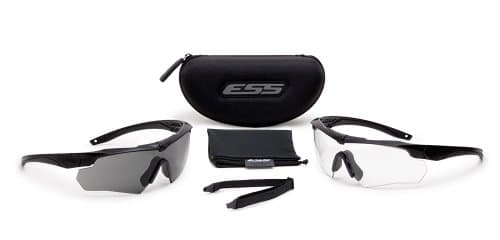
ESS Crossbow 2LS Kit
APEL8.6/10Route two: keep the ballistic lens and put your prescription behind it. ESS documents three inserts for the Crossbow — U-Rx, Vice and UPLC — on an APEL kit stating MIL-PRF-32432A.
$101.55Amazon#ad · Price as of October 10, 2026 · Disclosure for the link to ESS Crossbow 2LS Kit
Best top-focal for pistol sights
SSP Eyewear Top Focal AST Kit
Z87.1+7.1/10Route three, for the front-sight problem specifically: three ANSI Z87.1-rated lenses with a top-mounted bifocal segment from +1.00 to +3.00, so the magnification is where your sight is.
$130.00Amazon#ad · Price as of October 10, 2026 · Disclosure for the link to SSP Eyewear Top Focal AST Kit
Which route suits you is mostly decided by your prescription strength and how often you shoot. The comparison in full is on the prescription shooting glasses guide, with the insert-versus-glazed-lens trade-off on inserts vs prescription lenses, and the over-the-glasses field ranked on best over-the-glasses shooting glasses.
A range-day checklist
Five things to get right before the first string, none of which costs money.
Check the fit under your muffs before you load. An over-the-glasses shell plus a muff cup is a lot of hardware, and the usual failure is the shell lifting off your face when the cup presses the temple. Thin-temple options and the whole interaction are on best shooting glasses for ear muffs.
Expect fog, and plan for it. Two lenses with trapped air between them is the worst fog geometry there is. If you are going the over-the-glasses route, buy the version with a named anti-fog coating — Pyramex's H2X or H2MAX — rather than the base SKU. The rest of the toolkit is on how to stop shooting glasses fogging.
Set the frame position deliberately. Push it as high and as close as it comfortably goes, then mount the gun. If the stock comb moves the frame, adjust the frame rather than your cheek weld.
Take the clear lens. If your prescription route gives you one tint, make it clear. A tint you cannot remove is a liability on an indoor bay or at dusk, and the lens colour decision is on the lens colour guide.
Inspect the lens. A scratched prescription lens scatters light across your whole sight picture, and a pitted one is no longer protective equipment — see when to replace shooting glasses.
How Lens & Lead rates eyewear
How these picks were chosen
Every pair here is picked from the certification its maker publishes and repeats in its own wording ("meets", "certified", "tested to", "APEL"), the lens system and the tints in the box, whether the temples are described for ear muffs, and whether an Rx route exists — then scored on a public rubric that weights protection first. Every figure links to the page it came from, so you can confirm the protection before you buy. The standards themselves are explained on ANSI Z87.1 vs MIL-PRF-32432.
Scores are editorial judgments from that documented research, and the rating, the lens system and the fit are what move a pick. The rubric and its weights are published.
Questions
Frequently asked
Can you shoot with glasses on?
Yes, and millions of people do. What you should not do is shoot in your street frames: the American Academy of Ophthalmology warns that regular eyeglasses do not offer proper eye protection and can make an injury worse if they shatter. Use an over-the-glasses shield, an Rx insert behind a rated lens, or a prescription safety lens.
Why does my sight picture look blurry with glasses?
Usually because your eye is not behind the lens's optical centre when your head is on a stock or your arms are extended. Away from the centre a lens adds prism and aberration. Move your head so you look through the middle of the lens, and wear a frame that sits high and close.
Are progressive lenses bad for shooting?
For pistol and iron sights, yes — the front sight sits at intermediate distance in the upper field of view, and a progressive puts intermediate correction low and distance high. Use a single-vision distance lens, a top-focal segment, or a prescription made for arm's length. With a scoped rifle it does not matter.
Do glasses affect eye dominance?
They do not change which eye is dominant, but a big difference in correction between eyes can make the crisper eye feel dominant. Run the dominance test wearing the glasses you shoot in, and if you are cross-dominant, a small patch of translucent tape on the non-dominant side of a dedicated shooting lens is the cheapest fix available.
Keep reading
Related on Lens & Lead
Receipts
Sources
- American Academy of Ophthalmology — Sports Eye Safety ("Regular eyeglasses do not offer proper eye protection and, in some cases, can make an injury worse if they shatter"; polycarbonate protective sports glasses) (checked 2026-09-24)
- Cornell Legal Information Institute — 21 CFR 801.410, Use of impact-resistant lenses in eyeglasses and sunglasses ("a 5/8-inch steel ball weighing approximately 0.56 ounce is dropped from a height of 50 inches upon the horizontal upper surface of the lens") (checked 2026-09-24)
- Revant Optics (lens maker explainer) — Sunglasses impact resistance: the ANSI Z80.3 drop-ball test is run on the lens alone on a tube, while ANSI Z87.1 tests the assembled frame and lens on a head form (checked 2026-09-24)
- MSC Industrial Supply — Understanding ANSI Z87.1 (high-mass 500 g from 4 ft; high-velocity steel ball at 102 mph; Z87+ and U/L/W/H/D/X markings) (checked 2026-09-21)
- Pyramex — OTS Over the Spectacle Eyewear page (ANSI/ISEA Z87.1-2020+, fits frames up to 137 mm x 44 mm, adjustable temples) (checked 2026-09-21)
- ESS EyePro — Crossbow 2LS Kit page (ANSI Z87+ 2020, ClearZone FlowCoat, U-Rx / Vice inserts, Tri-Tech Fit) (checked 2026-09-21)
- SSP Eyewear — Top Focal AST Kit page (ANSI Z87.1 rated ballistic lenses, 3 lenses, +1.00 to +3.00 top focal, NVR Fog, warranty) (checked 2026-09-21)
- American Academy of Ophthalmology — What is astigmatism? ("Astigmatism is an imperfection in the normal curvature of your eye's cornea or lens"; "blurry vision or areas of distorted vision", headaches and squinting; corrected with eyeglasses or contact lenses; the prescription "Cylinder" value "measures what degree of astigmatism you have") (checked 2026-09-26)
- OSHA — 29 CFR 1910.133 Eye and face protection (checked 2026-09-21)
Ratings, lens systems, fit notes and coatings come from the maker's own product pages and manuals (linked on every product), with the published safety standards behind them, and a labeled retailer or press page where the maker's own page was unavailable. Every buy button opens today's live Amazon price. Read the full method.