Ratings / Guide
OSHA approved safety glasses: there is no such thing, and here is what to buy instead
No agency stamps a pair of safety glasses OSHA approved, because OSHA does not approve products. It requires devices that comply with specific editions of ANSI Z87.1 — which is a question you can answer from the maker's own page.
By Mike M.Updated Researched from maker specs & standards
#adLens & Lead earns from qualifying Amazon purchases. Prices are set by the retailer and change. A commission never decides a ranking. How we rate · Disclosure
Why nothing is OSHA approved
Search for safety glasses on any retail site and you will find listings that say "OSHA approved", "OSHA compliant" or "OSHA certified". None of those phrases describes a real process. OSHA is an enforcement agency: it writes rules that bind employers and inspects workplaces against them. It does not test eyewear, maintain a product list, issue certificates to manufacturers or put a mark on a temple. If a listing implies otherwise, that is the seller's wording, not a regulatory status.
That matters practically, because the phrase is doing real work in people's heads. A buyer who believes there is an OSHA list stops reading at the badge. A buyer who knows there is not goes looking for the thing that actually exists — a stated ANSI Z87.1 compliance, with an edition year, from the maker. One of those two buyers ends up with eye protection that would survive an inspection, and it is not the first one.
The closest thing to a genuine government list in this category is the U.S. Army's APEL, which is real, is maintained, and does authorize specific eyewear configurations for issue — a different programme with nothing to do with OSHA. It is covered on the APEL approved eyewear list.
What 1910.133 actually requires
The rule is short enough to read, and worth quoting rather than paraphrasing. Paragraph (a)(1): "The employer shall ensure that each affected employee uses appropriate eye or face protection when exposed to eye or face hazards from flying particles, molten metal, liquid chemicals, acids or caustic liquids, chemical gases or vapors, or potentially injurious light radiation."
Then paragraph (b)(1) is the part that connects the law to a product you can buy: protective eye and face protection devices "must comply with any of the following consensus standards", and it names ANSI/ISEA Z87.1-2010, ANSI Z87.1-2003, and ANSI Z87.1-1989 (R-1998). Paragraph (b)(2) adds the escape hatch: devices the employer demonstrates are "at least as effective" as devices built to one of those standards are deemed compliant too.
So the chain is: the regulation points at ANSI Z87.1, ANSI Z87.1 is where the tests live, and the maker is the one who states which tests its product passes. Nobody in that chain is OSHA. What the tests involve, and what the "+" adds, is on what does Z87+ mean. Note what is not on the regulation's list: the European EN 166, which is why a pair marked only to that standard does not satisfy the rule on its face — the comparison is on ANSI Z87.1 vs EN 166.
The edition trap
Notice that the editions named in the regulation are 2010, 2003 and 1989 (R-1998), while the current edition of the standard is ANSI/ISEA Z87.1-2020. That mismatch is normal — a regulation incorporates specific documents by reference and updates slowly — and it creates two practical situations.
A pair stating the 2020 edition is not somehow outside the rule; it is built to a newer version of the same consensus standard, which ISEA describes as updating criteria including anti-fog performance and marking. A pair stating only ANSI Z87.1-2003 is genuinely named in the regulation, even though the document is more than twenty years old. Our own preference, stated plainly on every product page on this site, is to favor the current edition where a maker publishes it: on this list the Pyramex Intruder and Cappture Pro both state ANSI/ISEA Z87.1-2020 + High Impact.
The edition is also the detail most listings omit. Where a maker gives one, we quote it verbatim — including the uncomfortable cases, such as products whose pages still cite 2003 or 2010 wording. The honest comparison between editions and marks is on Z87 vs Z87+.
Side protection is a separate requirement
This is the clause people miss, and it is the one most likely to fail an inspection. Paragraph (a)(2): the employer shall ensure each affected employee "uses eye protection that provides side protection when there is a hazard from flying objects", and it explicitly permits detachable side protectors — clip-on or slide-on side shields — provided they meet the pertinent requirements.
A plain pair of prescription glasses with Z87-rated lenses but open temples does not satisfy that. Neither does a stylish safety frame with a narrow lens and a gap at the temple. A wraparound frame satisfies it by geometry; a frame with integrated or clip-on side shields satisfies it by hardware. The options, including the clip-on route for people who want to keep their own frames, are on best shooting glasses with side shields.
The prescription clause most people miss
Paragraph (a)(3) is unusually specific, and it is the clause that decides what a prescription wearer has to buy: the employer shall ensure that each affected employee who wears prescription lenses in operations involving eye hazards "wears eye protection that incorporates the prescription in its design, or wears eye protection that can be worn over the prescription lenses without disturbing the proper position of the prescription lenses or the protective lenses".
Two routes, both named in the rule. Either a prescription safety frame — your correction built into a rated device — or an over-the-glasses frame that does not shift your own glasses out of position. What it rules out is the common workaround of wearing a loose pair of safety glasses perched over your own, which disturbs both. The Cappture Pro is in the picks below because Pyramex builds it as an over-the-spectacle frame and still states Z87.1-2020 + High Impact; the prescription routes and what each costs are on the prescription guide.
Picks that satisfy the rule
Our picks for this
Three frames whose makers state the standard and the edition
Best cheap Z87.1+ pair to buy in bulk
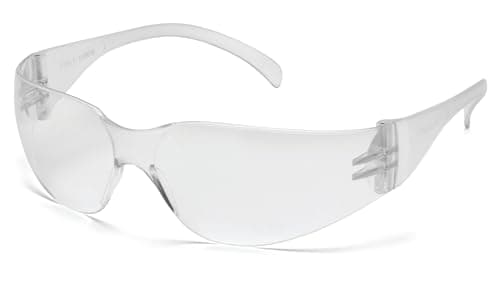
Pyramex Intruder
Z87.1+7.2/10States ANSI/ISEA Z87.1-2020 + High Impact, CAN/CSA Z94.3-2020 and CE/UKCA EN 166 on one page, in a frameless wraparound shape that gives side protection by geometry. The cheapest way to equip a crew to the current edition.
$3.14Amazon#ad · Price as of November 2, 2026 · Disclosure for the link to Pyramex Intruder
Best for all-day shop wear
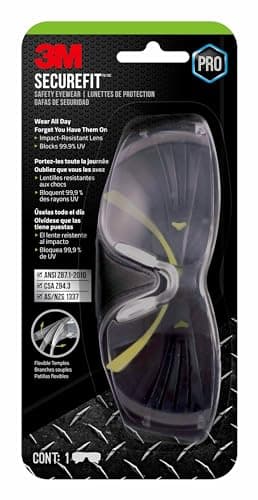
3M SecureFit 400
Z87.1+7.2/10Listed by the retailer at the ANSI Z87.1+ high-impact standard, under an ounce, with 3M's Pressure Diffusion Temple. The pair people actually keep on for a whole shift, which is the real compliance problem.
$12.79Amazon#ad · Price as of November 2, 2026 · Disclosure for the link to 3M SecureFit 400
Best anti-fog OTG
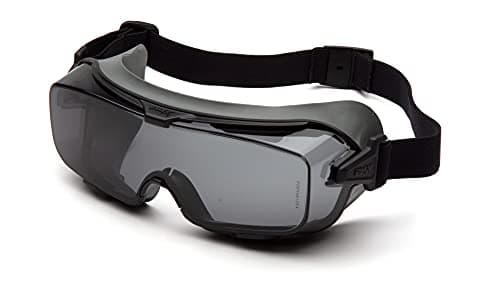
Pyramex Cappture Pro
Z87.1+7.1/10The over-the-spectacle route named in 1910.133(a)(3), stating ANSI/ISEA Z87.1-2020 + High Impact with the H2MAX lens treatment for abrasion and chemical resistance.
$17.99Amazon#ad · Price as of November 2, 2026 · Disclosure for the link to Pyramex Cappture Pro
None of these is "OSHA approved", because no product is. Each one states a consensus standard and an edition on a page we link, which is the evidence the regulation actually cares about.
How to check a pair in thirty seconds
One. Find the maker's own specification page, not the retail listing. Retail copy is where "OSHA approved" comes from.
Two. Look for the words ANSI Z87.1 with an edition year. If the page says "meets or exceeds" without naming the standard, treat it as unverified.
Three. Look for the "+" or the words high impact if there is any chance of a fast-moving particle. Most workplace hazards that hurt people are high-velocity ones.
Four. Check the physical marking when the pair arrives: Z87 or Z87+ on the frame, and Z87-2 on a prescription safety frame. A frame with no marking at all is not a safety frame, whatever the box says — the full marking decoder is on what does Z87+ mean, and the method for checking a ballistic claim is on how to tell if glasses are ballistic rated.
How Lens & Lead rates eyewear
How these picks were chosen
Every pair here is picked from the certification its maker publishes and repeats in its own wording ("meets", "certified", "tested to", "APEL"), the lens system and the tints in the box, whether the temples are described for ear muffs, and whether an Rx route exists — then scored on a public rubric that weights protection first. Every figure links to the page it came from, so you can confirm the protection before you buy. The standards themselves are explained on ANSI Z87.1 vs MIL-PRF-32432.
Scores are editorial judgments from that documented research, and the rating, the lens system and the fit are what move a pick. The rubric and its weights are published.
Questions
Frequently asked
Are any safety glasses OSHA approved?
No. OSHA does not approve, certify or list eyewear. Its rule, 29 CFR 1910.133, requires eye protection that complies with named editions of ANSI Z87.1 — so what you are looking for on a product page is an ANSI Z87.1 statement, not an OSHA badge.
What does OSHA require for safety glasses?
Appropriate eye or face protection where there are hazards from flying particles, molten metal, chemicals, gases, vapors or injurious light radiation; side protection where flying objects are a hazard; and devices complying with ANSI/ISEA Z87.1-2010, ANSI Z87.1-2003 or ANSI Z87.1-1989 (R-1998), or demonstrated to be at least as effective.
Does OSHA allow prescription glasses as safety glasses?
Only through the two routes the rule names: eye protection that incorporates the prescription in its design, or protection worn over the prescription lenses without disturbing the position of either. Ordinary prescription glasses with no side protection do not satisfy the rule.
Is ANSI Z87.1-2020 OSHA compliant if the rule names 2010?
The regulation names the 2010, 2003 and 1989 (R-1998) editions and also deems compliant any device the employer demonstrates is at least as effective. The 2020 edition is a newer revision of the same consensus standard, and we prefer makers who state it.
Keep reading
Related on Lens & Lead
Receipts
Sources
- Cornell Legal Information Institute — 29 CFR 1910.133, Eye and face protection, full text ("The employer shall ensure that each affected employee uses appropriate eye or face protection when exposed to eye or face hazards from flying particles, molten metal, liquid chemicals, acids or caustic liquids, chemical gases or vapors, or potentially injurious light radiation"; "eye protection that provides side protection when there is a hazard from flying objects"; employees who wear prescription lenses must wear "eye protection that incorporates the prescription in its design, or... eye protection that can be worn over the prescription lenses without disturbing the proper position of the prescription lenses or the protective lenses"; devices "must comply with any of the following consensus standards" — ANSI/ISEA Z87.1-2010, ANSI Z87.1-2003 or ANSI Z87.1-1989 (R-1998) — or be demonstrated "at least as effective") (checked 2026-10-17)
- OSHA — 29 CFR 1910.133 Eye and face protection (checked 2026-09-21)
- ISEA — ISEA publishes ANSI/ISEA Z87.1-2020 eye and face protection standard update (anti-fog criteria, relaxed optics, marking) (checked 2026-09-21)
- MSC Industrial Supply — Understanding ANSI Z87.1 (high-mass 500 g from 4 ft; high-velocity steel ball at 102 mph; Z87+ and U/L/W/H/D/X markings) (checked 2026-09-21)
- Pyramex — Intruder frameless eyewear page (ANSI/ISEA Z87.1-2020+, CSA, EN 166, polycarbonate, tints, coatings) (checked 2026-09-21)
- Safety Gear Pro — 3M SecureFit 400 listing ("ANSI Z87.1+ High Impact", Pressure Diffusion Temple, under 1 oz, 99.9% UV) (checked 2026-09-21)
- Pyramex — Cappture Pro over-the-spectacle page (ANSI/ISEA Z87.1-2020+, H2MAX, 99% UV) (checked 2026-09-21)
- U.S. Army — Effective Eye Protection Preserves Sight to Fight (APEL managed by PEO Soldier / MCEP; the APEL logo marks authorized eyewear) (checked 2026-09-21)
Ratings, lens systems, fit notes and coatings come from the maker's own product pages and manuals (linked on every product), with the published safety standards behind them, and a labeled retailer or press page where the maker's own page was unavailable. Every buy button opens today's live Amazon price. Read the full method.