Ratings / Guide
Polycarbonate vs Trivex for safety and shooting glasses
Trivex wins on Abbe value, density and refractive index. Polycarbonate wins on availability, price and the one thing that decides whether a pair is legal for the job: a frame-and-lens assembly that has actually been tested and marked.
By Mike M.Updated Researched from maker specs & standards
#adLens & Lead earns from qualifying Amazon purchases. Prices are set by the retailer and change. A commission never decides a ranking. How we rate · Disclosure
The direct answer
This question arrives in two very different situations, and they have two different answers.
You are buying a pair of safety or shooting glasses. Then the material is not really your decision. Polycarbonate is what the entire protective-eyewear industry molds, and there is no off-the-shelf ANSI-marked shooting glass on this site made of anything else. Buy on the marking, the fit and the tint; the material comes with the product.
You are ordering prescription safety lenses and your optician asked. Then the question is real, and Trivex is worth the upcharge if optical clarity matters to you — which, if you are looking through the lens at a front sight or a clay, it does. The published figures favor it on every count except price and availability.
What follows is what each material's documentation actually says, and the one trap in the middle of this comparison: a lens material is not a safety rating, and treating the two as interchangeable is how people end up with a lens that cannot legally be worn for the job.
The published numbers
Trivex is a urethane-based lens material introduced as an alternative to polycarbonate. Here is what is published for it, against the one polycarbonate figure in the same source set:
| Property | Polycarbonate | Trivex | What it decides |
|---|---|---|---|
| Abbe value | 30 | 43-45 | Color fringing at the edge of the lens. Higher is cleaner |
| Refractive index | — | 1.532 | How thin a given prescription can be ground |
| Density | — | 1.1 g/cm³ | Weight on your nose over a long day |
| Impact resistance | The industry default for rated eyewear | "62-times the impact resistance of ordinary plastic lenses" | Neither figure is a substitute for a Z87.1 marking |
| UV | Stated per product | "Blocks 100% of the sun's harmful ultraviolet rays" | Both materials block UV inherently; check the product anyway |
Quoted from the two documents linked in Sources below. A dash means the figure is not published in the sources we cite — we are not filling those cells from memory. The polycarbonate Abbe value of 30 is quoted from a retailer that sells both materials.
One source describes Trivex as "engineered to be the lightest material (1.11g/cm3)" with "an Abbe value of 45 which produces lens clarity virtually equivalent to CR-39 material"; the other states "Density of 1.1 g/cm³ makes it the lightest corrective lens material in common use" and that "Trivex is clearer and lighter than polycarbonate, yet it is also nearly as durable, which makes it a great choice for safety eyewear".
Read those claims carefully. "Nearly as durable" is a retailer describing its own product favorably and still conceding the gap. That concession is the reason polycarbonate remains the default in molded, mass-produced protective eyewear, and it is the honest summary of the trade: Trivex buys you optics and weight, polycarbonate buys you toughness, availability and price.
The rating belongs to the assembly, not the material
This is the part that matters most and gets written about least. ANSI/ISEA Z87.1 does not certify lens materials. It tests a complete protector — lens and frame together — and the Z87 or Z87+ marking belongs to that tested assembly. The high-impact tests are physical: a 500 g pointed weight dropped from 50 inches, and a quarter-inch steel ball fired at roughly 150 ft/s.
So "my lenses are Trivex" is not an answer to "are your glasses Z87 rated?", and neither is "my lenses are polycarbonate". A high-impact prescription safety pair needs a frame rated for prescription lenses, lenses ground to the required minimum thickness, and the markings on both parts. Your optician does that work; the markings are how you check it afterwards. What the stamps mean, letter by letter, is on what does Z87 mean, the plus is unpicked on Z87 vs Z87+, and if you are holding a pair and cannot tell, start at how to tell if glasses are ballistic rated.
Abbe value, and why a shooter cares
Abbe value measures chromatic dispersion — how much a lens splits white light into its colors as it bends it. A low Abbe value shows up as colored fringing, worst at the periphery of the lens and worse again in a strong prescription. Polycarbonate's 30 is low; Trivex's 43-45 is roughly where ordinary plastic sits, which is why one source says it gives "lens clarity virtually equivalent to CR-39".
For a shooter this is not an abstract optical virtue. You look through the periphery of a shooting lens constantly — picking up a bird at the edge of your vision, tracking across a field, holding a target in soft focus behind a front sight. Fringing at the edge of the lens is exactly where it is least welcome. In a plano (non-prescription) lens the effect is small, because there is little optical power to disperse anything; in a strong prescription it is noticeable, and it is the single best argument for Trivex.
The other half of clarity is optical class, which ANSI grades separately from impact, and tint, which changes contrast rather than sharpness. If what you are chasing is a crisper sight picture rather than a different lens material, the tint is usually the cheaper lever: the lens color guide starts there, and best shooting glasses for low lightcovers the hardest light.
Where Trivex actually shows up
Three places, in order of how likely you are to meet it.
Prescription safety glasses from an optical lab. This is the main one. When a lab offers you a material choice for a Z87-rated prescription pair, polycarbonate and Trivex are usually the two impact-resistant options, and Trivex is the upcharge. If you are going down this route, what the whole thing costs is set out on prescription shooting glasses cost, and the rated frames and routes are on best prescription safety glasses.
Prescription sports and shooting eyewear. Some specialist makers offer it on sport frames, for the same reason: a strong prescription in a wrapped lens is where dispersion is most visible.
Almost nowhere off the shelf. We checked every product in this site's registry. Not one plano safety or shooting lens is sold as Trivex. What the makers publish is polycarbonate, or a branded polycarbonate — Wiley X calls its version Selenite, Global Vision writes "shatterproof polycarbonate" — or, in Oakley's case, its own Plutonite, which is a different proprietary material again. If you want a Trivex shooting lens, you are ordering it, not buying it.
Our picks for this
Three polycarbonate pairs whose makers publish the material
Most product pages in this category never say what the lens is made of. These three do — including the only published lens thickness on the site.
Best ballistic goggle
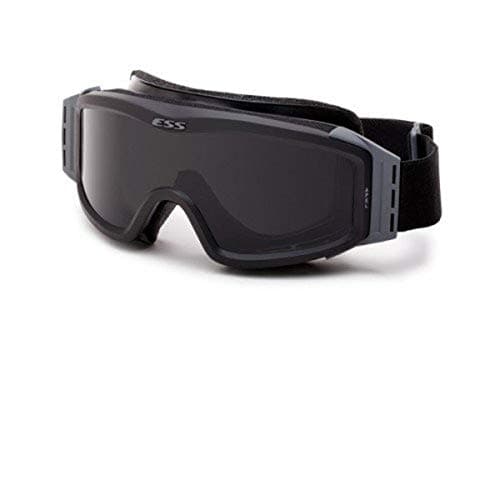
ESS Profile NVG Goggle
MIL-PRF-324328.0/10The only pair on this site with a published lens thickness: ESS states "extra-thick 2.8mm polycarbonate", behind MIL-PRF-32432 and EN 166, with the ClearZone FlowCoat dual coating. If you want the material and the thickness in writing, this is it.
$89.95Amazon#ad · Price as of November 2, 2026 · Disclosure for the link to ESS Profile NVG Goggle
Best cheap Z87.1+ pair to buy in bulk
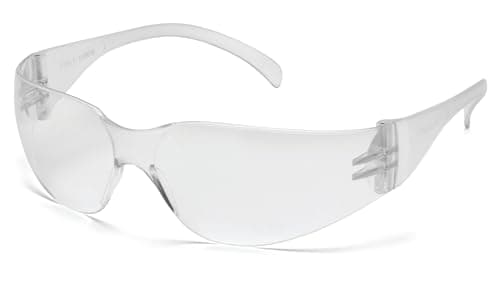
Pyramex Intruder
Z87.1+7.2/10The cheap end done properly: polycarbonate stated, ANSI/ISEA Z87.1-2020 + High Impact stated, seven tints and an optional H2MAX anti-fog coating. Proof that you do not need to spend to get the current edition of the standard.
$3.14Amazon#ad · Price as of November 2, 2026 · Disclosure for the link to Pyramex Intruder
Best polarized optics
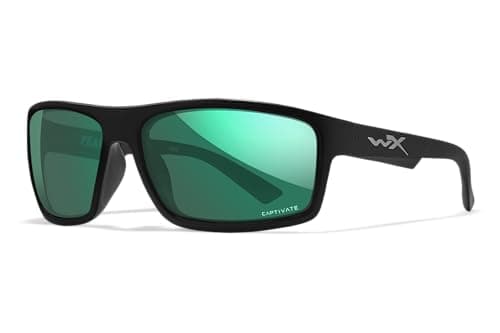
Wiley X WX Peak (CAPTIVATE Polarized)
Z87.1+7.1/10Wiley X publishes "shatterproof Selenite polycarbonate lenses" — a branded polycarbonate — with CAPTIVATE polarization. The pick when glare off water, a hood or a shop floor is the actual problem rather than clarity.
$191.75Amazon#ad · Price as of November 2, 2026 · Disclosure for the link to Wiley X WX Peak (CAPTIVATE Polarized)
Thickness, weight and the coating
Three practical consequences of the material choice that an optician may not raise unprompted.
Thickness. High-impact prescription lenses have a minimum center thickness, and Trivex's refractive index of 1.532 is marginally higher than standard plastic, so a given prescription comes out a little thinner than CR-39 and comparable to polycarbonate. Nobody in our source set publishes a side-by-side thickness for the same prescription in both materials, so we will not claim one. Ask your lab. Plano lenses are no better documented: even the best-specified pair on this site, reviewed on the Revision StingerHawk review, cites both impact standards by clause number and still publishes no lens thickness at all.
Weight. Trivex's 1.1 g/cm³ makes it the lightest corrective lens material in common use, per the source above. On a strong prescription in a large frame that difference is real. On a plano lens in a wraparound it is swamped by the frame — and in this category nobody publishes the frame weight either, which is the subject of best lightweight shooting glasses.
Coatings. Both materials are soft and both need a hard coat; neither is scratch-resistant on its own. Every scratch-resistance claim you read is a claim about a coating, not about the plastic underneath it, and the coatings that survive are the ones the maker names and describes — which is the whole argument of best scratch-resistant safety glasses. The same goes for anti-fog: see how to stop shooting glasses fogging.
Which one you should buy
If the real question underneath this one was whether your everyday prescription glasses will do for the range, the answer is on safety glasses vs normal glasses and the practical workarounds are on how to shoot with glasses. If it was whether your sunglasses will do, that is are sunglasses safe for shooting.
How Lens & Lead rates eyewear
How these picks were chosen
Every pair here is picked from the certification its maker publishes and repeats in its own wording ("meets", "certified", "tested to", "APEL"), the lens system and the tints in the box, whether the temples are described for ear muffs, and whether an Rx route exists — then scored on a public rubric that weights protection first. Every figure links to the page it came from, so you can confirm the protection before you buy. The standards themselves are explained on ANSI Z87.1 vs MIL-PRF-32432.
Scores are editorial judgments from that documented research, and the rating, the lens system and the fit are what move a pick. The rubric and its weights are published.
Questions
Frequently asked
Is Trivex better than polycarbonate for safety glasses?
Optically, yes: Trivex has an Abbe value of 43-45 against polycarbonate's 30, and it is lighter at 1.1 g/cm³. For toughness and availability polycarbonate wins — a retailer selling both describes Trivex as "nearly as durable", and essentially all off-the-shelf rated eyewear is molded polycarbonate. Buy Trivex when you are ordering prescription lenses, not when you are buying a pair off a shelf.
Is Trivex ANSI Z87.1 rated?
Z87.1 does not rate materials. It tests a complete protector — lens plus frame — and the marking belongs to that assembly. Trivex is offered as an impact-resistant option for prescription safety lenses, but whether a finished pair is Z87 or Z87+ depends on the frame, the lens thickness and the markings on both parts, not on the material name.
What is the Abbe value of polycarbonate?
30, per the retailer source we cite — the lowest of the common lens materials. That is why strong polycarbonate prescriptions can show color fringing toward the edge of the lens. Trivex sits at 43-45, which one source describes as clarity "virtually equivalent to CR-39 material".
Can you get Trivex shooting glasses?
Not as an off-the-shelf product, as far as our registry goes: none of the 47 pairs on this site is sold with a Trivex lens, and the ones that state a material state polycarbonate or a branded version of it. Trivex in shooting eyewear means prescription lenses ordered through an optical lab or a specialist sports-Rx maker.
Is Trivex scratch resistant?
No more than polycarbonate is. Both are soft plastics that rely on an applied hard coat for scratch resistance, and both are compatible with the usual coatings. Judge scratch resistance by the coating the maker names, not by the lens material.
Keep reading
Related on Lens & Lead
Receipts
Sources
- 20/20 Magazine — Trivex lenses and its material attributes ("Trivex material has an Abbe value of 45"; "engineered to be the lightest material (1.11g/cm3)"; "the index of 1.53"; "62-times the impact resistance of ordinary plastic lenses"; automatic UVA/UVB protection) (checked 2026-10-22)
- Rx Safety — Trivex lenses for safety glasses, retailer explainer ("The Abbe Value of polycarbonate is 30. Trivex boasts an Abbe Value of between 43-45"; "Refractive Index is 1.532"; "Density of 1.1 g/cm³ makes it the lightest corrective lens material in common use"; "Trivex is clearer and lighter than polycarbonate, yet it is also nearly as durable"; "Blocks 100% of the sun's harmful ultraviolet rays") (checked 2026-10-22)
- ISEA — ISEA publishes ANSI/ISEA Z87.1-2020 eye and face protection standard update (anti-fog criteria, relaxed optics, marking) (checked 2026-09-21)
- MSC Industrial Supply — Understanding ANSI Z87.1 (high-mass 500 g from 4 ft; high-velocity steel ball at 102 mph; Z87+ and U/L/W/H/D/X markings) (checked 2026-09-21)
- ESS EyePro — Profile NVG Black w/Clear & Smoke Gray page, SKU 740-0499 (ANSI Z87.1-2015, MIL-PRF-32432, EN 166, 2.8 mm polycarbonate, kit contents, Rx inserts, Outrigger strap, ClearZone FlowCoat) (checked 2026-09-21)
- Pyramex — Intruder frameless eyewear page (ANSI/ISEA Z87.1-2020+, CSA, EN 166, polycarbonate, tints, coatings) (checked 2026-09-21)
- Wiley X — WX Peak ACPEA19 page ("ANSI Z87.1+ Optical clarity and high mass/high velocity impact standards"; CAPTIVATE Polarized lenses; "Shatterproof Selenite Polycarbonate Lenses"; 100% UVA/UVB; Triloid nylon frame; Medium and Large fits; lifetime warranty; $200.00; "In Stock. Ships within 1 - 5 Business Days") (checked 2026-09-26)
Ratings, lens systems, fit notes and coatings come from the maker's own product pages and manuals (linked on every product), with the published safety standards behind them, and a labeled retailer or press page where the maker's own page was unavailable. Every buy button opens today's live Amazon price. Read the full method.