Ratings / Guide
Do safety glasses expire? No — but your pair may already be retired
There is no date stamped inside the temple and no standard that sets one. A rated pair is retired by its condition, not by the calendar, and the six things that retire one are all visible in five minutes on a kitchen table.
By Mike M.Updated Researched from maker specs & standards
#adLens & Lead earns from qualifying Amazon purchases. Prices are set by the retailer and change. A commission never decides a ranking. How we rate · Disclosure
There is no expiration date, and that is not an oversight
This question usually arrives one of two ways: someone finds a pair in a range bag and wonders whether five-year-old polycarbonate is still worth anything, or someone wants a number to put in a shop policy. The honest answer to both is that eyewear is not a fire extinguisher. There is no date molded inside the temple, no shelf life printed on the box, and no clause in the standard that retires a pair at some age.
That is deliberate. Polycarbonate does not have a cure date or a chemical clock the way a respirator cartridge or an epoxy does. An unused pair stored in a drawer in a case is, materially, the pair that left the factory. What changes is the surface and the frame, and that happens through use — so the standard is written around performance and marking rather than around time. ANSI/ISEA Z87.1-2020 tightened anti-fog criteria, relaxed some optical requirements and specified marking; it did not introduce an expiry.
Which leads to the useful reframing: the question is not how old is this pair, it is what has this pair been through. A six-month-old pair that lives loose in a tool bag is more likely to be retired than a five-year-old pair that has lived in a case.
What the rules actually say
It is worth being precise here, because a lot of safety-blog writing invents requirements that do not exist.
OSHA sets out its eye-protection requirements in 29 CFR 1910.133, and they are about selection rather than age. The employer must ensure eye protection "that provides side protection when there is a hazard from flying objects" (1910.133(a)(2)); that an employee who wears prescription lenses in an eye-hazard operation "wears eye protection that incorporates the prescription in its design, or wears eye protection that can be worn over the prescription lenses" (1910.133(a)(3)); and that eye and face PPE "shall be distinctly marked to facilitate identification of the manufacturer" (1910.133(a)(4)). There is no replacement interval in the rule, and no expiry.
Published safety guidance, on the other hand, is unambiguous about condition. Ohio State University Extension's eye-protection fact sheet for trainers and supervisors states it in four words — "Discard pitted or scratched eyewear" — and adds "Replace cracked, pitted, or damaged goggles or spectacles". That is the operative standard for a private shooter: not a date, a condition.
The manufacturers, meanwhile, often go the other way and warrant the frame for a very long time. Wiley X states a lifetime warranty on the Saber Advanced, the WX Vapor, the WX Gravity and the WX Peak; NoCry states a limited lifetime warranty; SSP Eyewear states a lifetime warranty plus a 60-day guarantee. Read those carefully, because a lifetime frame warranty is a promise about manufacturing defects — not a statement that a scratched lens is still protective.
The six checks
Take the pair to a window, in daylight, and work through these in order. Any single failure retires the pair, or at minimum the lens.
- Scratches and pits in your line of sight. Hold the lens so light rakes across it at an angle, the way you would check a car's paint. Fine haze everywhere is wear; a cluster of pits, or any scratch you can feel with a fingernail, is a retirement. The central zone matters more than the edges.
- Crazing. A web of fine cracks in the lens surface, often near the edges or around a mounting point, usually from solvents, aggressive cleaners, DEET or heat. Crazing is a structural change, not a dirty lens, and it does not clean off.
- A cracked, sprung or deformed frame. Sit the glasses upside down on a flat table. They should sit on both temple tips evenly. A frame that rocks, a temple that has lost its spring, a hinge with slop, a nose piece torn away — all of it moves the lens out of the position the rating was tested in.
- A lens that no longer locks in. On any interchangeable-lens frame, the lens must seat and lock positively. Z87.1's high-impact test is about an assembled frame retaining its lens; a lens you can rock in its channel has already failed the premise.
- No Z87 mark. Look for "Z87" or "Z87+" on the lens or the temple, with the maker's mark. If it was never there, it was never the thing you thought you owned; if the marking has been polished away, you can no longer prove what you are wearing. How to read the full set of markings is on what Z87 means.
- Any impact it has already taken. See the section below; this one is the least intuitive and the most important.
Why a scratch is a safety problem and not a cosmetic one
Two separate reasons, and most writing on this topic only gives the first.
Optics. A scratched lens scatters light. Against a bright sky, or under range lights, that scatter turns into veiling glare — the whole field of view washes out slightly and low-contrast detail disappears first. On a clay field, the thing that disappears is the edge of an orange target against trees. At a pistol bay it is the front sight against a shadowed target. The lens is still "working"; you are just shooting worse, and you will blame your eyes rather than the $12 you have not spent.
Surface integrity. This is the one that matters for protection. Polycarbonate gets its remarkable impact performance from being able to deform and absorb energy, and deep scratches and pits are stress concentrations — initiation sites, in the language of materials failure. A lens with a field of pits from grinding sparks or close steel is not the lens that passed the test. Nobody publishes a chart that says "this many scratches equals this much loss", and we are not going to invent one; the honest statement is that the published guidance says discard pitted or scratched eyewear, and the reason is sound.
Coatings wear out long before the lens does
The part of modern eyewear with the shortest working life is the few microns on the outside and inside of the lens. Makers are specific about these when they are good: ESS names ClearZone FlowCoat, anti-scratch outside and anti-fog inside; Pyramex names H2X and H2MAX; DEWALT names ToughCoat plus an anti-fog coating; Uvex claims a premium anti-fog "permanently bonded to lens for up to 60X longer fog-free performance"; Edge advertises a 3x anti-scratch coating.
None of them publish a life in hours, so neither will we. What is reliably true is the failure order: the anti-fog goes first, because it is on the inside where fingers, shirts and sweat reach it; then the hard coat hazes; then the lens itself pits. A pair that has started fogging in conditions it used to handle has usually lost its interior coating, and no amount of cleaning brings that back. If your pair is fogging and you are not sure whether it is the coating or the conditions, work through the fogging guide first — it is a cheaper diagnosis than a new pair.
The single biggest killer of both coatings is dry-wiping. A lens wiped dry with a shirt tail is being sanded with whatever dust is on the shirt and on the lens. Rinse, then blot with a clean microfiber.
Does the UV protection fade?
In polycarbonate, UV absorption is inherent to the material rather than a coating that can wear off, which is why makers quote figures like 99% or 100% UVA/UVB as a property of the lens. So the honest answer is: we have seen no published maker or standards statement that a polycarbonate safety lens loses its UV blocking with age, and we are not going to assert one in either direction beyond that. What you can see is the lens yellowing or going brittle after years of hard sun and heat — a dashboard, a truck toolbox in Arizona — and that is a visible condition failure under check two and check three above. Retire on what you can see.
After an impact: retire it, even if it looks fine
This is the rule people break. If a pair has taken a real hit — a case bounced back off a wall into the lens, a chunk of clay, a BB, a fragment off a steel plate, a chip from a grinder, a fall onto concrete under your boot — replace it, or at least replace that lens, whether or not you can find a mark.
The reasoning is the same as for a climbing rope or a motorcycle helmet: these things work by absorbing energy once, and some of that absorption is permanent deformation you cannot see. Z87.1's high-impact test fires a quarter-inch steel ball at roughly 150 ft/s at an assembled frame and asks that the lens not fracture and not come out of the frame; MIL-PRF-32432 does the same thing with a far more energetic fragment simulator. Both are single-event tests. A pair is certified to survive the hit, not to survive it and then be as good as new.
One honest exception: if your eyewear is an interchangeable kit, this is a lens replacement, not a pair replacement — assuming the frame passes check three. The pairs that make this easy are on the lens-kit ranking.
A schedule that actually works
Because the real failure mode is not noticing, a calendar is still useful — not as an expiry, but as a prompt to run the six checks. What we use, and the reasoning rather than a rule we made up and dressed as a standard:
- Every range trip: ten seconds. Look through them at the light before you put them on.
- Twice a year: the full six checks on every pair you own, including the loaners. Published guidance for workplaces commonly suggests an annual inspection; twice a year costs nothing and catches a coating failure before a season.
- Immediately: after any impact, any solvent or DEET contact, any time a pair has been loose in a bag with tools, or any time you notice new fogging in old conditions.
- Loaner and youth pairs: treat these as consumables. They get dropped, sat on, cleaned with shirts and stored badly, and they are worn by the people least likely to report a problem. A fresh cheap rated pair every season for a kid is a better purchase than a nice pair kept for three years.
What to replace it with
The replacement decision splits cleanly in two, and both halves are legitimate buys rather than a compromise.
Replace the pair, cheaply and often. If your eyewear is a single-lens frame, the correct response to a scratched lens is a new frame, and the cheapest way to make that painless is to own a rated frame that costs less than a box of ammunition. Buy several, keep one in every bag, and stop nursing them.
Replace the lens, not the frame. If you own a kit frame with a tool-free lens system, a scratched lens is a spare-lens problem. That is a real argument for buying a kit in the first place: the expensive part — the frame, the certification, the fit — stays, and the consumable part gets swapped.
Our picks for this
One of each: the pair you replace, and the pair whose lens you replace
Both of these are already on this site's rankings and both state their rating on the maker's page. Prices come only from the live price layer — we never print a number here.
Best cheap Z87.1+ pair to buy in bulk
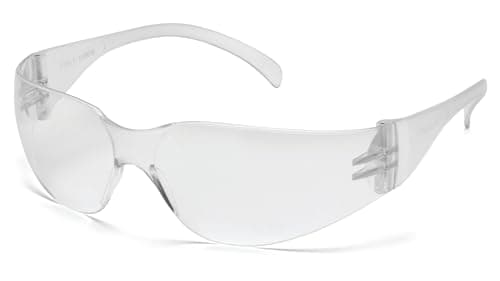
Pyramex Intruder
Z87.1+7.2/10The consumable: ANSI/ISEA Z87.1-2020 with the high-impact plus, polycarbonate, seven tints, cheap enough to replace the moment it hazes rather than nursing it. No MIL-PRF wording, and it does not claim any.
$5.03Amazon#ad · Price as of October 8, 2026 · Disclosure for the link to Pyramex Intruder
Best APEL-listed kit
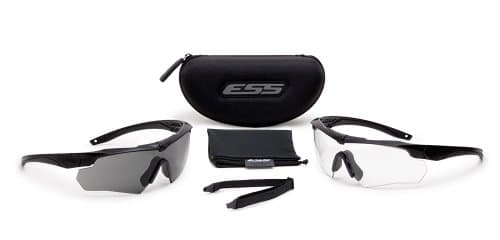
ESS Crossbow 2LS Kit
APEL8.6/10The frame you keep: APEL-listed with MIL-PRF-32432A stated on the APEL kit page, a patented DedBolt lens lock for tool-free swaps, and clear plus smoke lenses in the box — so a scratched lens is a swap, not a purchase.
$101.55Amazon#ad · Price as of October 8, 2026 · Disclosure for the link to ESS Crossbow 2LS Kit
If the pair being retired was a prescription one, the replacement question is different and more expensive — the routes and roughly what each costs are on prescription shooting glasses cost.
Making the next pair last
Four habits, in order of how much they matter.
Store them in a case. The Ohio State guidance is to "store clean eye wear in a closed, dustproof case", and that single habit is worth more than every coating on the market. A lens that lives loose in a bag with a multi-tool is being lapped every time you drive.
Rinse before you wipe. Water first to float the grit off, then a clean microfiber. Never dry shirt, never paper towel, never the hem of a sweaty t-shirt.
Keep solvents away. Bore cleaner, brake cleaner, acetone, aggressive glass cleaner with ammonia, and insect repellent with DEET all attack polycarbonate and the coatings on it. This is the main cause of crazing on an otherwise healthy pair.
Do not leave them in a hot car. Heat plus a dashboard is how a frame goes soft and a lens goes brittle, and it is the one failure mode that genuinely is about time passing.
Finally, keep the markings legible. If you cannot read the Z87 on the temple, you cannot tell the next person — or yourself in two years — what you are wearing, and the whole basis for trusting it is the mark plus the maker's published rating. That is also how you check a pair you already own: how to tell if glasses are ballistic rated walks the check end to end.
How Lens & Lead rates eyewear
How these picks were chosen
Every pair here is picked from the certification its maker publishes and repeats in its own wording ("meets", "certified", "tested to", "APEL"), the lens system and the tints in the box, whether the temples are described for ear muffs, and whether an Rx route exists — then scored on a public rubric that weights protection first. Every figure links to the page it came from, so you can confirm the protection before you buy. The standards themselves are explained on ANSI Z87.1 vs MIL-PRF-32432.
Scores are editorial judgments from that documented research, and the rating, the lens system and the fit are what move a pick. The rubric and its weights are published.
Questions
Frequently asked
Do safety glasses expire?
No. No standard assigns safety eyewear a shelf life or an expiration date, and OSHA's eye-protection rule, 29 CFR 1910.133, contains no replacement interval. Condition retires a pair: scratches or pits in your line of sight, crazing, a damaged frame, a lens that no longer locks in, missing markings, or a hit it has already taken.
How long do safety glasses last?
As long as they stay in good condition, which depends entirely on use and storage — months for a pair that lives loose in a tool bag, years for one kept in a case. Run a full inspection twice a year and replace on the first failure rather than on a date.
Should I replace safety glasses after they are hit?
Yes — replace the pair, or at least the lens, even if you cannot see damage. The ANSI high-impact and MIL-PRF ballistic tests are single-event tests: the eyewear is certified to survive one hit, not to survive it and be as good as new. On an interchangeable-lens frame this is a lens swap rather than a new pair.
Are scratched safety glasses still safe?
Published safety guidance says to discard pitted or scratched eyewear, for two reasons: scratches scatter light and cost you contrast exactly where you need it, and deep scratches and pits are stress concentrations in a lens whose protection comes from deforming without fracturing. Replace, or swap the lens.
Can you polish scratches out of safety glasses?
Don't. Polishing removes the hard coat and the anti-fog treatment, changes the lens thickness in the area you work on, and does nothing about a pit's depth. A new rated frame costs less than almost any other item in your range bag.
Does the UV protection in safety glasses wear out?
UV absorption in polycarbonate is a property of the material rather than a surface coating, and we have seen no maker or standards statement that it fades with age — so we will not claim it does. What you can judge is visible: yellowing, brittleness or crazing after years of heat and sun are condition failures, and they retire a pair on their own.
Keep reading
Related on Lens & Lead
- What does Z87 mean?How to read every marking on the temple you are inspecting.
- How to tell if glasses are ballistic ratedThe five-step check on a pair you already own.
- Best interchangeable-lens shooting glassesThe frames where a scratched lens is a swap, not a purchase.
- How to stop shooting glasses foggingDiagnose a dead anti-fog coating before you buy a replacement.
- Best shooting glasses under $50Where to buy the consumable pair, by the box.
- Best airsoft eye protectionThe discipline hardest on a lens, and the goggles built for it.
Receipts
Sources
- Ohio State University Extension, Agricultural Safety and Health Program — Ohioline AEX-892235, Personal Eye Protection for Trainers and Supervisors ("Discard pitted or scratched eyewear"; "Replace cracked, pitted, or damaged goggles or spectacles"; "Store clean eye wear in a closed, dustproof case") (checked 2026-10-08)
- OSHA — 29 CFR 1910.133 Eye and face protection (checked 2026-09-21)
- ISEA — ISEA publishes ANSI/ISEA Z87.1-2020 eye and face protection standard update (anti-fog criteria, relaxed optics, marking) (checked 2026-09-21)
- MSC Industrial Supply — Understanding ANSI Z87.1 (high-mass 500 g from 4 ft; high-velocity steel ball at 102 mph; Z87+ and U/L/W/H/D/X markings) (checked 2026-09-21)
- Wikipedia — Ballistic eyewear (MIL-PRF-31013 0.15 cal T37 at 640–660 ft/s for spectacles; 0.22 cal at 550–560 ft/s for goggles; Z87 vs Z87+ marking) (checked 2026-09-21)
- Pyramex — Intruder frameless eyewear page (ANSI/ISEA Z87.1-2020+, CSA, EN 166, polycarbonate, tints, coatings) (checked 2026-09-21)
- ESS EyePro — Crossbow 2LS Kit page (ANSI Z87+ 2020, ClearZone FlowCoat, U-Rx / Vice inserts, Tri-Tech Fit) (checked 2026-09-21)
- ESS EyePro — Crossbow Black 2x w/Clear & Smoke Gray APEL page (ANSI Z87.1+ 2015, MIL-PRF-32432A, APEL) (checked 2026-09-21)
- Wiley X — Saber Advanced product page (ratings, frame measurements, warranty) (checked 2026-09-21)
- NoCry — EyeArmor+ Adjustable Anti-Fog page (ANSI/ISEA Z87.1-2020, EN 166, adjustable temples, anti-fog/anti-scratch, UV380) (checked 2026-09-21)
- SSP Eyewear — Top Focal AST Kit page (ANSI Z87.1 rated ballistic lenses, 3 lenses, +1.00 to +3.00 top focal, NVR Fog, warranty) (checked 2026-09-21)
- Honeywell Store — Uvex Stealth OTG S3970HS ("Meets ANSI Z87.1-2003 and CSA Z94.3 standards"; "Unique Stealth OTG (Over-the-Glass) design fits comfortably over most prescription eyewear"; "Premium anti-fog coating permanently bonded to lens for up to 60X longer fog-free performance"; indirect ventilation system; pivoting quick-adjust neoprene headband) (checked 2026-09-26)
- DEWALT — DPG82 Concealer goggle page (ANSI Z87.1+, polycarbonate, ToughCoat, anti-fog, 99.9% UVA/UVB, strap, vents) (checked 2026-09-21)
- Safety Glasses USA — Edge Hamel listing ("ANSI Z87.1+2010, Military Ballistic MCEPS GL-PD 10-12, and EN166 F CE standards"; "3x Anti-Scratch lens coating"; Vapor Shield anti-fog) (checked 2026-09-26)
Ratings, lens systems, fit notes and coatings come from the maker's own product pages and manuals (linked on every product), with the published safety standards behind them, and a labeled retailer or press page where the maker's own page was unavailable. Every buy button opens today's live Amazon price. Read the full method.