Lens Tints / Guide
Vermillion and rose lenses: the two warm tints, what each is actually for, and where they fail
Vermillion is the tint competitive clay shooters argue about and everyone else mispronounces. It has two real uses — one outdoors and one indoors — and three situations where it is the wrong lens entirely.
By Mike M.Updated Researched from maker specs & standards
#adLens & Lead earns from qualifying Amazon purchases. Prices are set by the retailer and change. A commission never decides a ranking. How we rate · Disclosure
What the two tints are
Both are warm filters in the pink-red family, and both work by subtraction. A vermillion lens absorbs a substantial slice of the yellow-green part of the spectrum and transmits red and orange strongly. A rose lens does the same thing more mildly, leaving more total light coming through. That is the entire difference, and everything below follows from it.
The word itself causes confusion because it is spelled several ways and because retailers use it loosely for anything pinkish. In shooting eyewear it has a settled meaning: the strong pink-red filter Honeywell, Radians and the clay lens houses all sell under that name. Rose is the lighter one. Neither is the same as amber, which cuts blue rather than green and raises overall contrast in flat light rather than separating colours — the distinction matters and it is laid out across the lens colour guide.
Use one: orange against green
The outdoor case is the famous one. A clay target is a bright orange dome; a sporting clays course puts trees, hedges and summer grass behind it; and a lens that kills green while passing orange does the separating for you. Against a treeline on an overcast day, vermillion is the strongest tool in the box, and rose is the version for the same background with more light available.
The thing worth understanding is that the lens is not improving the target. It is degrading the background. That is why the effect is dramatic against foliage and almost absent against sky: there is no green in a grey overcast to remove. It also explains why a vermillion lens looks so strange when you first put it on — the whole world goes warm and the grass goes dull, and after ten minutes your brain adapts and you stop noticing anything except that the bird is easier to pick up.
The full station-by-station treatment, including which backgrounds want which tint, is on best lens colour for sporting clays and trap, and the field-hunting version is on best glasses for upland hunting.
Use two: fluorescent and halogen indoor ranges
This is the use almost nobody mentions, and it comes straight off Honeywell's own page: the vermillion lens in the Genesis Sharp-Shooter kit is named for fluorescent and halogen indoor ranges. That is a specific and defensible claim, because those light sources do not emit a smooth spectrum. They spike in some bands and fall away in others, and the result indoors is a flat, slightly sickly scene where a black paper target on a grey backstop has very little to separate it.
A warm filter in that light does two useful things. It knocks down the greenish cast fluorescent tubes throw, and it raises apparent contrast between the target's black rings and the paper. What it does not do is add light — and that is the catch, because an indoor bay is usually darker than you think. The decision between a clear lens and a warm one for indoors is worked through properly on best lens colour for an indoor range, and the honest summary is: clear first, vermillion if your range is fluorescent-lit and you have the lens.
Rose: the version you can wear all day
Rose gets dismissed as weak vermillion, and that undersells it. Because it removes less light, it is the one tint in the warm family you can wear from a dawn hunt into the middle of the day without feeling like you are looking through something. On Walker's IKON Tanker it is offered alongside amber, clear and smoke, which tells you where Walker's thinks it sits: a general-purpose field lens rather than a competition filter.
Three situations where rose is the better choice than vermillion. A day whose light changes a lot, because a strong filter is wrong half the time. A shooter who finds strong tints tiring — some people get a mild headache from a heavy warm filter and it is not worth arguing with. And any case where you need to read something: a score card, a chronograph, a phone screen. Vermillion makes colour-coded anything harder to read; rose mostly does not.
Three places both tints fail
A bright open trap field. There is no green behind the target, so the filter has nothing to remove, and all you have done is reduce transmission. Amber is the answer in bright open sky and yellow in flat light. The trap page ranks accordingly.
Low light. Dawn in timber, dusk on a pond, an underlit indoor bay. In all of them the constraint is how much light reaches your eye, and every filter makes that worse. Clear or yellow, and nothing else — this is the argument on yellow vs clear.
In front of an illuminated optic. A red dot is a red emitter and a warm lens passes red happily, so the dot itself is fine. The problem is that a strong warm filter flattens everything around the dot, so the dot floats on a washed scene and you lose the target edge you were aiming at. If you shoot a red dot or a lit reticle, test before you commit — and note the separate and worse problem a polarizer causes, covered on should shooting glasses be polarized.
Picks
Our picks for this
The four rated routes into a warm lens
Best value ballistic-rated pair
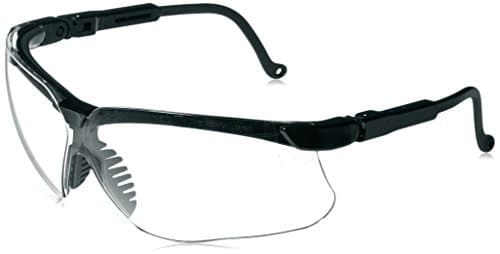
Howard Leight Genesis Sharp-Shooter
Military V08.1/10The only pick whose maker names the vermillion lens for a specific job — fluorescent and halogen indoor ranges. Check the SKU: Amazon stocks the single clear lens; the three-lens combo kit is a Honeywell-direct order.
$15.97Amazon#ad · Price as of October 10, 2026 · Disclosure for the link to Howard Leight Genesis Sharp-Shooter
Best frameless clay tints
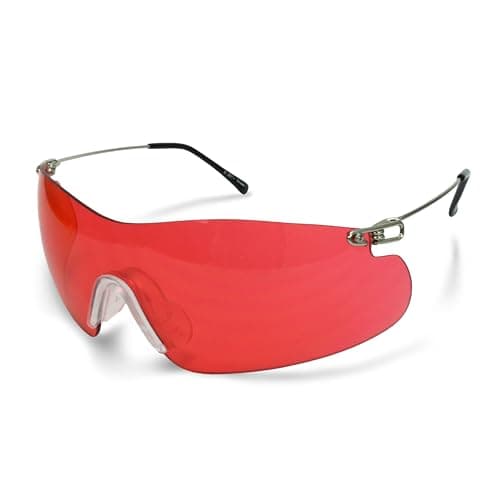
Radians Clay Pro
Z87.15.9/10Vermillion on a frameless frame with thin metal temples — the classic clay shape. The Z87.1 wording comes from the retailer, not from Radians' own page.
$18.73Amazon#ad · Price as of October 10, 2026 · Disclosure for the link to Radians Clay Pro
Best grip for a hot range
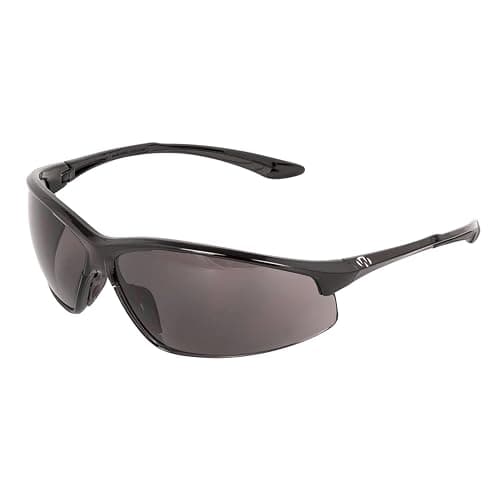
Walker's IKON Tanker
Z87.1+6.2/10Rose on a grippy full frame that exceeds ANSI Z87.1-2010 high impact: the cheapest way to try the warm family, and the one you can wear all day.
$21.99Amazon#ad · Price as of October 10, 2026 · Disclosure for the link to Walker's IKON Tanker
Best premium clay kit
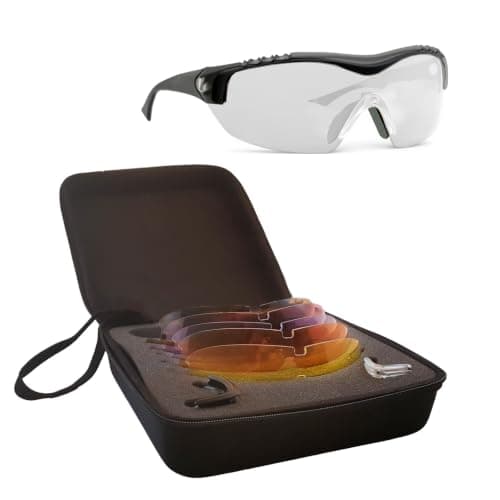
SSP Eyewear Methow 6 HD Kit
Z87.1+6.8/10Six interchangeable HD lens colours in one box from a collection SSP states meets ANSI/ISEA Z87.1-2015 high impact — the deepest tint set on this site, and Rx-able.
$342.53Amazon#ad · Price as of October 10, 2026 · Disclosure for the link to SSP Eyewear Methow 6 HD Kit
How to buy the tint without buying the wrong frame
The mistake here is buying a tint and inheriting a frame that does not suit how you shoot. Three checks before you order.
Does it take other lenses? A warm tint is a second lens, not a first. The Genesis and the Methow are kit frames; the Clay Pro and the Tanker are one lens per pair, which means a second purchase for indoor or low light. The kits are compared on best interchangeable lens shooting glasses.
Will it clear your muffs? Clay shooters mostly wear muffs, and a clays frame with thin metal temples — the Clay Pro — is one of the best things on this site under a muff cup. A rubberised full frame like the Tanker is one of the worst. That interaction is on best shooting glasses for ear muffs.
Is the rating from the maker or a retailer? Honeywell, Walker's and SSP publish their impact statements themselves. The Clay Pro's comes from a retailer listing and carries no high-impact plus, which is why it scores lowest here on protection despite being the best shape. If you want the rating to come from the maker's own page, that narrows the warm family to three products — and the test for any pair is on how to tell if glasses are ballistic rated.
How Lens & Lead rates eyewear
How these picks were chosen
Every pair here is picked from the certification its maker publishes and repeats in its own wording ("meets", "certified", "tested to", "APEL"), the lens system and the tints in the box, whether the temples are described for ear muffs, and whether an Rx route exists — then scored on a public rubric that weights protection first. Every figure links to the page it came from, so you can confirm the protection before you buy. The standards themselves are explained on ANSI Z87.1 vs MIL-PRF-32432.
Scores are editorial judgments from that documented research, and the rating, the lens system and the fit are what move a pick. The rubric and its weights are published.
Questions
Frequently asked
What are vermillion lenses for?
Two things. Outdoors, cutting yellow-green so an orange clay separates from trees and grass. Indoors, Honeywell names its vermillion Genesis lens specifically for fluorescent and halogen range lighting, where a warm filter lifts contrast in a flat, spiky light.
What is the difference between vermillion and rose lenses?
Strength. Vermillion is the stronger pink-red filter: more green removed, more effect on an orange target, less light through. Rose removes less and transmits more, which makes it the one you can wear all day and in changing light.
Are vermillion lenses good for trap shooting?
Only when the trap house sits against trees. On a bright open field the target is against sky, there is no green to remove, and amber or yellow will serve you better.
Can you use vermillion lenses at an indoor range?
Yes, and Honeywell recommends it for fluorescent and halogen lighting. Bear in mind an indoor bay is often darker than it looks, so a clear lens remains the default and vermillion is the upgrade for a fluorescent-lit range.
Keep reading
Related on Lens & Lead
Receipts
Sources
- Howard Leight Shooting Sports — Genesis Sharp-Shooter Combo Kit page (ANSI Z87.1-2010 high impact, CSA Z94.3, "Military V0" on clear/amber, Uvextreme, 3 lenses) (checked 2026-09-21)
- Radians — Clay Pro Shooting Glass page (frameless, metal temples, style codes) (checked 2026-09-21)
- Full Source — Radians Clay Pro listing ("meet ANSI Z87.1", amber and vermillion lenses, thin metal temples) (checked 2026-09-21)
- Full Source — Radians Clay Pro listing, stock re-check (Vermillion RAD-CP5780CS and Amber RAD-CP5740CS both listed and active; "Most Radians Clay Pro glasses meet ANSI Z87.1 standards"; "Non-obstructive view with thin metal temples and a frameless lens design") (checked 2026-10-01)
- Walker's — IKON Tanker Glasses page (ANSI Z87.1-2010 high impact, MCEPS GL-PD 10-12, TPR temples) (checked 2026-09-21)
- SSP Eyewear — Methow shooting eyewear collection (3 XHD kit, NVR Fog a-EYE lenses, RX-able) (checked 2026-09-21)
- SSP Eyewear — Sportsman collection page ("All lenses meet ANSI/ISEA Z87.1-2015 specifications for high impact protection") (checked 2026-09-21)
- MSC Industrial Supply — Understanding ANSI Z87.1 (high-mass 500 g from 4 ft; high-velocity steel ball at 102 mph; Z87+ and U/L/W/H/D/X markings) (checked 2026-09-21)
Ratings, lens systems, fit notes and coatings come from the maker's own product pages and manuals (linked on every product), with the published safety standards behind them, and a labeled retailer or press page where the maker's own page was unavailable. Every buy button opens today's live Amazon price. Read the full method.