Lens Tints / Guide
Purple lens shooting glasses: what the tint does, and why almost nobody rated sells one
Purple is a real and useful shooting tint. It is also almost absent from eyewear that publishes an impact rating, which puts a buyer in a specific and solvable bind.
By Mike M.Updated Researched from maker specs & standards
#adLens & Lead earns from qualifying Amazon purchases. Prices are set by the retailer and change. A commission never decides a ranking. How we rate · Disclosure
The direct answer
If you searched for purple lens shooting glasses, you were almost certainly sent here by a clay shooter or a forum thread, and the advice was not wrong. Purple is a genuine competition tint. The problem is a supply one: the lens houses that sell purple and violet filters build them for clay competitors, and the mainstream safety and shooting eyewear makers whose certification pages we can actually read — Pyramex, Radians, Walker's, Honeywell, Wiley X, ESS, Edge, Revision — do not list a purple lens among their tints. We checked every tint list behind every product on this site. There is amber, vermillion, rose, yellow, copper, G-15, smoke, clear, infinity blue and several mirrors. There is no purple.
That leaves two honest options and this page covers both: buy the rated neighbour, which is vermillion or rose, or buy a purple lens from a competition lens house and accept that you may not be able to read a published impact rating for it. This site will always point you at the first.
What a purple filter actually does
Every shooting tint works the same way: it removes part of the spectrum so the rest stands out. The target is not made brighter — the background is made duller in the colours the target does not contain.
An orange clay sits in the red-orange part of the spectrum. Grass, leaves and summer foliage sit in the yellow-green part. So any lens that absorbs yellow-green while transmitting red makes an orange target separate from a green background. Vermillion does this. Rose does this slightly more gently. Purple and violet do it harder, and they also pass blue, which keeps a sky looking natural instead of muddy — that combination is why clay competitors like it against heavy green.
| Tint | What it cuts | What it lifts | Rated pair available? |
|---|---|---|---|
| Purple / violet | Yellow-green, hard | Orange and red, with blue kept natural | Not on this site |
| Vermillion | Yellow-green | Orange and red | Yes — Radians Clay Pro, Honeywell Genesis lens |
| Rose | Yellow-green, gently | Orange, with a warmer overall scene | Yes — Walker's IKON Tanker |
| Amber | Blue | General contrast in flat light | Yes — most kits |
| Smoke | Everything, evenly | Nothing | Yes, and it is the wrong lens here |
Editorial matrix describing how each filter family transmits colour. The tint availability column is from the lens lists on the maker and labeled retailer pages cited below. The full tint-by-light treatment is on the lens colour guide.
When purple is the right tint
Purple earns its reputation in a narrow set of conditions, and it is worth knowing them because if your conditions are not these, you are chasing a tint you do not need.
Orange targets against heavy green. A wooded sporting-clays course in high summer is the classic case: trees behind every station, a bright orange dome crossing them, and a tint that kills green doing most of the work for you.
Bright conditions where amber is too flat. Amber raises contrast across the whole scene, but on a vivid green background it does not separate colours — it just makes everything warmer. A purple or vermillion lens is doing something specifically to the background.
Not trap, mostly. On a trap field you are looking at sky, not foliage, and there is no green to cut. Yellow and amber are the right answers there, which is exactly what the trap page recommends. The same goes for an indoor range, where the question is transmission and fluorescent lighting rather than background colour — that is on the indoor range lens page.
Why rated purple lenses are so rare
Two reasons, and the second is the important one. The first is simply market size: purple is a competition clay tint, and competition clay is a small slice of a market dominated by industrial safety eyewear. Pyramex and Honeywell sell millions of pairs in clear and gray; nobody is tooling a purple polycarbonate run for a few thousand clay shooters.
The second is that specialist clay lens houses sell into a market that does not demand an ANSI statement. Their customer is shooting registered targets with a shotgun on an open field, and the lens is sold as an optical tool rather than as personal protective equipment. That is a legitimate business, and it is why so many purple and violet shooting lenses carry no Z87 claim you can check. It also means that if you buy one, you are stepping off the evidence ladder this whole site is built on — the ladder is explained on ANSI Z87.1 vs MIL-PRF-32432.
Picks: the rated tint that does the same job
Our picks for this
Vermillion and rose, with a rating you can read
Best frameless clay tints
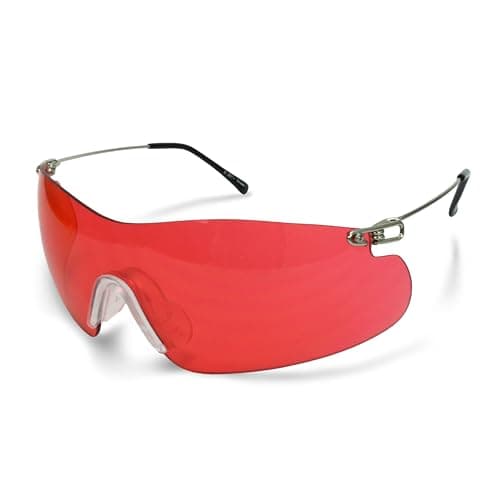
Radians Clay Pro
Z87.15.9/10The closest thing to purple you can buy with a rating attached: a vermillion lens on a frameless frame with thin metal temples. The Z87.1 wording is a retailer's, not Radians' own.
$18.73Amazon#ad · Price as of October 10, 2026 · Disclosure for the link to Radians Clay Pro
Best grip for a hot range
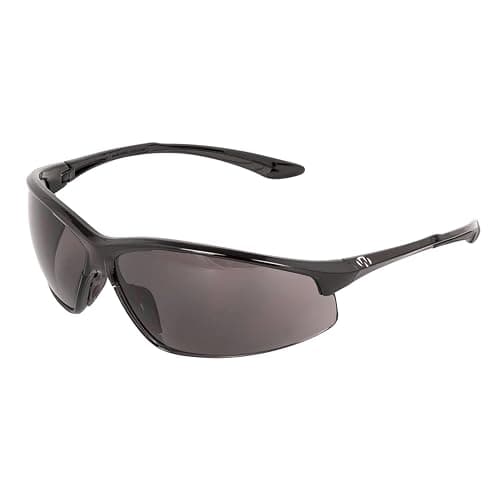
Walker's IKON Tanker
Z87.1+6.2/10Rose on a grippy full frame that exceeds ANSI Z87.1-2010 high impact — a gentler version of the same effect, and the cheapest route into the warm family.
$21.99Amazon#ad · Price as of October 10, 2026 · Disclosure for the link to Walker's IKON Tanker
Best value ballistic-rated pair
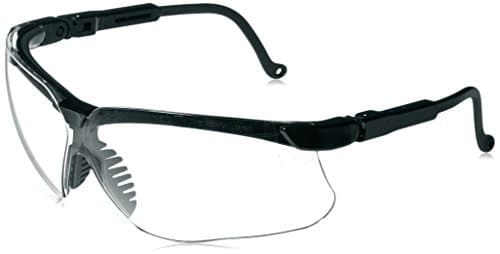
Howard Leight Genesis Sharp-Shooter
Military V08.1/10Honeywell sells a vermillion lens for the Genesis and names it for fluorescent and halogen indoor ranges; the frame states Z87.1-2010 high impact and a military V0 pass on clear and amber.
$15.97Amazon#ad · Price as of October 10, 2026 · Disclosure for the link to Howard Leight Genesis Sharp-Shooter
If you want several warm tints in one box rather than one lens, the kits are ranked on best interchangeable lens shooting glasses — the SSP Methow ships six HD colours and is the deepest tint set on this site.
If you are determined to buy purple
Three things to do, in order. First, check the frame rather than the lens: if your frame takes interchangeable lenses from the same maker, a specialist tint is a lens purchase, not a new pair, and you keep whatever rating the frame and lens system was tested with. Second, read the lens page for a standard — "polycarbonate" and "shatterproof" are not standards, and the difference is explained on Z87 vs Z87+. Third, if the answer is that no standard is stated, keep the purple lens for registered clay targets on an open field and keep a rated clear or vermillion pair in the bag for everything else.
That last point is not a hedge. Most shooters who own a purple competition lens also own a rated pair, and they swap. Buying one lens to cover a trap line, a wooded clays course, an indoor bay and a day in the shop was never going to work anyway — which is the argument behind yellow vs clear and most of this hub.
How Lens & Lead rates eyewear
How these picks were chosen
Every pair here is picked from the certification its maker publishes and repeats in its own wording ("meets", "certified", "tested to", "APEL"), the lens system and the tints in the box, whether the temples are described for ear muffs, and whether an Rx route exists — then scored on a public rubric that weights protection first. Every figure links to the page it came from, so you can confirm the protection before you buy. The standards themselves are explained on ANSI Z87.1 vs MIL-PRF-32432.
Scores are editorial judgments from that documented research, and the rating, the lens system and the fit are what move a pick. The rubric and its weights are published.
Questions
Frequently asked
What are purple lens shooting glasses for?
Cutting yellow-green so an orange clay target separates from grass and foliage, while still passing blue so the sky looks natural. It is a sporting-clays tint, used against heavy green backgrounds rather than against open sky.
Are purple lenses better than vermillion for trap shooting?
Neither is the right answer for trap. On a trap field the target is against sky, so there is no green to cut; yellow in flat light and amber under bright sky are the tints that help. Purple and vermillion are for targets crossing foliage.
Can you get Z87 rated purple shooting glasses?
Not from any maker whose tint list we could read. Pyramex, Radians, Walker's, Honeywell, Wiley X, ESS, Edge and Revision all publish their lens options and none of them lists purple. Vermillion is the rated tint that does the same job.
Is purple the same as vermillion?
They are neighbours, not twins. Both cut green to lift orange; purple does it harder and keeps more blue, vermillion is warmer overall. In practice a vermillion lens gets most of the way to the same result on an orange target against trees.
Keep reading
Related on Lens & Lead
Receipts
Sources
- Radians — Clay Pro Shooting Glass page (frameless, metal temples, style codes) (checked 2026-09-21)
- Full Source — Radians Clay Pro listing ("meet ANSI Z87.1", amber and vermillion lenses, thin metal temples) (checked 2026-09-21)
- Walker's — IKON Tanker Glasses page (ANSI Z87.1-2010 high impact, MCEPS GL-PD 10-12, TPR temples) (checked 2026-09-21)
- Howard Leight Shooting Sports — Genesis Sharp-Shooter Combo Kit page (ANSI Z87.1-2010 high impact, CSA Z94.3, "Military V0" on clear/amber, Uvextreme, 3 lenses) (checked 2026-09-21)
- SSP Eyewear — Methow shooting eyewear collection (3 XHD kit, NVR Fog a-EYE lenses, RX-able) (checked 2026-09-21)
- Pyramex — Intruder frameless eyewear page (ANSI/ISEA Z87.1-2020+, CSA, EN 166, polycarbonate, tints, coatings) (checked 2026-09-21)
- Edge Eyewear — Hamel tactical eyewear page ("MIL-PRF 32432-A"; "ANSI Z87.1+"; EN166; UKCA; CSA Z94.3; Polarized Smoke, Photochromic, G-15, Clear and Tigers Eye Vapor Shield lens options; "block 99.9% of UVA, UVB and UVC rays"; thin temples that integrate with "helmets, hats or hearing protection"; 66 mm lens width, 140 mm temple; $71.88) (checked 2026-09-26)
- MSC Industrial Supply — Understanding ANSI Z87.1 (high-mass 500 g from 4 ft; high-velocity steel ball at 102 mph; Z87+ and U/L/W/H/D/X markings) (checked 2026-09-21)
- ISEA — ISEA publishes ANSI/ISEA Z87.1-2020 eye and face protection standard update (anti-fog criteria, relaxed optics, marking) (checked 2026-09-21)
Ratings, lens systems, fit notes and coatings come from the maker's own product pages and manuals (linked on every product), with the published safety standards behind them, and a labeled retailer or press page where the maker's own page was unavailable. Every buy button opens today's live Amazon price. Read the full method.