Lens Tints / Guide
Safety glasses tint levels: the numbers that exist, and the ones nobody prints
Sunglasses have categories. Welding filters have shade numbers. Safety glasses mostly have names — clear, amber, gray, vermillion — and the one place a real transmission figure turns up is on photochromic lenses.
By Mike M.Updated Researched from maker specs & standards
#adLens & Lead earns from qualifying Amazon purchases. Prices are set by the retailer and change. A commission never decides a ranking. How we rate · Disclosure
Why there is no tint level on the box
If you have come here from the sunglasses world, the absence of a number is jarring. Fashion sunglasses are commonly described by filter category, and photographic and welding filters have their own well-defined scales. Industrial safety eyewear mostly does not work that way: Pyramex lists the Intruder in "Clear, Gray, I/O Mirror, Amber, Infinity Blue, Silver Mirror, Blue Mirror", Walker's ships a kit with "Clear, Smoke Gray, Amber, Yellow", and neither prints a transmission percentage anywhere.
There are two reasons for that, and both are worth knowing. The ANSI Z87.1 standard is primarily an impact and marking standard, with filter requirements attached for lenses that are filters — so a lightly tinted impact lens has no scale number to carry. And commercially, these are catalogue products sold by the box to employers, where the purchasing decision is clear-versus-gray-versus-amber rather than a number.
The practical consequence: you cannot compare two safety tints numerically, and anyone presenting a tidy table of safety-lens transmission percentages has either found a source we have not or made them up. We will not. Where a figure is published, it is in the table below with the document it came from.
The three numbering systems that do exist
The U scale: ultraviolet filters. Marked U followed by a number from 2 to 6, with U6 the highest step. This describes UV filtering, which is invisible and unrelated to how dark a lens looks — covered in detail on do safety glasses block UV.
The L scale: visible-light filters. Marked L followed by a scale number, for lenses intended as visible-light filters rather than general-purpose tinted impact lenses. This is the closest thing to a "tint level" in the standard, and the reason most safety glasses do not carry one is that most safety glasses are not sold as light filters.
The W scale: welding shades. Marked W followed by a shade number — on the frames and lenses in our registry, the Pyramex Capstone 500 is offered in an IR3 shaded variant, for example. These are a different product class with a different purpose: blocking the intense visible and infrared radiation of an arc or flame. A welding shade is not a "darker tint", it is a filter chosen from a table by process and amperage, and nothing on this page is a substitute for that table.
All of these are markings on the device, which makes them the only tint information on a pair of safety glasses that is tied to the standard rather than to marketing. The complete decoder is on what does Z87+ mean.
Every transmission figure we can cite
Notice what these have in common: they are all photochromic lenses. Transition lenses are the one category where makers publish a range, because the range is the product.
| Lens | Published light transmission | Source |
|---|---|---|
| Pyramex Ever-Lite SB8624D photochromic | 85% clear to 24% dark | Retailer listing |
| Edge Brazeau photochromic | 22% at darkest to 85% at lightest | Edge Eyewear |
| CO Eyewear A Phase Z87+ photochromic | 80%-13% (light) and 60%-9% (dark) variants | Retailer listing |
| 3M Smart Lens photochromic | No percentage published; "light to dark in less than 20 seconds", dark to light in under 3 minutes | Retailer listing |
| Every fixed tint in our registry (clear, amber, yellow, gray, vermillion, I/O mirror) | No transmission figure published by any maker we cite | — |
Figures quoted verbatim from the linked documents. The last row is the honest state of the category: for fixed tints there is no number to compare, which is why this site ranks tints by light condition and target instead.
How to choose without a number
Choose by the light you are in and the target you are looking at. That is how this site organizes the whole tint hub, and in the absence of transmission data it is the only defensible method.
Dim indoor light. Clear, or vermillion where the range runs fluorescent or halogen fixtures — the tint Honeywell names specifically for that lighting on the Genesis Sharp-Shooter. The indoor-range guide has the detail.
Flat, overcast, dusk. Amber or yellow. Honeywell names amber for low light, cloudy and foggy outdoor environments. These lenses are not dark; they lift apparent contrast. Yellow vs clear settles the common argument.
Bright open sun. Gray or smoke, for even dimming without a color shift — smoke lens safety glasses.
Orange clay against sky or trees. Vermillion, rose or purple, which lift orange out of a green or blue background — vermillion and rose and purple lens shooting glasses.
Changing light all day. A photochromic lens, which is the one case where you get a published number — best photochromic safety glasses.
Kits: the honest way to find your tint
If the numbers do not exist, the cheapest way to settle a tint question is to own several and find out. Three of the four picks below are multi-lens kits for exactly that reason.
Our picks for this
Three kits and the one lens that publishes its range
Best budget lens kit
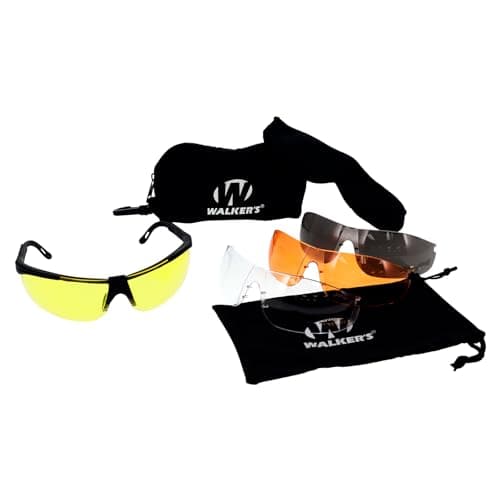
Walker's Sport Glasses (4-lens kit)
Z87.1+7.1/10Four lenses in the box — clear, smoke gray, amber and yellow — on an adjustable frame with ratcheting lens pitch. Walker's states the kit exceeds the ANSI Z87.1-2003 high-impact requirement. The cheapest way to test four tints.
$19.99Amazon#ad · Price as of November 2, 2026 · Disclosure for the link to Walker's Sport Glasses (4-lens kit)
Best value ballistic-rated pair
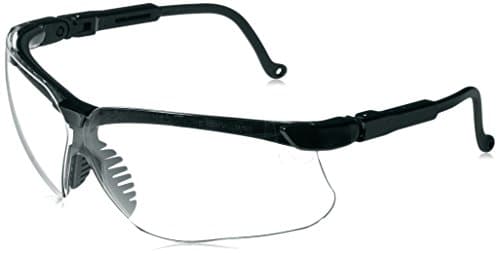
Howard Leight Genesis Sharp-Shooter
Military V08.1/10The combo kit ships clear, amber and vermillion, and Honeywell names the light each is for: clear for indoor/outdoor, amber for low light and fog, vermillion for fluorescent and halogen indoor ranges. Clear and amber are also stated to meet the Military V0 ballistic test.
$11.77Amazon#ad · Price as of November 2, 2026 · Disclosure for the link to Howard Leight Genesis Sharp-Shooter
Best photochromic overall
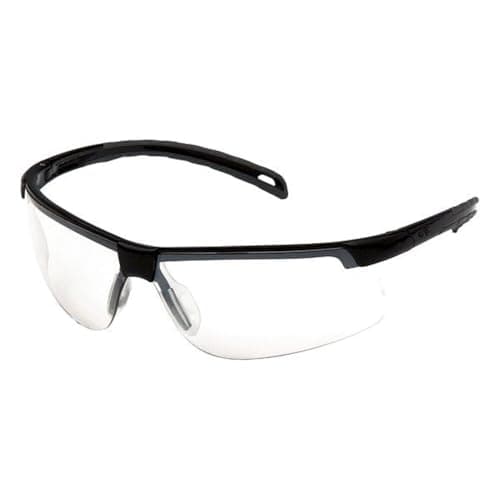
Pyramex Ever-Lite (SB8624D photochromic)
Z87.1+7.1/10The one lens in this registry with a published range: 85% to 24% light transmission, on a 22-gram frame stating ANSI/ISEA Z87.1-2020 + High Impact. It needs direct UV to darken, so it stays light behind glass.
$31.52Amazon#ad · Price as of November 2, 2026 · Disclosure for the link to Pyramex Ever-Lite (SB8624D photochromic)
Best premium clay kit
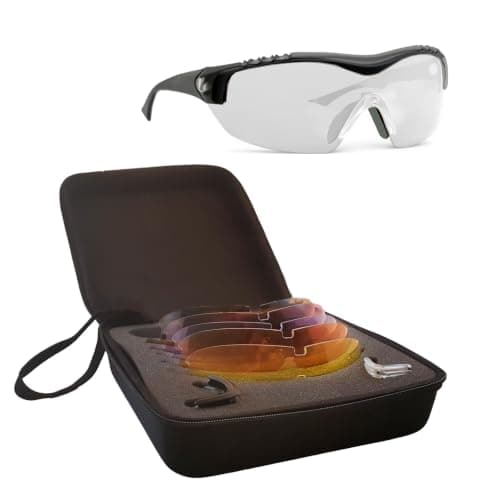
SSP Eyewear Methow 6 HD Kit
Z87.1+6.8/10Six interchangeable HD lens colors in one kit, with NVR Fog lenses and an Rx option, for the clay shooter who wants to work through the tint question properly.
$321.23Amazon#ad · Price as of November 2, 2026 · Disclosure for the link to SSP Eyewear Methow 6 HD Kit
Where shade numbers genuinely matter
One serious caveat to end on. If your work involves welding, cutting or brazing, tint selection stops being a preference and becomes a shade-number decision governed by the process and the current you are running. A general-purpose dark safety lens is not a welding filter, and no amount of tint depth makes it one — the hazard includes infrared and intense visible radiation that a sunglass tint does not address.
That is outside what this site rates: we cover impact-rated eyewear for the range, the field and the shop, not welding filters. What we will say is that the markings are the place to check — a W or R code on the lens means it was assessed as that kind of filter — and that eye protection worn under a welding helmet for grinding and chipping is a separate, legitimate purchase. The grinding side of that job is on safety glasses for grinding metal.
How Lens & Lead rates eyewear
How these picks were chosen
Every pair here is picked from the certification its maker publishes and repeats in its own wording ("meets", "certified", "tested to", "APEL"), the lens system and the tints in the box, whether the temples are described for ear muffs, and whether an Rx route exists — then scored on a public rubric that weights protection first. Every figure links to the page it came from, so you can confirm the protection before you buy. The standards themselves are explained on ANSI Z87.1 vs MIL-PRF-32432.
Scores are editorial judgments from that documented research, and the rating, the lens system and the fit are what move a pick. The rubric and its weights are published.
Questions
Frequently asked
What are the tint levels for safety glasses?
There is no general tint-level scale for industrial safety glasses — makers sell tints by name. The three numbered systems in ANSI Z87.1 are the U scale for UV filters, the L scale for visible-light filters and W shade numbers for welding filters.
How dark is a gray safety lens?
No maker we cite publishes a transmission percentage for a fixed gray lens. Treat it as sunglass-grade for open daylight and too dark for indoor or evening work. The only published ranges in our registry belong to photochromic lenses, where 24% is a typical dark state.
Is a darker safety lens more protective?
No. Darkness controls visible light only. Impact protection comes from the rating and the construction, and UV filtering is a separate property that clear lenses have too.
Can I use dark safety glasses for welding?
No. Welding requires a filter selected by shade number for the process, marked with a W or R code. A dark general-purpose tint does not address the infrared and intense visible radiation of an arc.
Keep reading
Related on Lens & Lead
Receipts
Sources
- Pyramex — Ever-Lite half-frame eyewear page (ANSI/ISEA Z87.1-2020 + High Impact; CAN/CSA Z94.3-2020; "Transition lens option-SB8624D photochromic lens transitions from clear to dark after exposure to direct UV light"; "Lightweight spectacle – 22 gm"; slim co-injected temples; H2X / H2MAX options) (checked 2026-09-26)
- Full Source — Pyramex SB8624D Ever-Lite light-adjusting photochromic listing ("Transitions between 85% - 24%", 99% UVA/B/C, scratch-resistant polycarbonate, 22 grams, $41.99 per pair) (checked 2026-09-26)
- Edge Eyewear — Brazeau Photochromic Transition page (rated to "ANSI Z87.1+ safety standards in an independent lab"; "Photochromic lens transitions when exposed to UV radiation"; "transition from 22% light transmission at their darkest to 85% at its lightest"; nylon composite frame; "nylon temple pieces slide comfortably under hard hats or caps"; 65 mm lens width; $59.88) (checked 2026-09-26)
- Safety Glasses USA — CO Eyewear A Phase Z87+ photochromic listing ("ANSI Z87+ Rated"; photochromic 80%-13% light and 60%-9% dark VLT; "100% UV protection, all the time"; $59.00) (checked 2026-09-26)
- Select Safety Sales — 3M Smart Lens photochromic safety glasses, CAS13407-00000 ("Meet ANSI Z87.1-2003 & ANSI Z80.3-2008 Standard"; "Changes from light to dark in less than 20 seconds"; "Changes from dark to light in less than 3 minutes"; "Blocks 99.9% of UV rays"; hard coating; soft adjustable nose bridge and spring-hinged temples) (checked 2026-09-26)
- Walker's — Sport Glasses With Interchangeable Lens page (4-lens kit, "exceeds ANSI Z87.1-2003 high-impact requirement") (checked 2026-09-21)
- Howard Leight Shooting Sports — Genesis Sharp-Shooter Combo Kit page, re-read for the review ("Clear for most indoor/outdoor uses; Amber for low light/cloudy/foggy outdoor environments; Vermillion for indoor fluorescent/halogen lit ranges"; "Clear and Amber lenses meet Military V0 ballistic impact test requirements (7X higher than ANSI)"; "Meets ANSI Z87.1-2010 (High Impact)" and CSA Z94.3; "Uvextreme anti-fog coating and ventilation channel expertly controls fog and moisture"; "soft, elastomer browguard diffuses impact while providing comfort"; "Customize your fit with the flexible nose piece, temple length and lens inclination"; "9-base wraparound uni-lens provides outstanding peripheral vision and protective side coverage"; 99.9% UV protection) (checked 2026-10-15)
- SSP Eyewear — Methow shooting eyewear collection (3 XHD kit, NVR Fog a-EYE lenses, RX-able) (checked 2026-09-21)
- Pyramex — Intruder frameless eyewear page (ANSI/ISEA Z87.1-2020+, CSA, EN 166, polycarbonate, tints, coatings) (checked 2026-09-21)
- Pyramex — Capstone 500 goggle page ("Fits over most prescription glasses"; ANSI/ISEA Z87.1-2020 + High Impact; CAN/CSA Z94.3-2020; CE/UKCA EN 166; MIL-PRF-32432 high-velocity impact; "polycarbonate lens on the outer side with an acetate anti-fog lens on the inner side"; H2X anti-fog; D3 / D4; removable vent caps; adjustable elastic headband) (checked 2026-09-26)
- MSC Industrial Supply — Understanding ANSI Z87.1 (high-mass 500 g from 4 ft; high-velocity steel ball at 102 mph; Z87+ and U/L/W/H/D/X markings) (checked 2026-09-21)
- ISEA — ISEA publishes ANSI/ISEA Z87.1-2020 eye and face protection standard update (anti-fog criteria, relaxed optics, marking) (checked 2026-09-21)
Ratings, lens systems, fit notes and coatings come from the maker's own product pages and manuals (linked on every product), with the published safety standards behind them, and a labeled retailer or press page where the maker's own page was unavailable. Every buy button opens today's live Amazon price. Read the full method.