Fit & Youth / Guide
Safety glasses that fit with a respirator: the one rule, and the frames that respect it
A respirator seals on your face. Safety glasses sit on your nose. Those two facts fight each other, and only one of them is allowed to win.
By Mike M.Updated Researched from maker specs & standards
#adLens & Lead earns from qualifying Amazon purchases. Prices are set by the retailer and change. A commission never decides a ranking. How we rate · Disclosure
The one rule: the mask seal wins
A half-mask respirator works by sealing against your skin so that every breath you take comes through the cartridge rather than around the edge. If something lifts that seal — a temple arm, a strap, a beard, the bottom rim of a pair of glasses — you are breathing unfiltered air and the mask is doing a fraction of its job. You will not necessarily feel it happen.
So the order of operations is not negotiable. Fit the respirator properly first, then find eye protection that does not disturb it. Never the other way round, and never by loosening the mask to make room for a frame you prefer. Respirator selection and fit testing are regulated separately from eye protection and are outside what this site covers; OSHA's eye and face protection rule, 29 CFR 1910.133, is the one we work from, and it requires eye protection with side protection where flying objects are a hazard. Both devices are required on plenty of jobs, which is exactly why this page exists.
Where the two devices actually collide
Three contact points, and knowing which one is your problem tells you what to buy.
The nose bridge. A half-mask seals across the bridge of the nose, which is exactly where a pair of glasses wants to sit. If the mask comes up high, the glasses end up perched on top of it — unstable, angled wrong, and pressing down on the seal. The fix is a frame with a soft adjustable nose piece that can sit slightly higher, or a frame with the integrated nose bridge that frameless designs use.
The cheek. The mask body flares out over the cheekbone, and a deep lens that reaches down to the cheekbone lands on it. This is the one that pushes the whole frame up and off your face as you talk or move your jaw. A shallower lens height is the fix, which is one of the few cases on this site where less lens coverage is the right answer.
The temple, over the mask strap. A half-mask strap runs behind the head and over the top; a temple arm runs straight back over the ear. They cross, and whichever is softer gives. If the strap presses the temple into your head you get a pressure point within twenty minutes; if the temple lifts the strap you have moved the mask. Thin, flexible temples with a long straight run are the answer — the same property that makes a frame work under ear muffs, discussed on best shooting glasses for ear muffs.
Three frame features that make it work
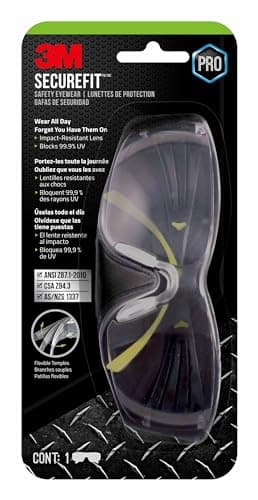
Low weight and self-adjusting temples. The 3M SecureFit 400 is the standout and it is the one feature in this category that is genuinely engineered rather than marketed: the retailer listing describes 3M's Pressure Diffusion Temple Technology as diffusing pressure over the ear, and the frame weighs less than an ounce. Less than an ounce matters because a light frame is not fighting the mask for position.
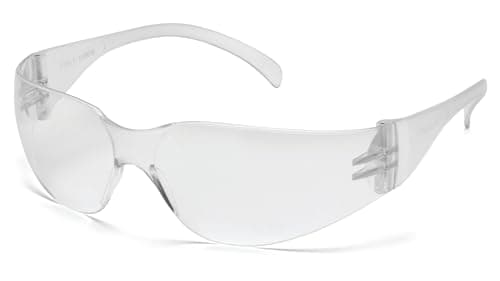
A frameless or half-frame profile. The Pyramex Intruder is a frameless wraparound with an integrated nose piece, which gives you a shallow lens, no lower rim to land on the mask body, and nothing thick at the hinge. It is also cheap enough to keep a pair in every toolbox, which matters because this is the kind of pairing where you work out the right combination by trying two or three.
Adjustable temple length and pitch. Where a maker offers it — Pyramex states that the OTS's lightweight nylon temples adjust for length and pitch, and NoCry gives the EyeArmor+ customisable temple arms and an adjustable nose pad — you can tune the frame to sit above the mask body rather than on it. That adjustment is worth more here than any coating.
What to avoid: a foam-gasketed frame, a deep wraparound with a thick rubberised full frame, and anything with a brow guard. All three are excellent features on a firing line and all three collide with a mask. The coverage trade-offs in general are on best shooting glasses with side shields.
Exhaled air is the other half of the problem
Even with a perfect seal, a half-mask pushes warm humid air out through its exhalation valve, and depending on the valve position some of that air rises across your lenses. Combine that with a cold workshop and you have the most reliable fogging situation in this entire site.
Three things help, in order of effect. A named anti-fog coating, not the word on a box: Pyramex's H2X and H2MAX, 3M's anti-fog clear and gray lenses, Bollé's Platinum. A vented or open frame, because airflow across the lens is what clears it — a frameless pair is inherently better ventilated than a gasketed one. And a frame that sits further from the eye, counter-intuitively, because it leaves a channel for the air to escape rather than trapping it.
If you are still fogging after all three, the problem is the valve direction, not the lens, and the answer is a dual-pane goggle — the one construction that solves fog structurally. The full toolkit is on how to stop glasses fogging.
When to switch to a goggle
Three signs it is time. You cannot find a frame whose temple clears the mask strap without a pressure point. You keep lifting the glasses to clear fog, which means you are also touching the mask. Or the hazard has moved on from dust to splash, where a seal is required rather than preferred.
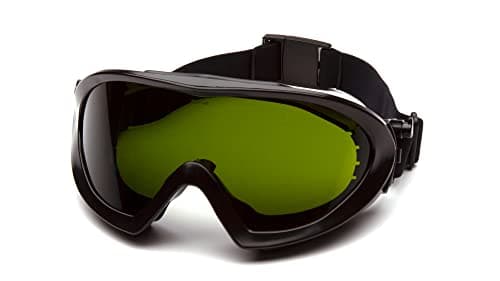
A goggle actually solves the respirator interference problem in an elegant way: it has no temples at all. A strap sits above the mask strap, the sealed body sits above the mask body, and the two devices stack instead of crossing. The Pyramex Capstone 500 is the pick on this site because it is a dual-pane design — Pyramex describes a polycarbonate outer lens with an acetate anti-fog inner lens — which answers the fog objection, and because it states an over-the-glasses fit, D3 droplet and splash and D4 dust with the vent caps in place, plus a MIL-PRF-32432 high-velocity pass.
The costs are real: heat, and the fact that you now have two straps on one head. The general form-factor comparison is on safety goggles vs glasses, and if the job also throws material at your jaw, read goggles vs a face shield.
Picks
Our picks for this
Two low-profile frames and the goggle to fall back on
Best for all-day shop wear
3M SecureFit 400
Z87.1+7.2/10The best temple design for this job: under an ounce, with pressure-diffusing dual-material temples and an anti-fog clear or gray lens. The rating is quoted from a retailer because 3M's own page would not load for us.
$9.99Amazon#ad · Price as of October 10, 2026 · Disclosure for the link to 3M SecureFit 400
Best cheap Z87.1+ pair to buy in bulk
Pyramex Intruder
Z87.1+7.2/10Frameless, shallow and thin at the hinge, stating ANSI/ISEA Z87.1-2020 with the high-impact plus plus CSA and EN 166 — cheap enough to buy two or three and find the one that clears your mask.
$5.03Amazon#ad · Price as of October 10, 2026 · Disclosure for the link to Pyramex Intruder
Best goggle to wear over glasses
Pyramex Capstone 500
MIL-PRF-324328.2/10The fallback with no temples at all: a dual-pane goggle that stacks above a half-mask instead of crossing it, stating MIL-PRF-32432, an over-the-glasses fit, and D3 and D4 with the vent caps in.
$48.54Amazon#ad · Price as of October 10, 2026 · Disclosure for the link to Pyramex Capstone 500
If you wear prescription glasses as well as a respirator, that is three devices on one face and the over-the-glasses options become the practical route — ranked on best over-the-glasses shooting glasses and best safety goggles over glasses.
The full-face respirator option
Worth naming because it removes the problem rather than managing it: a full-face respirator integrates the eye protection into the mask, so there is nothing to fit around. If you are doing enough spraying, blasting or chemical work that you are reading this page in the first place, it is the configuration to price up.
We do not carry or rate full-face respirators — this site covers eyewear, and a respirator is a different product class with its own selection and fit-testing requirements. But it is the right answer often enough that pretending otherwise would be unhelpful. For everything short of that, a thin-templed Z87+ frame and a named anti-fog coating will get you through a shift.
How Lens & Lead rates eyewear
How these picks were chosen
Every pair here is picked from the certification its maker publishes and repeats in its own wording ("meets", "certified", "tested to", "APEL"), the lens system and the tints in the box, whether the temples are described for ear muffs, and whether an Rx route exists — then scored on a public rubric that weights protection first. Every figure links to the page it came from, so you can confirm the protection before you buy. The standards themselves are explained on ANSI Z87.1 vs MIL-PRF-32432.
Scores are editorial judgments from that documented research, and the rating, the lens system and the fit are what move a pick. The rubric and its weights are published.
Questions
Frequently asked
Can you wear safety glasses with a respirator?
Yes, and on many jobs both are required. The constraint is that nothing may lift or cross the respirator's face seal, so you need a low-profile frame with thin temples and a shallow lens — and you fit the mask first, then the glasses.
What kind of safety glasses work best with a half-mask respirator?
Light, frameless or half-frame designs with thin, flexible temples and an adjustable nose piece. The 3M SecureFit 400 at under an ounce with pressure-diffusing temples and the frameless Pyramex Intruder are the two we would try first. Avoid foam-gasketed frames and brow guards.
Why do my glasses fog up when I wear a respirator?
A half-mask vents warm humid air through its exhalation valve, and depending on valve position some of it rises across your lenses. Use a frame with a named anti-fog coating, keep the frame vented rather than sealed, and if it still fogs, move to a dual-pane goggle.
Are goggles better than glasses with a respirator?
Often, yes — a goggle has no temple arms to cross the mask strap, so the two devices stack rather than interfere. The trade is heat and a second strap. A dual-pane goggle like the Pyramex Capstone 500 also handles the fog that a half-mask causes.
Keep reading
Related on Lens & Lead
Receipts
Sources
- OSHA — 29 CFR 1910.133 Eye and face protection (checked 2026-09-21)
- Safety Gear Pro — 3M SecureFit 400 listing ("ANSI Z87.1+ High Impact", Pressure Diffusion Temple, under 1 oz, 99.9% UV) (checked 2026-09-21)
- Pyramex — Intruder frameless eyewear page (ANSI/ISEA Z87.1-2020+, CSA, EN 166, polycarbonate, tints, coatings) (checked 2026-09-21)
- Pyramex — OTS Over the Spectacle Eyewear page (ANSI/ISEA Z87.1-2020+, fits frames up to 137 mm x 44 mm, adjustable temples) (checked 2026-09-21)
- Pyramex — Capstone 500 goggle page ("Fits over most prescription glasses"; ANSI/ISEA Z87.1-2020 + High Impact; CAN/CSA Z94.3-2020; CE/UKCA EN 166; MIL-PRF-32432 high-velocity impact; "polycarbonate lens on the outer side with an acetate anti-fog lens on the inner side"; H2X anti-fog; D3 / D4; removable vent caps; adjustable elastic headband) (checked 2026-09-26)
- Pyramex — Cappture Pro over-the-spectacle page (ANSI/ISEA Z87.1-2020+, H2MAX, 99% UV) (checked 2026-09-21)
- NoCry — EyeArmor+ Adjustable Anti-Fog page (ANSI/ISEA Z87.1-2020, EN 166, adjustable temples, anti-fog/anti-scratch, UV380) (checked 2026-09-21)
- RX-Safety — Bollé Tryon OTG listing (ANSI Z87+ high impact, Platinum coating, TR-90, 132 mm frame, expandable temples) (checked 2026-09-21)
- ISEA — ISEA publishes ANSI/ISEA Z87.1-2020 eye and face protection standard update (anti-fog criteria, relaxed optics, marking) (checked 2026-09-21)
- MSC Industrial Supply — Understanding ANSI Z87.1 (high-mass 500 g from 4 ft; high-velocity steel ball at 102 mph; Z87+ and U/L/W/H/D/X markings) (checked 2026-09-21)
Ratings, lens systems, fit notes and coatings come from the maker's own product pages and manuals (linked on every product), with the published safety standards behind them, and a labeled retailer or press page where the maker's own page was unavailable. Every buy button opens today's live Amazon price. Read the full method.