Ratings / Guide
Safety goggles vs a face shield: they are not alternatives, and the jobs that need one often need both
A goggle keeps things out of your eyes. A shield keeps things off your face and takes the big impact first. Treating them as competing products is how people end up with a shield and a pair of street glasses.
By Mike M.Updated Researched from maker specs & standards
#adLens & Lead earns from qualifying Amazon purchases. Prices are set by the retailer and change. A commission never decides a ranking. How we rate · Disclosure
The short answer
These two devices get compared constantly and they are not substitutes. The question "goggles or a face shield?" usually has the answer "yes", and the reason is geometry rather than rating.
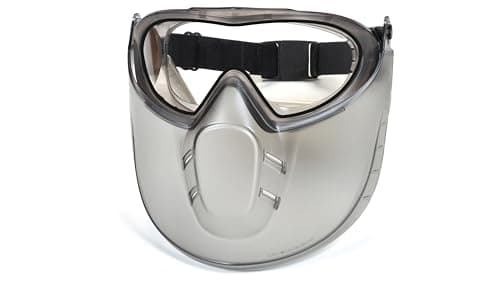
A goggle is a sealed enclosure around the eye socket. Its whole value is that there is no gap: Pyramex describes the Capstone Shield's soft vinyl body as conforming to facial contours, and the Capstone 500 passes D3 for droplet and splash and D4 for dust with its vent caps in place. A face shield is a curved sheet of polycarbonate hanging in front of your face from a brow mount or a headgear. It covers a much larger area and it absorbs an impact further from your eye — both genuinely useful — but it is open at the bottom and open at the sides, and anything deflecting off a workbench can travel up behind it.
OSHA's eye and face protection rule, 29 CFR 1910.133, is written around eye and face protection for exactly this reason, and it requires side protection where there is a hazard from flying objects. The practical reading is simple: the shield is not the eye protection. The way the industry sells it says the same thing — Pyramex's Capstone Shield is a goggle with a removable shield on top, not a shield with a strap.
What a goggle does
Three things, none of which a shield can do.
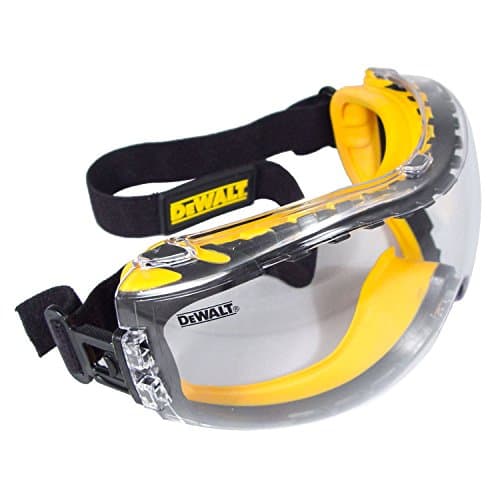
It seals. Dust, grit, sawdust, liquid splash and the fine particulate that a grinder throws all arrive from directions a hanging shield does not cover. A sealed body is the only answer to dust that actually works, which is why the DEWALT DPG82 uses a dual-injected rubber seal conforming to the face with an adjustable cloth strap.
It stays aligned. A strap holds a goggle in a fixed position relative to your eyes. A shield pivots, and when you tip your head down to look at the work the shield comes with you — opening the gap under your chin that was its only coverage at that angle.
It can carry the ballistic tier. Pyramex states a MIL-PRF-32432 high-velocity impact pass for the Capstone 500 and the Capstone Shield, and the ESS Profile NVG uses an extra-thick 2.8 mm polycarbonate lens. Nothing in the face-shield category on this site makes that claim. If the hazard is a projectile rather than debris, you want the goggle.
The cost of all that is heat and fog. A sealed enclosure stops the airflow that keeps a lens clear, which is why the serious goggles solve it structurally: Pyramex's dual-pane construction on the Capstone 500 and the I-Force puts a polycarbonate lens outside and an acetate anti-fog lens inside, and ESS runs a full-perimeter ventilation and filtration system. The general comparison of goggles against spectacles is on safety goggles vs glasses.
What a face shield does
Also three things, and they are the reason not to dismiss it.
It covers your face. Your eyes are not the only part of your head that a disc grinder, a brush cutter or a chainsaw can ruin. Teeth, nose and cheekbones are all in the path and all outside the coverage of any goggle made.
It takes the energy further out. A shield sits an inch or two off your face, so an impact is absorbed at a distance and spread across a large surface rather than against something pressed to your skin.
It flips up. This sounds trivial and it is the single biggest determinant of whether it gets worn. Pyramex's Capstone Shield uses a ratchet that holds the shield in three positions, so you can clear your view to set up a cut and bring it back down without removing anything. A device you can get out of the way in half a second is a device you keep on your head.
What a shield does not do is seal, and it does not deal with dust at all. In a cloud of sanding dust a shield is close to useless and a goggle is close to perfect.
Job by job
| Job | Goggle | Face shield | What we would wear |
|---|---|---|---|
| Angle grinder, cut-off wheel | Essential | Strongly advised | Both — a sealed goggle under a shield |
| Chainsaw, brush cutter, strimmer | Advised | Essential | Both, or shield headgear over a goggle |
| Sanding, sawdust, router work | Essential | Does almost nothing | Goggle only |
| Chemical splash, parts washing | Essential (D3 rated) | Useful for the face | Goggle; shield if splash is at face height |
| Drilling overhead, debris falling | Essential | Useful | Goggle; shield adds jaw cover |
| Reloading bench, primer work | Advised | Not needed | Goggle or a Z87+ wraparound |
| Firing line | Rated ballistic goggle only | Wrong tool entirely | Spectacles or a ballistic goggle |
Editorial recommendations. The device capabilities behind them are quoted from the maker pages cited below — Pyramex's D3 droplet-and-splash and D4 dust ratings, DEWALT's rubber seal and ventilation channels, and Pyramex's ratcheting three-position shield.
Wearing both, and the one-unit option
Wearing a goggle under a separate shield works and is what most workshops do, but it has two annoyances: the shield headgear competes with the goggle strap for space, and two layers of polycarbonate in front of your eyes doubles the reflections.
The alternative is a combined unit, and the Pyramex Capstone Shield is the one on this site: a goggle body with a removable polycarbonate shield that ratchets into three positions and has four ventilation holes, stating ANSI/ISEA Z87.1-2020 with the high-impact plus, a MIL-PRF-32432 high-velocity pass, H2X anti-fog and an over-the-glasses fit. It is the heaviest and hottest option in this comparison and that is the trade — you are wearing one device instead of two, and you notice it within an hour.
Neither belongs on a firing line as-is
A face shield has no place at a range. It is a shop and yard tool: bulky, open at the bottom, and it interferes with a gun mount and with hearing protection.
A goggle does belong, but only a rated one. The pairs that state both a ballistic standard and an over-the-glasses fit — the Capstone 500, the Capstone Shield — are genuinely useful for an air-gun or airsoft field, and the issued military goggles like the ESS Profile NVG are a different class again. The rated ballistic goggles are ranked on best shooting goggles, and for most range work spectacles are the better system because they do not fight your muffs — see best shooting glasses for ear muffs.
Picks
Our picks for this
One of each, and the hybrid in between
Best OTG goggle with a face shield
Pyramex Capstone Shield
MIL-PRF-324327.3/10Both devices in one: a goggle body stating Z87.1-2020+, MIL-PRF-32432 and an over-the-glasses fit, with a removable shield that ratchets into three positions. Heaviest option here, and the only one that covers your jaw.
$21.62Amazon#ad · Price as of October 10, 2026 · Disclosure for the link to Pyramex Capstone Shield
Best sealed goggle for the shop
DEWALT DPG82 Concealer Goggle
Z87.1+6.7/10The goggle on its own: a dual-injected rubber seal, ventilation channels, ToughCoat hard coat and an anti-fog lens at ANSI Z87.1+. The right answer for sawdust and grinding debris.
$12.59Amazon#ad · Price as of October 10, 2026 · Disclosure for the link to DEWALT DPG82 Concealer Goggle
Best glasses-to-goggle hybrid
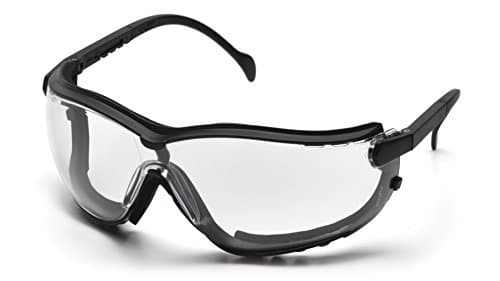
Pyramex V2G
MIL-PRF-324328.1/10The middle road: glasses that convert to a sealed goggle with foam and a headband in the box, stating MIL-PRF-32432 as well as Z87.1-2020+ — far cooler than a full goggle and far more sealed than spectacles.
$8.10Amazon#ad · Price as of October 10, 2026 · Disclosure for the link to Pyramex V2G
If the job is shop work rather than a choice between form factors, the ranked roundups are woodworking, construction and anti-fog goggles.
How Lens & Lead rates eyewear
How these picks were chosen
Every pair here is picked from the certification its maker publishes and repeats in its own wording ("meets", "certified", "tested to", "APEL"), the lens system and the tints in the box, whether the temples are described for ear muffs, and whether an Rx route exists — then scored on a public rubric that weights protection first. Every figure links to the page it came from, so you can confirm the protection before you buy. The standards themselves are explained on ANSI Z87.1 vs MIL-PRF-32432.
Scores are editorial judgments from that documented research, and the rating, the lens system and the fit are what move a pick. The rubric and its weights are published.
Questions
Frequently asked
Can a face shield replace safety goggles?
No. A shield covers your face but seals nothing, and material can travel up behind it from a bench or a workpiece. OSHA's rule is written around eye and face protection together and requires side protection where flying objects are a hazard — the shield is the layer in front of rated eye protection, not a substitute for it.
Do I need both goggles and a face shield for grinding?
For an angle grinder or a cut-off wheel, yes — that is the clearest case in the whole comparison. A sealed goggle for the eyes and a shield for the jaw and nose, or one combined unit like the Pyramex Capstone Shield that is both.
Is a face shield enough for a chainsaw?
A shield is the more important of the two for chainsaw work because of the area it covers, but a mesh or polycarbonate shield does not keep fine chips out of your eyes. Wear a goggle or a Z87+ wraparound under it.
Which is better for dust, a goggle or a shield?
A goggle, by a wide margin, and the gap is not close. Dust arrives from every direction and only a seal stops it — Pyramex rates the Capstone goggles D4 for dust with the vent caps in place. A shield does essentially nothing against sanding or sawdust.
Keep reading
Related on Lens & Lead
Receipts
Sources
- OSHA — 29 CFR 1910.133 Eye and face protection (checked 2026-09-21)
- Pyramex — Capstone Shield goggle page ("Fits over prescription glasses"; ANSI/ISEA Z87.1-2020 + High Impact; CAN/CSA Z94.3-2020; CE/UKCA EN 166; MIL-PRF-32432; H2X or dual-lens H2X anti-fog; "removable shield provides full face protection"; ratchet shield with 3 positions; removable vent caps; D3 / D4) (checked 2026-09-26)
- Pyramex — Capstone 500 goggle page ("Fits over most prescription glasses"; ANSI/ISEA Z87.1-2020 + High Impact; CAN/CSA Z94.3-2020; CE/UKCA EN 166; MIL-PRF-32432 high-velocity impact; "polycarbonate lens on the outer side with an acetate anti-fog lens on the inner side"; H2X anti-fog; D3 / D4; removable vent caps; adjustable elastic headband) (checked 2026-09-26)
- DEWALT — DPG82 Concealer goggle page (ANSI Z87.1+, polycarbonate, ToughCoat, anti-fog, 99.9% UVA/UVB, strap, vents) (checked 2026-09-21)
- Pyramex — V2G Sealed Eyewear page (ANSI/ISEA Z87.1-2020+, MIL-PRF-32432, CSA, EN 166, H2X/H2MAX, temples + strap) (checked 2026-09-21)
- ESS EyePro — Profile NVG Black w/Clear & Smoke Gray page, SKU 740-0499 (ANSI Z87.1-2015, MIL-PRF-32432, EN 166, 2.8 mm polycarbonate, kit contents, Rx inserts, Outrigger strap, ClearZone FlowCoat) (checked 2026-09-21)
- ISEA — ISEA publishes ANSI/ISEA Z87.1-2020 eye and face protection standard update (anti-fog criteria, relaxed optics, marking) (checked 2026-09-21)
- MSC Industrial Supply — Understanding ANSI Z87.1 (high-mass 500 g from 4 ft; high-velocity steel ball at 102 mph; Z87+ and U/L/W/H/D/X markings) (checked 2026-09-21)
- American Academy of Ophthalmology — Sports Eye Safety ("Regular eyeglasses do not offer proper eye protection and, in some cases, can make an injury worse if they shatter"; polycarbonate protective sports glasses) (checked 2026-09-24)
Ratings, lens systems, fit notes and coatings come from the maker's own product pages and manuals (linked on every product), with the published safety standards behind them, and a labeled retailer or press page where the maker's own page was unavailable. Every buy button opens today's live Amazon price. Read the full method.