Lens Tints / Guide
How to tell if lenses are polarized: three tests, and what good polarization really means
Polarized is the most claimed and least verified property in eyewear. You cannot measure it at home, but you can prove it is present in about two minutes, with a phone and a pair of lenses.
By Mike M.Updated Researched from maker specs & standards
#adLens & Lead earns from qualifying Amazon purchases. Prices are set by the retailer and change. A commission never decides a ranking. How we rate · Disclosure
What polarization actually does
Light bouncing off a flat surface — water, a wet road, a car hood, a glass window, a painted panel — comes away with its waves largely oriented in one plane. That is reflected glare, and it is a different thing from brightness. A polarizing filter is oriented to block light in that plane, which is why a polarized lens can cut the hard sheen off a lake surface while leaving the rest of the scene looking normal.
Two things follow, and they are the reason this test matters. First, a polarized lens does something that darkening cannot do, so if you bought a lens for glare and it is not actually polarized, you did not get the product. Second, a polarized lens affects any light source that is already polarized — including most LCD displays — which is both the easiest way to prove the filter is there and the main practical drawback on a range or in a vehicle.
Test 1: the screen test
The quickest and the most reliable with nothing but a phone.
Step one. Put a plain white image on an LCD screen — a blank note, a white web page — and turn the brightness up. A phone, tablet or laptop screen all work. OLED phone screens can behave differently from LCDs, so if you get an ambiguous result, try a laptop or a monitor instead.
Step two. Hold the lens about a hand's width in front of your eye and look at the screen through it, straight on.
Step three. Slowly rotate the lens ninety degrees — tilt the glasses, do not move your head.
What you are looking for. A polarized lens will go noticeably darker through part of that rotation, often close to black, then brighten again. The change is dramatic and unmistakable. An unpolarized tinted lens stays exactly the same brightness at every angle. There is no in-between result here: either the screen dims as you rotate or it does not.
Test 2: two lenses, rotated
If you have a second pair you already know is polarized, this is the cleanest demonstration of all. Hold the two lenses one in front of the other, look through both at a bright but unpolarized source — a lamp, a bright wall, the sky away from the sun — and rotate one of them ninety degrees. If both are polarized, the overlapping area goes dark. If the overlap stays the same at every angle, one of them is not polarized.
You can run a version of this with a single pair of glasses if the lenses are separate: hold the glasses up, look through one lens, and rotate a second pair in front of it. With a single-lens wraparound eyeshield — which most ballistic frames are — you need the screen test instead.
Test 3: the reflection test
The least precise and the most useful, because it tests the thing you are actually buying. Find a flat reflective surface outdoors: a puddle, a car hood, a pond, a wet road. Look at it through the lens, then tilt your head ninety degrees to the side.
A polarized lens shows a visible difference between the two head angles — the reflection comes back when the filter is no longer aligned against it. If the glare looks identical with your head upright and tilted, the lens is dimming light rather than filtering polarized light. This test is also the one that tells you whether polarization is worth it for your use case at all: if you do not care about the difference you just saw, you do not need to pay for a polarized lens.
Why nobody publishes a quality figure
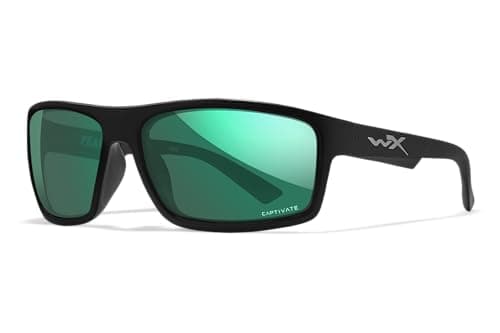
Here is the uncomfortable part, and it is the reason this page cannot rank polarization by strength. The property that would answer "how good is this polarization" is polarization efficiency — the percentage of polarized light the filter actually rejects. No maker in our registry publishes one. Wiley X names its lens technology (CAPTIVATE Polarized) and states 100% UVA/UVB and an oleophobic exterior, but no efficiency figure. Pyramex lists a polarized lens SKU for the Goliath and a polarized treatment for the Vallejo, with no figure either. Edge offers a Polarized Smoke lens among six options, again with no figure.
So we will not print one, and we would be skeptical of any site that does. What you can compare is what is published: the impact rating, the lens material, the coatings, the frame sizes and the warranty. On that basis the WX Peak is the strongest-documented polarized pair on this site — Z87.1+ for high mass and high velocity, shatterproof Selenite polycarbonate, an oleophobic exterior and hydrophobic interior, and a lifetime warranty. The full comparison is on best polarized safety glasses and best polarized shooting glasses.
If yours is not polarized
Our picks for this
Three rated polarized pairs, at three prices
Best polarized optics
Wiley X WX Peak (CAPTIVATE Polarized)
Z87.1+7.1/10The best-documented polarized pair here: CAPTIVATE Polarized lenses, ANSI Z87.1+ for high mass and high velocity impact, 100% UVA/UVB, an oleophobic exterior, Medium and Large fits and a lifetime warranty.
$191.75Amazon#ad · Price as of November 2, 2026 · Disclosure for the link to Wiley X WX Peak (CAPTIVATE Polarized)
Best polarized value
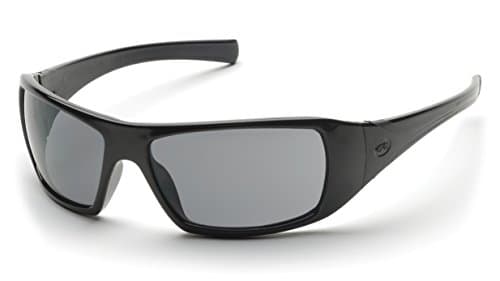
Pyramex Goliath (SB5621D polarized)
Z87.1+7.0/10The value pick: a gray polarized lens (SKU SB5621D) on a full frame stating ANSI/ISEA Z87.1-2020 + High Impact, CSA and EN 166, with co-injected rubber temples.
$36.58Amazon#ad · Price as of November 2, 2026 · Disclosure for the link to Pyramex Goliath (SB5621D polarized)
Best polarized pair you will keep wearing
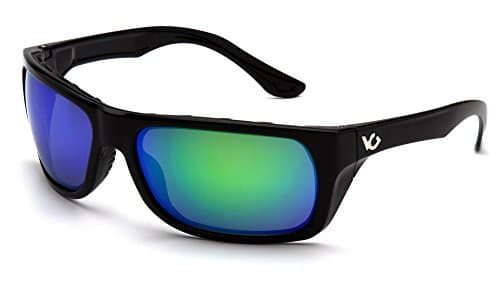
Venture Gear Vallejo (polarized)
Z87.1+7.0/10The one you will keep wearing: a polarized treatment on a vented frame Pyramex says increases airflow to prevent fogging, in frame and lens combinations that do not look like safety glasses.
$36.95Amazon#ad · Price as of November 2, 2026 · Disclosure for the link to Venture Gear Vallejo (polarized)
Note that all three are rated eyewear. A polarized fashion sunglass is tested as a lens rather than as an assembled device, which is a different and much weaker proposition — the argument is on safety glasses vs normal glasses.
The shooter's caveat
The same property that makes the screen test work is the reason we do not recommend polarized lenses for every shooter. Range timers, shot-counter displays, chronograph screens and vehicle dashboards are often LCDs, and a polarized lens can dim or black them out at certain head angles — which is exactly what you just demonstrated in test one. Some shooters also report interference with reflex and holographic sights and with stress patterns in laminated glass.
That does not make polarization wrong; it makes it a choice with a cost. If your shooting is clays under open sky, over water, or anything where glare is the enemy, the trade is usually worth it. If you shoot with a red dot and a timer in front of you, it usually is not. The full argument, including which lens to use instead, is on should shooting glasses be polarized, and the plain gray alternative is on smoke lens safety glasses.
How Lens & Lead rates eyewear
How these picks were chosen
Every pair here is picked from the certification its maker publishes and repeats in its own wording ("meets", "certified", "tested to", "APEL"), the lens system and the tints in the box, whether the temples are described for ear muffs, and whether an Rx route exists — then scored on a public rubric that weights protection first. Every figure links to the page it came from, so you can confirm the protection before you buy. The standards themselves are explained on ANSI Z87.1 vs MIL-PRF-32432.
Scores are editorial judgments from that documented research, and the rating, the lens system and the fit are what move a pick. The rubric and its weights are published.
Questions
Frequently asked
How can I tell if my sunglasses are polarized?
Hold a lens in front of a bright white LCD screen and rotate it ninety degrees. A polarized lens darkens sharply at one angle and brightens at another; an unpolarized lens does not change at all.
Does the screen test work on every phone?
It works reliably on LCD panels, which is most laptops, monitors and tablets. OLED phone screens can give a less obvious result, so if the answer looks ambiguous, repeat the test on a laptop or desktop monitor.
How do I know if the polarization is good quality?
You cannot tell at home, and no maker we cite publishes a polarization efficiency figure. Compare what is published instead — the impact rating, lens material, coatings, fit sizes and warranty — and treat any site quoting an efficiency percentage for these products with suspicion.
Are all mirrored or dark lenses polarized?
No. A mirror is a reflective coating and a tint is a dye; neither implies a polarizing filter. Many dark lenses are not polarized at all, which is exactly why the rotation test is worth two minutes.
Keep reading
Related on Lens & Lead
Receipts
Sources
- Wiley X — WX Peak ACPEA19 page ("ANSI Z87.1+ Optical clarity and high mass/high velocity impact standards"; CAPTIVATE Polarized lenses; "Shatterproof Selenite Polycarbonate Lenses"; 100% UVA/UVB; Triloid nylon frame; Medium and Large fits; lifetime warranty; $200.00; "In Stock. Ships within 1 - 5 Business Days") (checked 2026-09-26)
- Pyramex — Goliath full-frame eyewear page (ANSI/ISEA Z87.1-2020 + High Impact; CAN/CSA Z94.3-2020; CE/UKCA EN 166; polarized SKU SB5621D; co-injected rubber temples; H2X anti-fog option) (checked 2026-09-26)
- Pyramex — Vallejo eyewear page (ANSI/ISEA Z87.1-2020 + High Impact; CAN/CSA Z94.3-2020; polarized lens treatment option; built-in rubber nosepiece; "Vented frame increases air flow to prevent fogging"; SKU VGSB922T) (checked 2026-09-26)
- Edge Eyewear — Hamel tactical eyewear page ("MIL-PRF 32432-A"; "ANSI Z87.1+"; EN166; UKCA; CSA Z94.3; Polarized Smoke, Photochromic, G-15, Clear and Tigers Eye Vapor Shield lens options; "block 99.9% of UVA, UVB and UVC rays"; thin temples that integrate with "helmets, hats or hearing protection"; 66 mm lens width, 140 mm temple; $71.88) (checked 2026-09-26)
- ISEA — ISEA publishes ANSI/ISEA Z87.1-2020 eye and face protection standard update (anti-fog criteria, relaxed optics, marking) (checked 2026-09-21)
- MSC Industrial Supply — Understanding ANSI Z87.1 (high-mass 500 g from 4 ft; high-velocity steel ball at 102 mph; Z87+ and U/L/W/H/D/X markings) (checked 2026-09-21)
Ratings, lens systems, fit notes and coatings come from the maker's own product pages and manuals (linked on every product), with the published safety standards behind them, and a labeled retailer or press page where the maker's own page was unavailable. Every buy button opens today's live Amazon price. Read the full method.