Fit & Youth / Guide
How to fit shooting glasses on a child: five checks at the kitchen table
No safety standard defines a youth size. The rating on the box tells you the lens passed a test; it tells you nothing about whether the frame seals on your eight-year-old's face. That part is yours to check.
By Mike M.Updated Researched from maker specs & standards
#adLens & Lead earns from qualifying Amazon purchases. Prices are set by the retailer and change. A commission never decides a ranking. How we rate · Disclosure
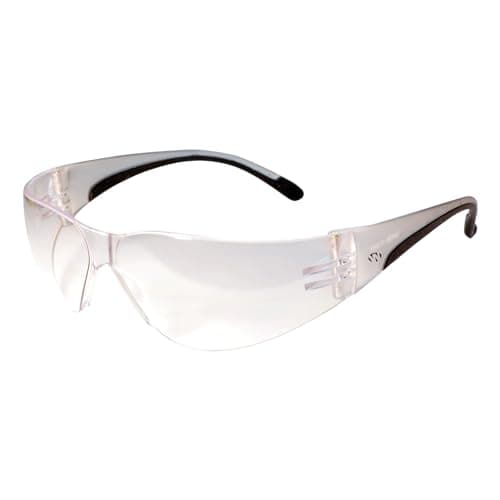
There is no youth size in the standard
This is the fact that makes the whole exercise necessary. ANSI/ISEA Z87.1 tests a device — a frame and lens assembly, on a head form — and it certifies that the device passed. It does not define a youth category, a child's head size, or a minimum coverage area relative to a face. So "youth shooting glasses" is a frame-size claim made by a manufacturer, in its own words, with no standard behind the claim.
Those words are worth reading precisely, because they differ. Walker's says the Clearview Youth is "engineered specifically for smaller heads with wraparound design". Radians says the Ducks Unlimited DU-Y1 is "specifically designed to fit smaller heads and faces". Pyramex says the Mini Ztek is "a design better suited for slimmer facial sizes" — slimmer, not smaller, which is a different claim and suits a narrow-faced teenager better than a small child. Radians also sells a MICRO shooting glass it describes as a 10% smaller frame for youth, ladies or anyone wanting a smaller frame, though the page we read does not state an ANSI rating, so it does not get a card here.
Nobody in this category publishes an age range, and you should be glad: heads vary enormously at the same age. Fit it to the face in front of you.
Two measurements before you order
You only need two, and a soft tape or a piece of string will do.
Temple-to-temple width. Measure straight across the face from the outside of one temple to the other, at eye level. This is the number that decides whether a frame rocks. If a frame's total front width is appreciably wider than this measurement, it will sit on the cheekbones and slide down no matter how you adjust it. Very few makers in safety eyewear publish a front width, which is why the ones that do are worth seeking out — Revision publishes the Sawfly at 144 mm for Small and 157 mm for Large, and the Bollé Tryon OTG at 132 mm.
Ear-to-eye length. Measure from the outer corner of the eye back to the point where the ear meets the head. This decides whether the temple arm reaches far enough to bend behind the ear rather than pressing on the side of the head. Where makers publish a temple length, compare it to this: the Edge Hamel's 140 mm and the Revision Sawfly Large's 180 mm are adult numbers, and a child needs far less.
Write both down. They stay useful for years, because they let you order online without a fitting and they let you tell whether the pair you already own has been outgrown.
The five fit checks, in order
Do these with the glasses on the child, in daylight, before the first range trip rather than at the range.
One: coverage. The top of the lens should sit above the eyebrow and the bottom should reach the cheekbone. If the eyebrow is above the lens, there is an open channel for anything arriving from above — which on a firing line is a hot casing and in the yard is a wood chip. If the lens stops short of the cheekbone, the whole lower field is open. Coverage comes before comfort because it is the thing you cannot adjust.
Two: the bridge. The frame's weight should sit on the bridge of the nose with the lens close to but not touching the eyelashes. Touching lashes means the frame will get pushed up within minutes. A visible gap of more than a few millimetres between the lens and the brow means the frame is too large. Rubber nose pieces — the DU-Y1 and the Mini Ztek both have one — make a real difference here because they stop the slide rather than just cushioning it.
Three: the temples. The arm should run straight back and begin to curve after it has passed the ear, not before it. An arm that bends early presses into the side of the head and leaves a red mark; an arm that is far too long levers the frame off the nose. Flexible temples with rubber tips, which Radians states for the DU-Y1 and Pyramex for the Mini Ztek, forgive a lot of this.
Four: the shake test. Have the child look down at their shoes, then shake their head side to side twice. If the glasses move more than a millimetre or two, they will move during a gun mount. This is the single most informative test on the list and it takes three seconds.
Five: the mount test. With an unloaded firearm, or a broom handle if you are at the kitchen table, have them take the shooting position they will actually use. Watch the glasses. If the stock comb touches the frame, or the frame shifts as the cheek comes down, the frame is sitting too low — and a young shooter will respond by lifting their head off the stock, which is a miss and a habit at the same time. Fix the frame, never the cheek weld.
Testing the fit under ear muffs
Do this as a separate step, with the muffs the child will wear, because almost every fit that works bare-headed fails here. A muff cup seals against the side of the skull, and a small head gives it less room; the cup lands directly on the temple arm.
Two things to look for. Does the cup lift the glasses off the nose when it settles? That is the arm being too thick, and the answer is a thinner temple — the frameless clay frames with thin metal temples are the best thing on this site for it. And can you see daylight between the cup and the head where the arm crosses? That is a broken acoustic seal and it costs real hearing protection, which matters more than the eyewear question you came here to solve.
If both fail, the answer is usually to change the glasses rather than the muffs, because muffs that fit a child are harder to find. The frames that clear a cup, and why, are on best shooting glasses for ear muffs, and the combined-system view is on glasses and ear protection combos.
Frames makers actually size for children
Our picks for this
Three frames with a published size claim
Best budget youth pair
Walker's Clearview Youth
Z87.1+6.7/10The clearest size claim at the lowest price: engineered for smaller heads with a wraparound design, exceeds ANSI Z87.1-2010 high impact, 99% UV, in yellow or clear/gray.
$7.99Amazon#ad · Price as of October 10, 2026 · Disclosure for the link to Walker's Clearview Youth
Best current-edition youth frame
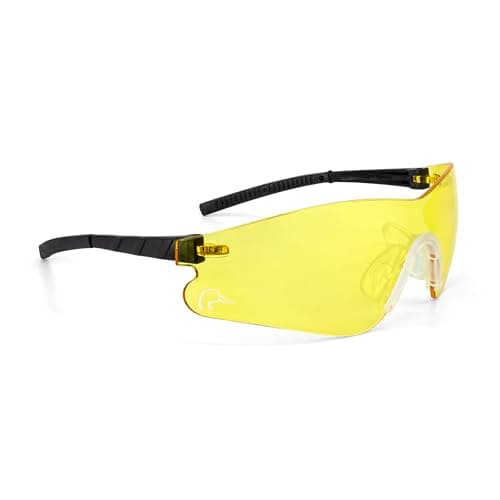
Radians Ducks Unlimited DU-Y1 Youth
Z87.16.1/10The current edition of the standard — ANSI/ISEA Z87.1-2020 — on a frame specifically designed for smaller heads and faces, with flexible rubber-tipped temples and 99.9% UV.
$17.98Amazon#ad · Price as of October 10, 2026 · Disclosure for the link to Radians Ducks Unlimited DU-Y1 Youth
Best for slim faces and older kids
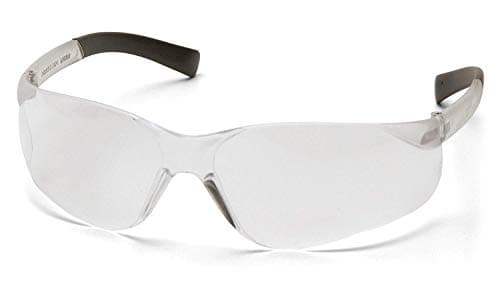
Pyramex Mini Ztek
Z87.1+7.2/10For a slimmer rather than smaller face, which is most teenagers: Z87.1-2020 with the high-impact plus, soft non-slip rubber temple tips, seven tints and an H2X anti-fog option.
$8.99Amazon#ad · Price as of October 10, 2026 · Disclosure for the link to Pyramex Mini Ztek
The full youth ranking, including the goggles for air-gun and airsoft use, is on best youth shooting glasses. If the shooting is trap rather than general range work, the tint question is covered on youth trap shooting glasses.
How to tell they have outgrown it
Four signs, and none of them involves a birthday.
The temple arms now bend before they pass the ear, leaving a mark. The lens no longer reaches the cheekbone when the child looks straight ahead. The frame slides down within a few minutes of putting it on, even with a rubber nose piece. Or they have simply started pushing it up onto their forehead, which is the behavioural version of the same message.
At that point the good news is that the options widen a great deal, because small adult frames are a real category with published dimensions: Revision's Sawfly in Small, Pyramex's Mini Ztek, and the frameless clay frames. Those are collected on best shooting glasses for small faces.
How Lens & Lead rates eyewear
How these picks were chosen
Every pair here is picked from the certification its maker publishes and repeats in its own wording ("meets", "certified", "tested to", "APEL"), the lens system and the tints in the box, whether the temples are described for ear muffs, and whether an Rx route exists — then scored on a public rubric that weights protection first. Every figure links to the page it came from, so you can confirm the protection before you buy. The standards themselves are explained on ANSI Z87.1 vs MIL-PRF-32432.
Scores are editorial judgments from that documented research, and the rating, the lens system and the fit are what move a pick. The rubric and its weights are published.
Questions
Frequently asked
Is there a youth size in ANSI Z87.1?
No. The standard tests a frame-and-lens device on a head form and certifies the device. "Youth" is a size claim made by the manufacturer in its own words, with no standard definition behind it — so the fit check is yours to do.
How do I know if shooting glasses fit my child?
Five checks: the lens covers eyebrow to cheekbone, the bridge carries the weight without touching eyelashes, the temple bends after it passes the ear, nothing moves on a head shake, and the fit survives ear muffs going on.
What size shooting glasses does a 10-year-old need?
There is no age-to-size table in this category, and heads vary too much for one to be useful. Measure temple-to-temple width across the face at eye level and ear-to-eye length, then compare them with the published frame dimensions where a maker gives them.
Can a child wear adult safety glasses?
Only if they pass the five checks, and most do not: an adult frame typically gaps at the temple and sits on the cheekbones. A small adult frame with published dimensions — Revision's Sawfly Small, or a frameless clay frame — is often the right answer for a teenager.
Keep reading
Related on Lens & Lead
Receipts
Sources
- Walker's — Clearview Youth page ("exceeds ANSI Z87.1-2010 high-impact requirement", smaller heads, 99% UV) (checked 2026-09-21)
- Radians — Ducks Unlimited DU-Y1 Youth Shooting Glass page (ANSI/ISEA Z87.1-2020, smaller heads, 99.9% UV) (checked 2026-09-21)
- Radians — MICRO Shooting Glass page ("10% smaller frame perfect for youth, ladies or those looking for a smaller frame") (checked 2026-09-21)
- Pyramex — Mini Ztek page (ANSI/ISEA Z87.1-2020+, "slimmer facial sizes", tints, H2X) (checked 2026-09-21)
- Revision Military — Sawfly Eyewear 1 Lens Kit page (MIL-PRF-32432A clause 3.8.4.1, ANSI Z87.1-2020 clause 7.1, sizes, Rx carrier) (checked 2026-09-21)
- RX-Safety — Bollé Tryon OTG listing (ANSI Z87+ high impact, Platinum coating, TR-90, 132 mm frame, expandable temples) (checked 2026-09-21)
- Edge Eyewear — Hamel tactical eyewear page ("MIL-PRF 32432-A"; "ANSI Z87.1+"; EN166; UKCA; CSA Z94.3; Polarized Smoke, Photochromic, G-15, Clear and Tigers Eye Vapor Shield lens options; "block 99.9% of UVA, UVB and UVC rays"; thin temples that integrate with "helmets, hats or hearing protection"; 66 mm lens width, 140 mm temple; $71.88) (checked 2026-09-26)
- ISEA — ISEA publishes ANSI/ISEA Z87.1-2020 eye and face protection standard update (anti-fog criteria, relaxed optics, marking) (checked 2026-09-21)
- MSC Industrial Supply — Understanding ANSI Z87.1 (high-mass 500 g from 4 ft; high-velocity steel ball at 102 mph; Z87+ and U/L/W/H/D/X markings) (checked 2026-09-21)
- Ohio State University Extension, Agricultural Safety and Health Program — Ohioline AEX-892235, Personal Eye Protection for Trainers and Supervisors ("Discard pitted or scratched eyewear"; "Replace cracked, pitted, or damaged goggles or spectacles"; "Store clean eye wear in a closed, dustproof case") (checked 2026-10-08)
Ratings, lens systems, fit notes and coatings come from the maker's own product pages and manuals (linked on every product), with the published safety standards behind them, and a labeled retailer or press page where the maker's own page was unavailable. Every buy button opens today's live Amazon price. Read the full method.